EN-32 Original User Guide | Pedelec Shimano Steps Version 1
3.14.4 Air system
*
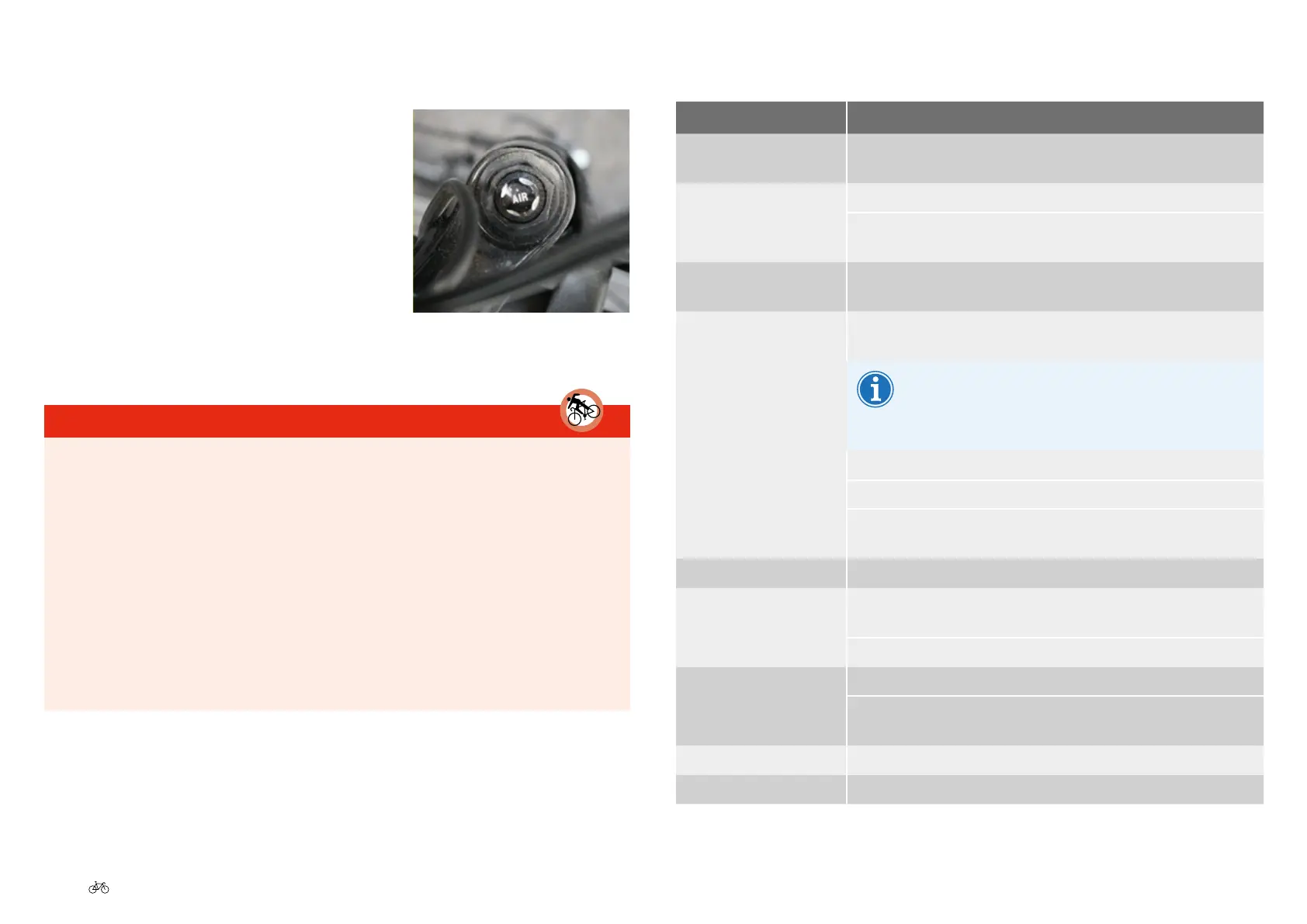
On some suspension forks it is possible to
alter the air pressure. You will need assis-
tance from your cycle dealer to do this, or if
you feel condent of doing it yourself, a sus-
pension fork pump with a pressure gauge
and the suspension fork manufacturer's ins-
tallation manual. The valve with cap (e.g.
marked ‘AIR’) is usually located on the left-
hand side of the fork.
4. Before every trip
DANGER
Replace any damaged (e.g. cracks, grooves) or bent components
before using the bike again. Not doing so can lead to essential parts
failing and cause a serious fall.
Do not use the bike if it is not in perfect technical condition. If you are
unsure, ask a cycle dealer to check it over.
We recommend asking your cycle dealer to assemble and adjust the
bike. Otherwise, components could become loose due to a faulty as-
sembly. If this happens whilst you are cycling, you could injure your-
self very seriously or even die.
Inspect your pedelec before every trip, and after each time it has been
transported anywhere or left unattended. Use the following checklist to
help you.
Checklist
Type Characteristics
Frame / forks Check the frame and forks for visible warping, cracks and
damage.
Handlebars / front stem Check they are seated securely.
Check that the bell is working and attached correctly and
securely.
Saddle / seatpost Check that the quick-release skewers / through-axles (if
available) are secure.
Wheels Check the condition (damage, foreign bodies), concentricity and
pressures of the tyres.
The maximum permissible pressure is marked on
the side of a tyre in bar and psi (pounds per square
inch). Tyres should not be inated above or below this
pressure.
Check the valves are seated securely.
Visually inspect the rims for damage and wear.
Check that the quick-release skewers / through-axles (if
available) are secured correctly.
Chain Check the chain, pinions and sprockets for wear and damage.
Brakes Check that the brake system (including brake levers) is working
and attached correctly and securely.
Visual inspection of the brake pads/disks.
Lights Check that the light system is adjusted and in working order.
Check that reectors are axed in accordance with applicable
national trac regulations.
Threaded joints Check that all threaded joints are tightened as specied.
Luggage Check it is attached securely.
*dependent on model



 To Next Page