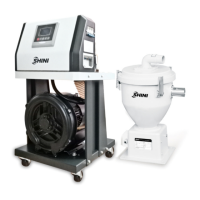
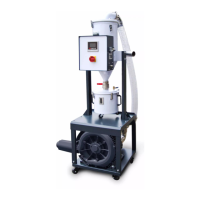
This document describes the SAL-430/460 series of self-contained hopper loaders, manufactured by Shini Plastics Technologies. The manual, dated June 2020 (Version Ver.B), provides comprehensive information on the device's function, technical specifications, operation, and maintenance.
Function Description
The SAL-430/460 series hopper loaders are designed for conveying plastic granules. The core principle of operation involves a blower creating a vacuum within the material hopper by drawing air out. This vacuum then pulls materials into the storage hopper through a material inlet pipe, leveraging air pressure difference. Once loading is complete, the blower stops, and materials are discharged by gravity. A microswitch detects the absence of material in the hopper, triggering the blower to restart the loading cycle. An alarm light on the control box indicates when material cannot be sucked or when there is a lack of material.
The device incorporates an automatic reversal dust cleaning mechanism, contributing to its efficiency and longevity. It is designed to be used with collection hoppers like SCH-U or SICH-U when installed in the feeder of a molding machine.
Important Technical Specifications
The SAL-430/460 series comes in two main models: SAL-430 and SAL-460, both designated as Version B. They are inductive type loaders.
- Blower Power (50/60Hz):
- SAL-430: 0.37 kW
- SAL-460: 0.75 kW
- Conveying Pipe Diameter:
- SAL-430: 1.25 Inch
- SAL-460: 1.5 Inch
- Conveying Capacity (kg/hr, 50Hz/60Hz):
- SAL-430: 200/220 kg/hr
- SAL-460: 300/330 kg/hr
- Note: Test conditions for conveying capacity include plastic material with a bulk density of 0.65 kg/L, diameter 3-5 mm, vertical conveying height of 4m, and horizontal conveying distance of 1m.
- Hopper Capacity:
- SAL-430: 3 L
- SAL-460: 6 L
- Input Voltage: 3Ø, 400VAC, 50Hz
- Material Level Control: Microswitch
- Filter: Standard cloth mesh filter
- Auto-cleaning: Standard
- Dimensions (H x W x D):
- SAL-430: 660 mm x 310 mm x 430 mm
- SAL-460: 735 mm x 350 mm x 455 mm
- Weight:
- SAL-430: 23 kg
- SAL-460: 26 kg
The loading capacity graph illustrates performance at a height of 4m, bulk density of 0.65 kg/L, and frequency of 60Hz, showing how capacity decreases with increasing horizontal distance.
Usage Features
The SAL-430/460 series is designed for user-friendliness and safety.
- Control Panel: The control panel features intuitive keys for ON/OFF, MENU, SET, DOWN, and UP functions, allowing users to start/stop the machine, enter/exit parameter settings, modify/confirm parameters, and navigate menus.
- Indicators: Dedicated lights indicate "FULL MAT.LIGHT" (full materials in hopper), "BLENDING" (machine mixing materials), "MAT.SHUT-OFF" (machine shutting off materials), "SHORTAGE ALARM" (no materials during suction), "COMMUNICATION" (communication active), "FILTER MESH CLEAN" (filter auto cleaning function), "OVERLOAD ALARM" (motor overload error), and "SCREEN BLOCKING" (prompt to clean/replace filter screen).
- Parameter Setting: Users can adjust various parameters, including:
- F.01 Suction action time: Motor suction time (5-127 seconds).
- F.02 Shut-off action time: Time for material shut-off (0-127 seconds).
- F.03 Mixing proportion: Percentage of suction time for mixing (0-100%).
- F.04 Mixing mode: Number of layers for mixing action (1-4 times).
- F.05 Mixing action count cycle start setting: How often mixing occurs (1-9 times).
- F.06 Setting time of cleaning before suction: Screen cleaning time before suction (0-99 seconds).
- F.07 Setting time of screen cleaning after suction: Screen cleaning time after suction (0-99 seconds).
- F.08 Screen cleaning cycle: Frequency of cleaning actions (1-99 times).
- F.09 Circulating suction waiting time: Delay before a new suction action (0-9990 x 10 seconds).
- F.10 Shortage metering alarm: Number of times material doesn't fall before alarm (1-9 times).
- F.11 Shutdown alarm for material shortage: Times no material falls before shutdown alarm (F.10-99).
- F.12 Time waiting for motor stoppage: Delay after motor starts before next action (0-99 seconds).
- F.13 Buzzer alarm type: Alarm sound pattern (0-2).
- F.14 Motor delay stop time: Delay after suction ends before motor stops (0-999 seconds).
- F.15 Motor working time: Check and clear motor working time (0-999 x 10 hours).
- Communication: Equipped with RS485 communication function, allowing for integration into broader control systems. Communication parameters like address, baud rate, and odd-even check can be configured.
- Manual Control Switch: A manual control switch is included for easy power switching, particularly useful when the machine is installed at a high location.
- Safety Regulations: Emphasizes the importance of qualified electricians for electrical installations, turning off the main switch during maintenance, and awareness of high voltage. It also provides guidelines for transportation, storage (indoors, 5-40°C, humidity < 80%), and working environment (dry, max 45°C, humidity < 80%, altitude < 3000m, 1m clearance, away from flammable sources).
- Data Resetting: A procedure is outlined to reset all parameter settings to factory defaults, requiring careful use.
Maintenance Features
Regular maintenance is crucial for the machine's performance and longevity. All repair work should be performed by professionals.
- Filter Bag: The cloth mesh filter bag requires periodic cleaning or when conveying capacity decreases. The process involves disconnecting the blower's heavy-duty connector, loosening snap hooks, removing the hopper cover, taking out the filter bag, and cleaning accumulated dust. Special attention is given to disconnecting the blower connector first to prevent injury.
- Blower Maintenance:
- Regularly clear the blower internally to prevent dirt accumulation, which can affect performance (temperature rise, reduced airflow, noise, vibration).
- Check blower performance; repair or replace the motor if it fails to start or makes loud noises.
- Consumable parts like bearings, seal rings, and silencers should be replaced periodically. Fans, covers, and metal screens may also need replacement.
- Storage Hopper:
- Loosen snap hooks and remove the hopper cover.
- Use high-pressure air to blow away any remaining material.
- Re-fix the hopper cover and fasten the snap hook.
- Note: Ensure the main switch is off before cleaning.
- Service Life of Key Parts:
- Motor: Above 5 years
- Circuit breaker: Above 100,000 actuations
- Maintenance Schedule:
- Check after Installation: Verify correct and tight connection of conveying hose, and secure mounting base. Check electrical specifications (voltage, Hz, fuse current, phase sequence).
- Daily Checking: Inspect main power switch, filter screen, and motor performance.
- Weekly Checking: Look for damaged electrical wires, loose electrical component connections, and loose flange screws at the material inlet.
- Monthly Check: Examine the spring lock on the hopper cover, check for deformation of the non-return valve, and assess the performance of the magnetic proximity switch/photoelectrical sensor.

 Need help?
 General

 To Next Page