14
4. OPERATION
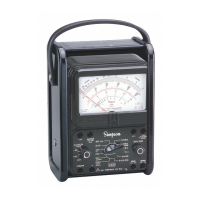
Multifunction instruments (VOM’s) such as the 260-8 are intended as general
purpose measuring Instruments for use in low power circuitry such as found in
consumer appliances, TV and radio receivers, and in general laboratory applica-
tions. Their use is not recommended in high voltage, high power circuitry where
operator errors and inadequate personal protective measures could result in
serious injury from arcing or explosion. Such circuitry is found in industrial or
commercial applications such as induction (r-f) heaters and broadcast transmit-
ters, power substations and distribution centers, x-ray equipment, large motor
controls, etc. Working in the high voltage section of such equipment requires
single-function, often specially designed instruments used by specially trained
personnel using appropriate protective equipment and procedures.
This section of the manual contains information required to operate the 260-8 in
a safe and proper manner.
4.1 Safety Precautions
The following precautions are suggestions of commonly recognized safe prac-
tices to adopt and specific hazards to be avoided and are not implied to be
sufficient to safeguard untrained personnel in all circumstances. Neither is this
manual a substitute for technical manuals covering the equipment in which mea-
surements are to be made. Always refer to the equipment manual and its specific
warnings and instructions and observe them as well as those contained herein.
a. The 260-8 should only be used by personnel qualified to recognize shock
hazards and who are trained in the safety precautions required to avoid
possible injury.
b. Do not connect any terminal of this Instrument to a circuit point at which a
voltage exceeding 1000 volts AC or DC may exist with respect to earth
ground. (Refer to Table 1-1, item 16.)
c. Turn off power and discharge any capacitors in the circuit to be measured
before connecting to or disconnecting from it.
d. Before using this Instrument, check accessories (if any) and test leads for
missing, damaged, deteriorated or otherwise faulty insulating parts. Do not
use, or permit the use of equipment with faulty insulation until it has been
properly repaired.
e. Always wear safety glasses when working in electrical circuitry.
f. Do not work alone on high voltage circuits. Make certain that someone
capable of giving aid is alert and located nearby.
g. Do not handle the Instrument, its test leads, or the circuitry while high voltage
is being applied.
h. Hands, shoes, floor, and workbench must be dry. Avoid making measure-
ments under humid, damp, or other environmental conditions that could
effect the dielectric withstanding voltage of the test leads or Instrument.
i. Do not change switch settings or test lead connections while taking mea-
surements. A mistake could result in damage to the Instrument and possible
personal injury.
!


 To Next Page
 Loading...