Chapter 8 – Operation
48 A46JRT – 0260996
1. When the machine is stopped due to activation of
the Snorkel Guard system or overload, immediately
depress the emergency stop, release the foot switch
and all controls. Perform an assessment of the situ-
ation which caused the system to activate.
2. If it is determined that all controls are released and
operation can proceed, return the emergency stop
to the on position, and activate the override switch.
3. Activate the foot switch.
4. Activate the necessary functions to move the platform
away from the obstacle that caused the Snorkel
Guard activation or if due to an overload fault, retract
the booms then lower in a safe condition.
5. Assess the machine for any damage. If damage
occurred, return to the stowed position, exit the unit
and perform a thorough inspection before returning
to service.
Gradeability
Machine gradeability refers to the maximum slope that
the aerial platform is capable of travel under practical
conditions. It is based on mathematical calculation, but
it also takes into account the practical application.
At any given moment when driving the machine on a
slope, at least one, if not all, of the factors contributing
to achieving theoretical gradeabilty will not be at optimal
performance. For example, tire contact may not be the
same at each drive wheel or the slope conditions may not
be optimal, which would then allow for loss of traction.
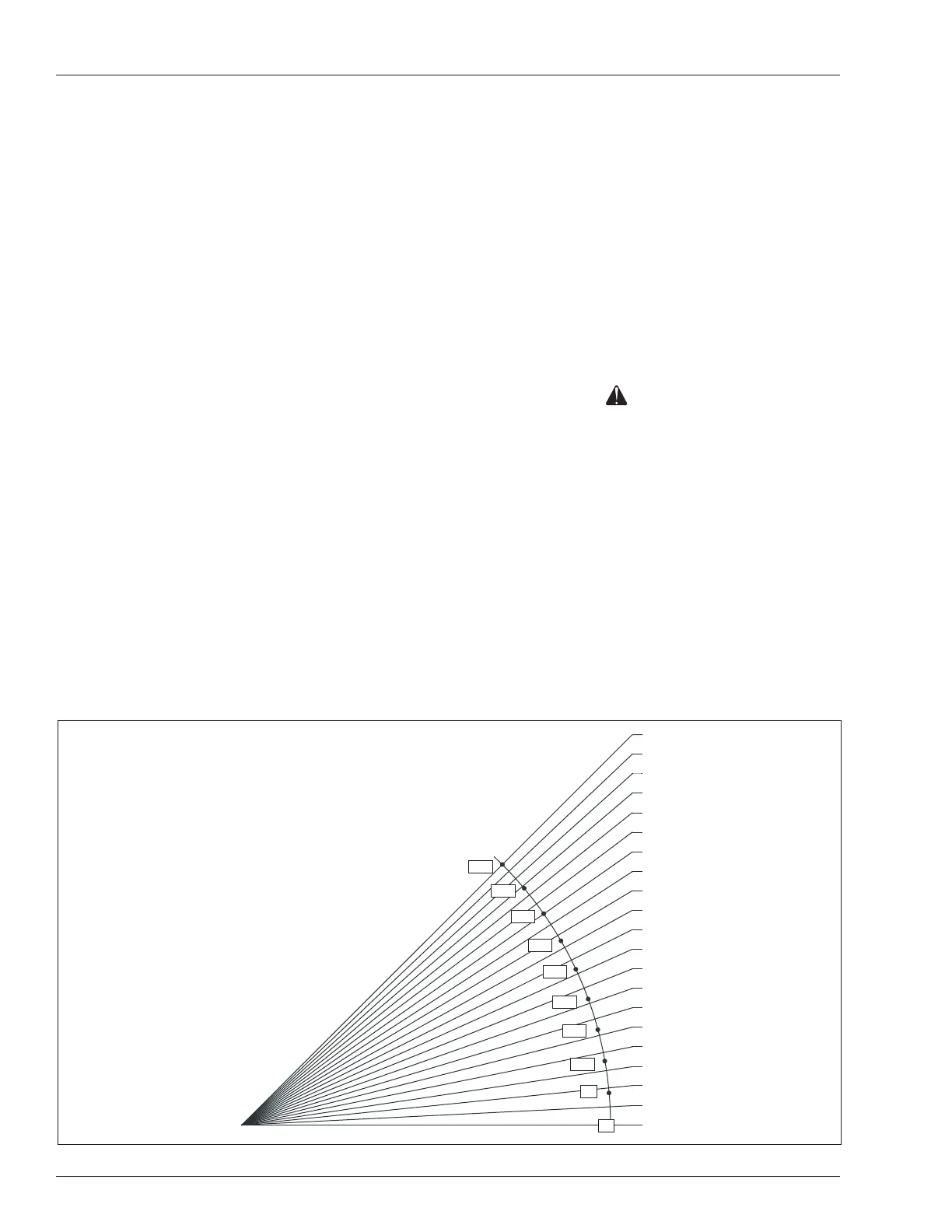
Percent vs. Degree of Slope
Gradeability is most often referenced as a percentage.
That value is based on a slope angle of 45° representing
100% grade.
Angle indicators, or inclinometers, often measure the an-
gle of the slope in degrees not the percent slope. Because
of that, it may be useful to understand the relationship
between percent slope and the degree of the slope angle
as shown in Figure 8.4.
Driving on a Slope
The machine should only be driven on a slope or load-
ing ramp in the stowed position with the platform on the
downhill side.
Danger
The aerial platform can tip over if it becomes unstable.
Death or serious injury will result from a tip-over ac-
cident. Do not drive on slopes that exceed 45 percent
grade, or where conditions of the slope could cause
driving to be hazardous.
Place the drive range switch in the low position before
attempting to drive the machine on a slope.
Drive the aerial platform only on slopes, or loading ramps
that are within the 45 percent grade capability of the
aerial platform.
Figure 8.4 – Slope Percent/Degree Conversion
Percent of
Grade
Angle of Slope
in Degrees
45°
40°
30°
35°
25°
20°
15°
10°
5°
5%
10%
15%
20%
25%
30%
35%
40%
45%
50%
55%
60%
65%
70%
75%
80%
85%
90%
95%
100%
0


 To Next Page