
 Need help?
Do you have a question about the socomec SIDER and is the answer not in the manual?
Provides an introduction to the SIDER visible breaking switch.
Details the main switch identification label and its electrical characteristics.
Covers environmental requirements including IP rating, operating conditions, and altitude.
Lists available customer and factory-fitted accessories for the SIDER.
Displays dual dimensions (in/mm) for B7 and B8 models.
Details copper bar connection requirements for SIDER from 2000 to 3200 A.
Shows recommended and not allowed mounting orientations for the product.
Guides the assembly of customer-mounted accessories, including connection kits.
Details the installation of terminal screens for protection against direct contact.
Describes optional and standard factory-fitted auxiliary contacts.
Provides information on cable or bar connections and power connection terminals.
The SIDER is a visible breaking switch designed for robust power management in various electrical installations. This instruction manual outlines its general overview, installation procedures, and connection guidelines, emphasizing safety and proper usage.
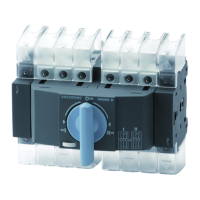
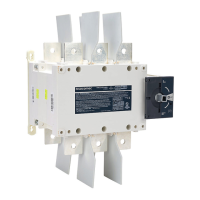
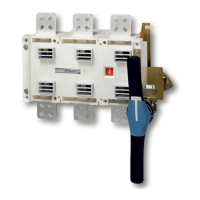
The SIDER is primarily a multipolar load break switch, engineered to safely interrupt current in electrical circuits. Its core function is to provide a visible break, ensuring that operators can visually confirm the disconnection of power, which is a critical safety feature in high-power applications. This visible breaking capability is essential for maintenance and repair work, as it eliminates any doubt about the circuit's de-energized state. The switch is designed to handle significant current ratings, making it suitable for industrial and commercial power distribution systems. It operates as a switch disconnector, meaning it can both make and break current under normal load conditions and provide isolation when required. The device's construction includes a power section with multiple poles, allowing for the control of multi-phase electrical systems.
The SIDER is built with several features to enhance its usability and integration into diverse environments. Its design accommodates various mounting orientations, although specific recommendations are provided to ensure optimal performance and safety. The product is identified by a main switch identification label that details its electrical characteristics, applicable standards, and terminal wiring information, simplifying installation and troubleshooting.
For environmental adaptability, the SIDER boasts an IP2X rating against direct contact for the power section when connections are in place and suitable terminal shields are installed. Without terminal shields, it maintains an IP0 rating for the bare power section. The device is designed to operate reliably across a wide temperature range, from -20°C to +40°C without derating, and up to +70°C with the application of a Kt derating correction factor. It also performs well in varying humidity conditions, with 80% humidity without condensation at 55°C and 95% humidity without condensation at 40°C. Furthermore, it can be used at altitudes up to 2000m without derating, with correction factors provided for higher altitudes.
The SIDER supports different connection methods, including copper bar and cable connections, offering flexibility in wiring configurations. The manual provides detailed instructions for copper bar connections for higher current ratings (2000 A to 3200 A), including recommended bar sections and tightening torques for secure connections. Power connection terminals are designed to accommodate various cable and bar sizes, ensuring compatibility with a broad range of electrical setups.
Customer-fitted accessories, such as terminal screens, are available to provide protection against direct contact with connection terminals, further enhancing safety. These screens are designed for both top/bottom connections and are available for different frame sizes (B7 and B8).
Maintenance of the SIDER is facilitated by its robust design and the availability of specific accessories and guidelines. The visible breaking mechanism itself is a key maintenance feature, allowing for quick and unambiguous verification of the switch's state before any work is performed. This reduces the risk of accidental re-energization during maintenance.
The device's compliance with international standards, including CE and EAC marking, ensures that it meets rigorous safety and quality requirements, which contributes to its long-term reliability and reduced maintenance needs. The product also adheres to the European directive for RoHS, indicating a lead-free process in its manufacturing, which is beneficial for environmental sustainability and potentially for end-of-life disposal.
Factory-fitted accessories, such as supplementary auxiliary contacts, are available to enhance monitoring and control capabilities. These contacts can be used for pre-breaking and signaling of switch positions, providing valuable feedback for system diagnostics and preventive maintenance. For higher current ratings (2000 A to 3200 A), these auxiliary contacts are included as standard, offering integrated monitoring features. The manual provides detailed instructions for fitting these auxiliary contacts, including torque specifications for screws, ensuring proper installation and functionality.
In case of operational issues, a trouble-shooting guide is provided to address common problems, such as the inability to manually operate the switch or padlock it. This guide directs users to check for padlocking, verify handle rotation, and ensure sufficient progressive action, as well as confirming the switch is in the "O" (off) position for padlocking. These guidelines help in quickly diagnosing and resolving minor operational issues, minimizing downtime and simplifying maintenance tasks. The overall design and documentation aim to make the SIDER a reliable and manageable component within any power distribution system.
 General
| Product range | SIDER |
|---|---|
| Frequency | 50/60 Hz |
| Rated Operational Current | 125 A |
| Rated voltage Ue (V) | 690 VAC |
| Rated Operational Voltage | 690 VAC |
| Protection Degree | IP20 |
| Poles | 3 |






 To Next Page