27
Sookook Corporation
Combustion Head Adjustment
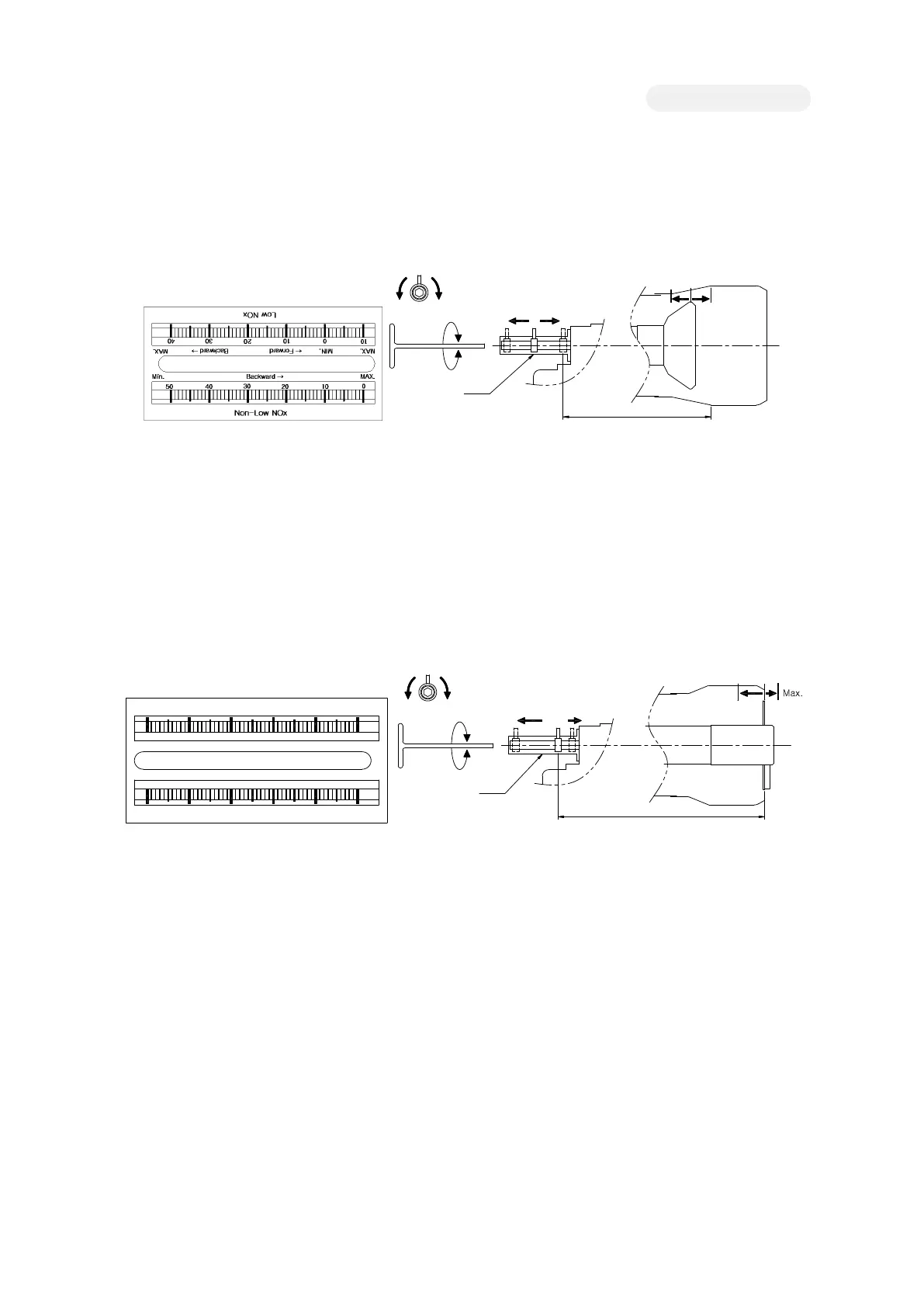
The burner is equipped with a combustion head adjuster to change the combustion condition and flame length according to the boiler type.
The maximum air flow changes depending on the position of the combustion head.
The combustion head shall be in the right position depending on the combustion chamber conditions because it changes the speed of the
combustion air passing through the head and can control the flame shape depending on the boiler, drying furnace, etc. The position of the
combustion head can be adjusted by turning the VRT clockwise or counter clockwise by hand.
[Figure 2G-C. Combustion Head Adjustment in Standard Burners]
Combustion Head Adjustment in Standard Burners
Closing the combustion head: Turn VRT clockwise.
- Decreased burner capacity (air flow), increased combustion efficiency
- Increased response to backfire, increased flame detection signal output, increased combustion noise
- Decreased flame length when the same air ratio is achieved by slightly opening the air damper
Opening the combustion head: Turn VRT counter clockwise.
- Increased burner capacity (air flow), decreased combustion efficiency,
- Decreased response to backfire, decreased flame detection signal output, decreased combustion noise
- Increased flame length when the same air ratio is achieved by slightly closing the air damper
[Figure 2G-D. Combustion Head Adjustment in Low NOx Burners]
Combustion Head Adjustment in Low NOx Burners
Opening the combustion head: Turn VRT clockwise.
- Increased burner capacity (air flow), increased NOx, decreased fuel efficiency,
- Decreased response to backfire, decreased flame detection signal output, decreased combustion noise
- Increased flame length when the same air ratio is achieved by slightly closing the air damper
Closing combustion head (to min. position): Turn VRT counter clockwise.
- Decreased burner capacity (air flow), decreased NOx, increased fuel efficiency,
- Increased response to backfire, increased flame detection signal output, increased combustion noise
- Decreased flame length when the same air ratio is achieved by slightly opening the air damper
Max.
Min.
Max.
Min.
VRT
Set Point
MAX.
0
10
Low NOx
20
10
MAX.
4030
MIN. ← Forward Backward →
10
0
30
20
Min.
50 40
Backward →
Non-Low NOx
MAX.
Max.
min
Max.
VRT
Set Point
min.
Max.


 To Next Page