504/2019 - EN/V9 Technetix Group Limited
Product user manual
DBE-1200S
Chapter 1: Overview of the DBE-1200S
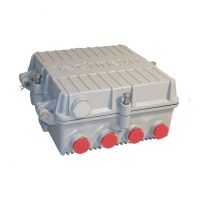
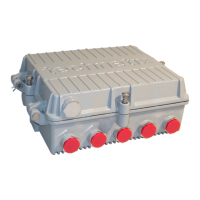
The Technetix DBE-1200S strand mount amplifiers and optical nodes are an innovative ‘crossover’ design which provides a
field upgradeable solution to deep fiber/fiber to the last amplifier (FttLA). Its RF function can be configured for use as a 1x1 up
to 3x3 or as an RF/optical hybrid as a single, dual, or triple output device. The amplifier provides reverse path transmission with
a hybrid amplification stage.
Forward and return path attenuation can be adjusted with electronic attenuators through software control. Electronic equalizers
can be adjusted via software for forward and return path equalization. Cable simulation can be implemented by inserting an
appropriate JXP module (available in 1 to 7 and 9 to 15 dB tilt values for applications up to 1.2 GHz).
The DBE-1200S has a highly ecient long-life switched-mode 90 W power supply (DBPSU-07-1) to provide power, with ample
margin, to the internal electronics.
Surge arrestors at the input and output ports protect the RF circuits in the event of lightning or mains power surges.
In the DBE-1200S these protection devices are field replaceable plug-in modules.
Benefits
■ Full digital control and setup with user selectable integrated Automatic Temperature Control (ATC), Automatic Gain Control
(AGC) or Automatic Level and Slope Control (ALSC)
■ Improved intermodulation distortion performance - innovative GaN technology operates to 1218 MHz
■ Energy ecient hybrid technology provides more gain with the same power consumption
■ Flexible and modular to meet changing network needs
■ Technetix CPD Safe
®
technology and surge protection mean fewer reported faults, improved customer service
and a reduction in truck rolls
* Note: Common Path Distortion (CPD)
■ On-board ingress detection facility provides an option to apply -6 dB or -40 dB of return path attenuation either by; (1)
local control through a USB connection in conjunction with the software, or (2) via a simple Frequency Shift Keying (FSK)
communications protocol via an FSK transmitter in the headend, or (3) through Simplified Network Management Protocol (SNMP)
control when the amplifier/node is outfitted with a Data Over Cable Service Interface Specification (DOCSIS) transponder.


 To Next Page