Challenger Series Installation and Quick Programming Manual 21
Application notes
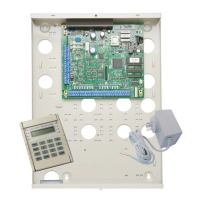
16 VAC plug pack (models TS1016, TS1016SE, or TS1016LE)
Notes
• Use the 16 VAC plug pack supplied with the Challenger panel.
• When installing plug packs, do not power the unit until you have terminated all
necessary wires and checked that you do not have a short circuit. Fused plug
packs cannot be replaced under warranty as the fuse operation can only be
caused by a direct short circuit.
12 V Battery
The Challenger panel should be connected to a 12 V 7.6 Ah battery compliant
with AS/NZS 2201.1:2007, Appendix C.
Auxiliary power terminals
Connect the + and – auxiliary power output terminals to devices that require
12 VDC power, such as detectors. If you need more connections you can use a
TS0844 board to increase the number of terminals (see “TS0844 Power
Distribution Board” on page 10).
RS-485 LAN
Use 2-pair twisted shielded data cable such as Belden 8723 to connect the
Challenger panel to system devices such as RASs and DGPs.
• Connect the + terminal to the red wire. The + terminal provides +12 V to LAN
devices such as RASs (within 100 m cabling distance).
• Connect the – terminal to the black wire. The – terminal provides -ve DC to
LAN devices such as RASs, and common 0 V for the RS-485 LAN.
• Connect the D+ terminal to the white wire. The D+ terminal is data positive.
• Connect the D– terminal to the green wire. The D– terminal is data negative.
• Connect the data cable shield to the LAN earth connection (Figure 7 on page
15, item 1 or Figure 9 on page 18, item 1).
The RS-485 LAN may be used to power devices up to 100 m cabling distance
from the Challenger panel. See “Power supply to RS-485 LAN devices” on page
6 for details.
If you need more than one connection to the LAN terminals you can use a
TS0844 board to increase the number of terminals (see “TS0844 Power
Distribution Board” on page 10).


 To Next Page