Chapter 1 - System DescriptionThe BreezeCOMPACT Solution
Chapter 1: System Description
The BreezeCOMPACT Solution
. . . . . . . . . . . . . . . . . . . . . . . . . . . . . . . . . . . . . . . . . . . . . . . . . . . . . . . .
BreezeCOMPACT System ManualBreezeCOMPACT System Manual
20
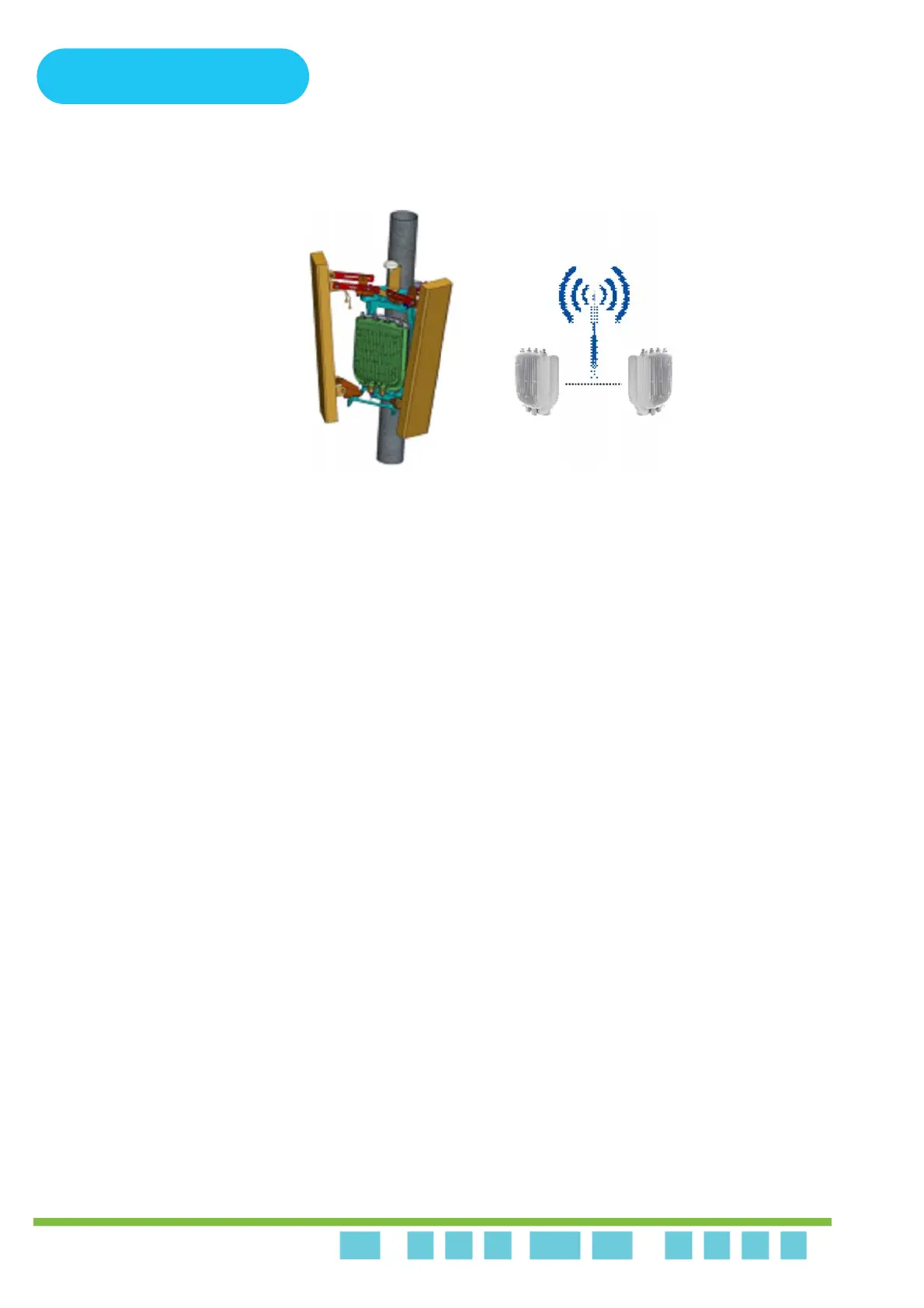
are located back to back. This configuration is not applicable for BreezeCOMPACT2000.
Figure 4: Two Sectors, Two Carriers
1.1.4 Antennas
In the system architecture, the antenna is approached as an independent element. This provides the operator with the
flexibility to select the antenna’s source according to its supplier policy. To ensure the availability of antennas that
complement the solution, Telrad works closely with several antenna suppliers to ensure availability of antennas that comply
with its requirements.
In cases where the operator prefers other antenna vendors, Telrad can provide a recommended antenna specification based
on the required antenna types.
Antennas may support mechanical down-tilt (MDT) using a suitable mounting kit, or electrical down-tilt (EDT) that may be
either fixed or adjustable using a special adjustment screw.
In addition to a range of standard commercial antennas, Telrad also offers a special attached antenna designed for convenient
installation on top of the BreezeCOMPACT unit. For the BreezeCOMPACT unit, a special mounting kit allows installation
of a standard antenna on top of the unit to minimize the space required for installation.
For details about the antennas offered by Telrad, refer to “Antennas” on page 28.
1.1.5 GPS
GPS is used to synchronize the air link frames of Intra-site and Inter-site located BTSs, in order to ensure that in all Base
Stations, the air frame will start at the same time, and that all Base Stations switch from transmit (downlink) to receive
(uplink) at the same time. This synchronization is necessary to prevent Intra-site and Inter-site interference and Base Station
saturation (assuming that all Base Stations are operating with the same frame size and with the same downlink/uplink ratio).
The all-outdoor GPS Receiver is a pole-mountable GPS receiver and antenna in a single environmentally protected enclosure
that is powered from the unit.
From R5.0 and up, GPS Chaining is supported, where the chaining enables use of a single GPS receiver for several
collocated units. The figure below describes the GPS chaining connectivity.



 To Next Page