- 4 -
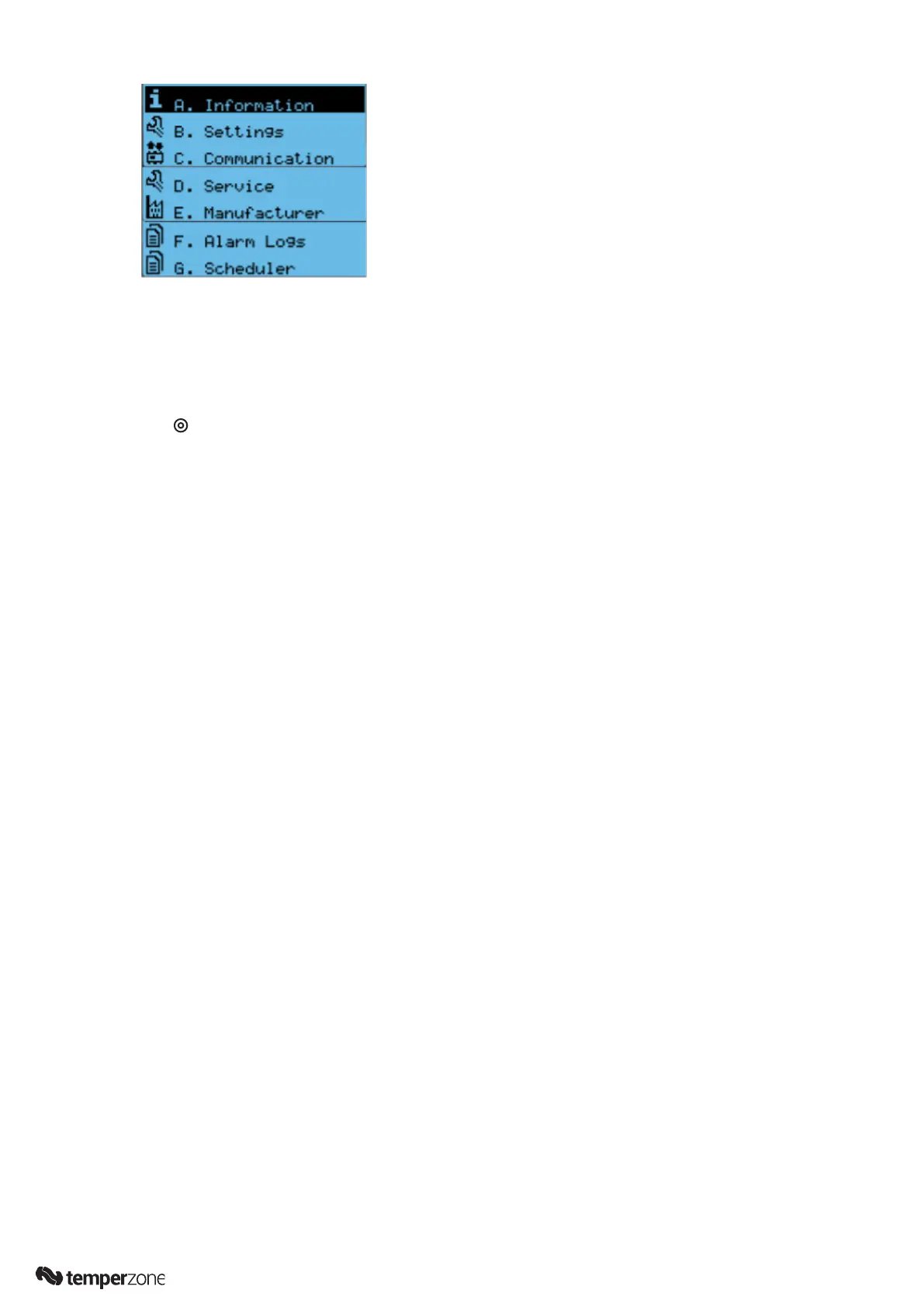
Main Menu:
6.3 Commissioning
After the four hour delay period has expired (see step 11 in
section 6.1) complete the following procedure. You can use
the Commissioning Sheet (supplied with the unit) to help
you.
1. From the initial screen of the Master Controller press
Menu button to bring up the Main menu.
2. Scroll down and select ‘D. Service’.
Enter password ‘2100’.
3. Scroll down and select ‘Manual Control’.
4. Scroll to ‘Manual Airow’. First enter airow requirement
in litres/second then select ‘Yes’ under enable to start
indoor fan operation. (refer Note below)
5. Measure air ows from duct work to verify air ows,
record current draw on each fan and then disable
‘Manual Airow’.
6. Scroll to sub menu ‘B. Settings’ and sselect ‘Fan
Cong’. Change fan mode to either ‘Airow’, ‘Fixed
Speed’ or ‘0-10VDC’.
7. Change airow setpoint on following pages to match
veried airows. If using xed speed, set speed
in % and cross check current draw against airow
measurements. Otherwise set airow in litres/second as
per measured values.
8. Scroll back to ‘D. Service’ menu and manual ‘control
menu’.
9. Navigate to ‘Manual Unit Capacity’ and select capacity
requirement. 100% = all compressor stages on. NOTE:
i. This does not correspond to compressor speed.
ii. Unit will need to be turned on by keypad to allow the
capacity control to function.
10. Allow compressors to run for a short duration while
checking for any unusual noises or vibrations.
11. Measure the current draw on each phase to the
compressor motor and to each fan motor. Check the
readings against the specied values in the wiring
diagram or Specication sheet.
12. Check each refrigeration system’s information, from
the Main menu select ‘Information’, then ‘UC8’ (refer
Appendix I for more detail). Also check Information/
Power usage.
13. Once testing is complete disable ‘Manual Unit
Capacity’.
14. Remove any swarf found inside the unit and touch up
any external paintwork damage incurred in transit to
prevent corrosion.
Note:
Setting the indoor fan speed too low can bring risk of frost
forming on the indoor coil with potential nuisance frost
protection trips on cooling, possibly even unit lock-out, and/
or HP trips on heating.
Setting the indoor fan speed too high can bring a risk of
blowing moisture off the ns of the indoor coil and into the
supply air duct. Water could then start leaking from the
supply air grilles and corrosion of ducting may occur.
Setting the indoor fan speed too high can also bring a risk
of ‘over-condensing’ (when the unit is heating) which in turn
could cause the unit to perform more outdoor coil de-ice
cycles than necessary.
Outdoor fans do not necessarily start rotating immediately
after the compressor is started. The fans may run-on for a
short period after the compressor stops.
The indoor fan will reduce speed if in heating mode and the
condensing temperature is too low to automatically allow
the condenser coil to warm up. The fan speed may also
slightly reduce when in Latent Cooling mode, if this option is
enabled.



 To Next Page