
 Need help?
Do you have a question about the Temptek CF Series and is the answer not in the manual?
Provides an overview of the chiller's capabilities, intended use, and manual's purpose.
Outlines critical safety precautions, warnings, and responsibilities for operation and maintenance.
Details procedures for checking the chiller upon delivery and documenting any damage.
Discusses factors affecting chiller efficiency, emphasizing proper maintenance and water quality.
Addresses compliance with the Clean Air Act regarding refrigerants and venting regulations.
Recommends water treatment practices to prevent scaling, corrosion, and maintain unit performance.
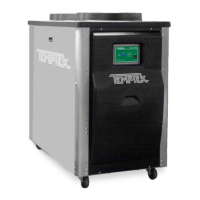
Identifies and labels the main external components of the chiller units.
Covers general guidelines for chiller installation, including shipping condition and piping materials.
Specifies requirements for the installation site, foundation, and clearances for optimal operation.
Guides on connecting process piping, recommending strainers and proper pipe design.
Details how to connect the automatic water make-up system and necessary precautions.
Explains air flow requirements, temperature limits, and clearances for air-cooled condensers.
Covers connecting water supply and return lines, flow rates, and pressure differentials.
Provides essential safety warnings and guidelines for connecting the unit's electrical power supply.
Emphasizes following operational procedures to prevent hazards and ensure proper unit function.
Guides on system filling, motor rotation check, and process flow adjustments for starting.
Details the control instrument's functions, startup, setpoint adjustments, and status lights.
Outlines the procedure for safely shutting down the unit and disconnecting it from the process.
Lists common causes and checks for when the unit fails to power on or start.
Addresses issues where the compressor attempts to run but does not start.
Explains reasons for high-pressure shutdowns and checks for air-cooled and water-cooled units.
Covers low-pressure shutdowns, lock-out conditions, and related faults.
Discusses causes and checks for internal compressor overload shutdowns.
Guides on troubleshooting issues related to insufficient process flow or pressure.
Identifies potential causes for reduced cooling performance and necessary checks.
Explains sensor function and basic troubleshooting steps for temperature probes.
Addresses troubleshooting steps for coolant pump issues, including overload trips.
Discusses the chiller controller's function and the process for repair or replacement.
Outlines the process for obtaining warranty assistance and required information.
Lists routine maintenance tasks to ensure optimal unit performance and longevity.
Details specific refrigeration system services that require a certified technician.
Provides procedures for maintaining and servicing the automatic water make-up system.
Guides on diagnosing and replacing the pump seal assembly.
Explains how to check the refrigerant charge using the sight glass and moisture indicator.
Details the process for cleaning evaporator plates to remove mineral deposits and maintain flow.
Describes the primary components of the chiller's water circulation system.
Details the key components of the chiller's refrigeration circuit.
Lists various optional features available for the chillers, such as low flow bypass and alarms.
Provides the mechanical schematic for water-cooled models in the 5-10 ton range.
Offers the mechanical schematic for water-cooled models in the 15-40 ton range.
Presents the mechanical schematic for air-cooled models with propeller fans.
Shows schematics for larger air-cooled models and those with optional blowers.
Illustrates the typical electrical schematic for air-cooled chiller units.
Displays the typical electrical schematic for water-cooled chiller units.
Shows physical dimensions and port locations for 5-ton air-cooled models.
Provides physical dimensions and port locations for 7.5-10 ton air-cooled models.
Offers physical dimensions for 15-20 ton fan-cooled air-cooled models.
Shows physical dimensions for 15-30 ton air-cooled models equipped with blowers.
Presents physical views for 5-10 ton air-cooled models with remote condensers.
Displays physical views for 15-30 ton air-cooled models with remote condensers.
Shows physical dimensions and port locations for 5-ton water-cooled models.
Provides physical dimensions for 7.5-10 ton water-cooled models.
Offers physical dimensions for 15-30 ton water-cooled models.
Shows physical dimensions for 40-ton water-cooled models.
Illustrates ducting schematics for air-cooled chillers equipped with centrifugal blowers.
Details necessary precautions and settings for operating the chiller at low temperatures.
Explains procedures for using glycol and adjusting settings for sub-optimal ambient conditions.
Provides a reference chart correlating refrigerant pressure with temperature for various refrigerants.
Recommends specific types of inhibited propylene glycol for use in chiller systems.
Shows how chiller output tonnage is affected by different operating temperatures.

 To Next Page
 General