E-DOC-CTC-20060609-0001 v2.0
Chapter 7
Thomson Gateway Wireless Configuration
59
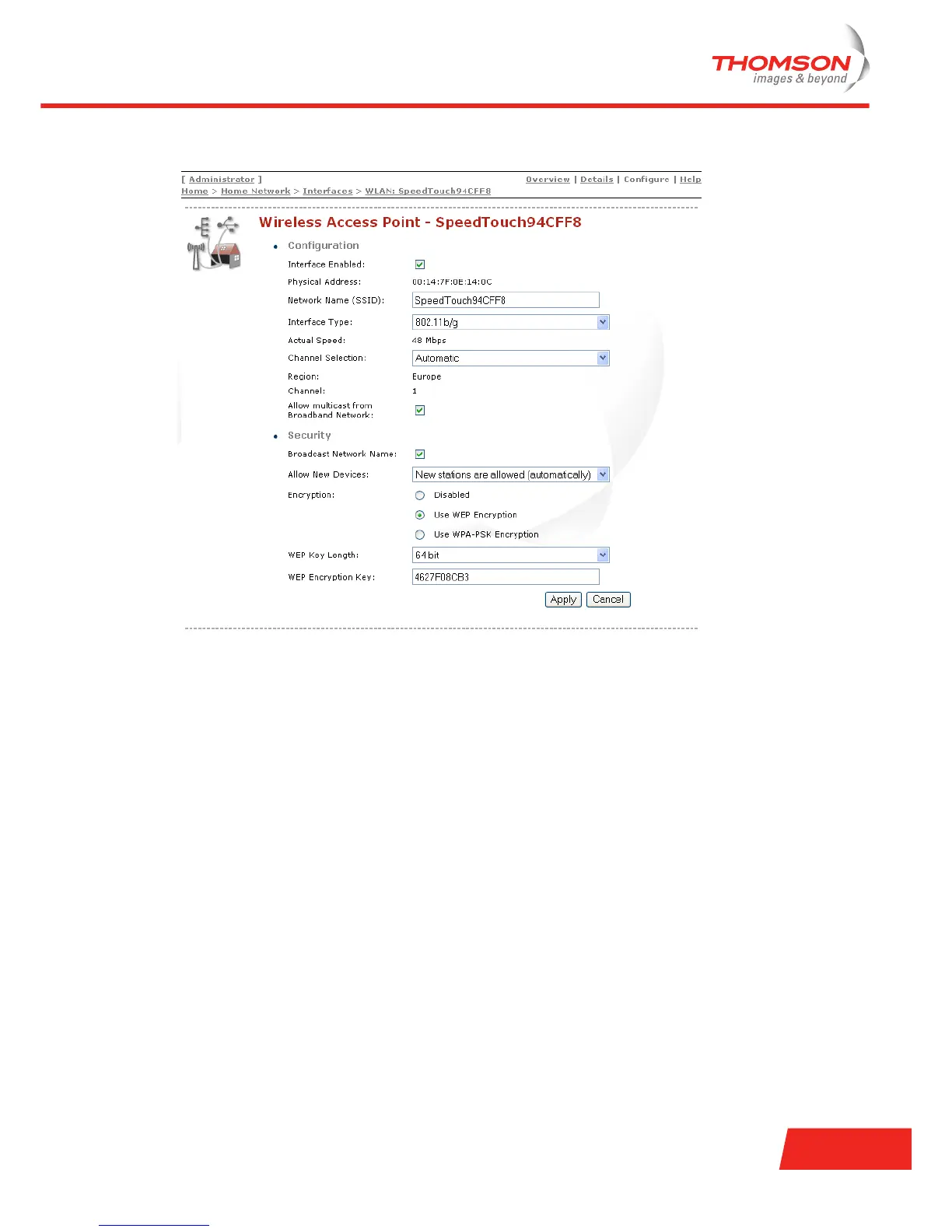
5 Configure your wireless station(s) with the same settings.
Enabling WPA-PSK
The Thomson Gateway supports WPA-PSK, which offers three advantages over WEP:
> Authentication via a 4-way handshake to check whether the Pre-Shared Keys (PSKs) are the same.
> Stronger encryption types:
Temporal Key Integrity Protocol (TKIP) (default): Instead of using a fixed WEP key, TKIP uses
temporary session keys in pairs. These keys are derived from the PSK during the 4-way handshake.
For each packet it uses a different key. TKIP also provides a message integrity check (MIC) and a
rekeying mechanism (in seconds).
Advanced Encryption Standard (AES): State-of-the-art encryption; can only be used if all wireless
devices in your WLAN support AES.
> Message Integrity Check (MIC): a strong mathematical function in which the recipient and transmitter
each compute and compare the MIC. If they don't match, it is assumed that a third person has been trying
to read the data.
Proceed as follows to enable WPA-PSK:
1 Select Use WPA-PSK Encryption.
2 In the WPA-PSK Encryption Key box, type a passphrase (also known as Pre-shared key) of your choice.
The passphrase must consist of 8 to 63 ASCII characters or 64 HEX digits.




 To Next Page