ETNZ
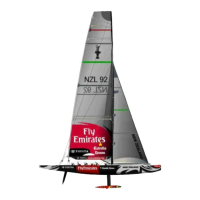
1-METER AMERICA’S CUP RACING YACHT
ETNZ
1-METER AMERICA’S CUP RACING YACHT
23
1. If your boat carries weather helm,
incline the mast a bit forward.
2. If your boat carries lee helm, incline
the master a bit backward.
• Refer to the explanation of weather
helm and lee helm below
Tuning Your ETNZ for Proper Operation
Straighten any left or
right leaning of master
Straighten any forward or
backward inclination of master
Adjust with the
jib halyard
Adjust with
the backsta
y.
Tighten or slacken the
adjuster in order to
straighten the mast.
Too little
tension
Proper
adjustment
Too much
tension
Maintaining an optimum sail profile is
important for both speed and control.
You may need to make some finer
adjustments to your tuning to obtain the
sail profile you want. The sail profiles
shown in the figure are viewed form
behind.
Mast Adusting
Ballast
Weather Helm
Lee Helm
Wind
Starboard
Starboard Tack
Port
Port Tack
Weather Helm and Lee Helm
With the Rudder in line with the Keel, if the boat tends
to turn windward, it is said that the boat carries
weather helm. If it tends to turn leeward, it is said that
it carries lee helm. The situation in which the boat
shows neither tendency is called balanced helm. In
general, a boat carrying a slight weather helm is better
in performance than one carrying lee helm or having
balanced helm.
Therefore, after adjusting the boat to
balanced helm re-adjust it so that it carries slight
weather helm.
Starboard
Tack and Port Tack
The right side of the boat is called starboard and the left
side of boat s called port. When the yacht sails with the
wind cross the starboard and the mainsail is on the port
side, it is said that the boat is on a starboard tack. When
it sails with the wind cross the port and with the mainsail
on the starboard, it is said that boat is on a port tack.
You can sail on a starboard or port tack when sailing
close-hauled (i.e. windward), wind abeam (i.e. leeward).
ETNZ
1-METER AMERICA’S CUP RACING YACHT
ETNZ
1-METER AMERICA’S CUP RACING YACHT
* Sail your ETNZ only in still bodies of water. Never
sail your boat in running water such as streams or
rivers, as it is easy to lose control of your boat.
* Do not sail ETNZ in very heavy winds.
* If you will be operating your ETNZ in the same area
as other R/C craft, be sure that you are all on different
frequencies to help avoid any mishaps.
Principle of Sailing
Wind abeam
Sails: each at a position of 45˚
Rudder: in center position
Wind
Quarter lee
Sails: letting both out a little more
Rudder: to the left
Starboard tack-running
Sails: letting both out to
their maximum position
Rudder: in center position
45˚
Port tack-running
Sails: letting both out to
their maximum position
Rudder: in center
position
Quarter lee
Sails: pulling both in a little
Rudder: in center position
Luffing up
Sails: pulling in bit by bit
Rudder: to the left
START
Wind abeam
Sails: each at a position of 45˚
Rudder: in center position
P
o
r
t
T
a
c
k
Luffing up
Sails: pulling both in all the way
Rudder: to the left
Port tack - close - hauled
Sails: keep pulling in
Rudder: to be held at the center
as long as the sails do not shiver
Tacking*
Sails: keep pulled in
Rudder: to the left
Starboard tack - close - hauled
Sails: keeping pulled in
Rudder: to be held at the center
as long as the sails do not shiver
Tacking
Sails: keeping pulled in
Rudder: to the left
Bearing away
Sails: let both out so as not to
shiver
Rudder: to the left
S
t
a
r
B
o
a
r
d
T
a
c
k
Port tack - close - hauled
Sails: keeping pulled in
Rudder: to be held at the center
as long as the sails do not shiver
Tacking
Sails: keeping
pulled in
Rudder: to the right
LAND
Other
Tips
24






 To Next Page