Need help?
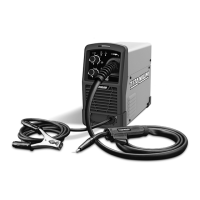
Do you have a question about the Titanium MIG140 and is the answer not in the manual?
Provides essential safety guidelines for operating the welder.
Explains hazard symbols and their meanings to prevent injury.
Details risks of welding fumes and necessary ventilation or respiratory protection.
Outlines required protective gear for welding arc rays to prevent burns and eye damage.
Essential precautions to prevent electric shock hazards during welder operation.
Guidelines to prevent fires and mitigate hazards associated with welding operations.
Guidelines for safe and proper use of the welder, including basic precautions.
Instructions for regular inspection, servicing, and upkeep of the welder.
Critical safety measures for handling and using gas cylinders with the welder.
Instructions for correct grounding connections to prevent electrical hazards.
Specifies that extension cords should not be used with this welder.
Rules for using only specified or identical replacement power cords for the welder.
Explains various symbols used on the welder and in the manual for safety and operation.
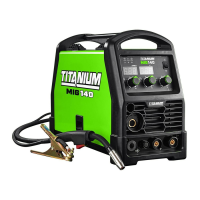
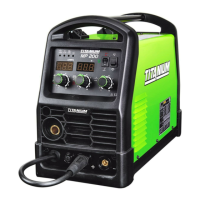
Details the electrical and performance specifications for the MIG 140 and MIG 170 models.
Step-by-step guide for installing a 2 lb wire spool and preparing the wire feed.
Instructions for setting up DCEN polarity and connecting wire for flux-cored welding.
Guide for setting up DCEP polarity and gas cylinder for solid core welding.
Instructions for adjusting feed roller and tensioner for proper wire feeding.
Steps for connecting the MIG gun and wire feed control cables.
Steps to prepare the MIG gun and connect the power cord safely.
Completing wire feed setup, testing tension, and final gun adjustments.
Overview of basic welding methods (MIG, Flux-Cored) and essential safety precautions.
Explains the function of each control on the front panel of the welder.
Identifies and describes important internal components of the welder.
Guides users to the settings chart for optimal weld parameters.
Explains duty cycle limitations and how to prevent welder overheating.
Steps for preparing workpieces, clamping, and setting initial weld parameters.
Instructions for setting up gas shielded welding, including cylinder and gas flow.
Explains stringer/weave beads, gun angles (push/drag), and CTWD for optimal welds.
Steps for examining welds, safe shutdown, and storing equipment after welding.
Procedures for cleaning welds after welding and inspecting their quality.
A test procedure to evaluate the strength and quality of a weld.
Guides on diagnosing and correcting weld penetration issues based on heat and speed.
Identifies and offers solutions for weld penetration problems.
Addresses slag removal and issues with welds not adhering properly.
Discusses causes and solutions for porosity and excessive spatter in welds.
Provides solutions for crooked/wavy beads and burn-through defects.
Detailed steps for cleaning and inspecting the MIG gun nozzle and contact tip.
Explains the meaning and solutions for various alarm indicator error codes.
Diagnoses problems with unstable arcs, weak strength, and power indicator issues.
Solutions for issues where the arc does not ignite or porosity appears in the weld.
A detailed list of all parts included with the welder, with quantities.
Visual guide showing how the different parts of the welder are assembled.
Outlines the terms, conditions, and exclusions of the product's 90-day limited warranty.
 General
| Input Voltage | 120V |
|---|---|
| Welding Output Range | 30-140A |
| Welding Processes | MIG |
| Spool Size Capacity | 4 in and 8 in |
| Wire Diameter | 0.035 in |
| Wire Feed Speed | 50-500 IPM |
| Weight | 24 lbs |
| Dimensions | 17 in. x 9 in. x 14 in. |

 To Next Page