
 Need help?
Do you have a question about the Topcon OM-4 and is the answer not in the manual?
General safety warning regarding moving parts during operation.
Guidelines for disposing of the instrument according to local laws.
Specifies temperature, humidity, and air pressure for operation.
Details on storage conditions, usage duration, and handling.
Defines temperature and humidity ranges for transit.
Key checks to perform before and during instrument use.
Explanation of warning and caution displays.
Explanation of graphical symbols used for warnings and actions.
Emphasizes professional maintenance and limits user intervention.
Procedure for replacing the instrument's illumination bulb.
Procedure for replacing the instrument's fuses.
Disclaimers regarding manufacturer's responsibility for damages.
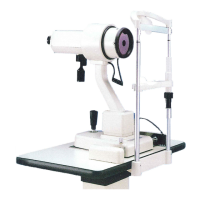
Identifies key parts of the ophthalmometer's main body.
Details materials of parts that contact the patient.
Step-by-step guide for installing the instrument's table.
Instructions for attaching the chinrest unit.
Procedure for positioning the instrument's base on the table.
Guidance on placing and securing chinrest paper.
Steps for connecting the power and connector cables.
Verifying the pilot lamp and mire plate illumination.
Setting up the environment and instrument for operation.
Procedure for practicing measurements using a test ball.
Detailed steps for measuring corneal curvature.
Procedure for measuring the curvature of contact lenses.
Troubleshooting steps for a non-functional illumination lamp.
Description of internal scales for radius and refractive power.
Details the extensive measurement range of the instrument.
Highlights the accuracy and sharpness of mire images.
Describes the quick and precise focusing capabilities.
Explains the efficiency of measuring principal meridians simultaneously.
Focuses on ergonomic design and one-hand operation.
Describes mire image analysis for astigmatism evaluation.
Technical specifications for the AIT-15 and AIT-16 instrument tables.
Detailed specifications for the instrument's measuring head.
Detailed specifications for the instrument's base unit.
Specifications for the instrument's power supply unit.
Physical dimensions and weight of the unit and table.
Information on EMC compliance and emissions/immunity guidance.
Classification of the instrument regarding electrical shock and water protection.
Defines the primary functions of the ophthalmometer.
Explains the fundamental mechanism of measurement.
Table detailing plug types for various countries.
Explanation of IEC symbols used in the manual and on the device.
Routine cleaning and care instructions for the instrument.
Step-by-step guide for replacing the instrument's fuses.
Procedure for replacing the disposable chinrest paper.
Instructions for safely replacing the illumination lamp.
Detailed instructions for cleaning different parts of the instrument.
 General
| Type | Operating Microscope |
|---|---|
| Depth of Field | Varies with magnification |
| Objective Lens | 200mm |
| Eyepieces | 12.5x |
| Light Source | Halogen |
| Illumination | Coaxial Illumination |
| Mounting Options | Ceiling Mount, Wall Mount, Floor Stand |
| Weight (approx.) | Varies depending on mounting option |


 To Next Page