Need help?
Do you have a question about the tormek SVS-50 and is the answer not in the manual?
Lists turning tool types like square, skew, parting, beading, and roughing gouges, with width limits.
Lists carving tool types including gouges and chisels, specifying shank type and size range.
Details the process for shaping skew chisels with straight edges, including initial shaping.
Details the importance and method for rounding the corners of flat skew chisels for smoother lathe operation.
Explains the re-designed closed seat, its dimensions, and its purpose for sharpening shorter tools.
Provides specific instructions for efficiently shaping wide chisels by grinding half the width at a time.
Explains how to move the jig to the honing wheel and polish the bevels to a mirror finish.
Compares grinding area and pressure for straight vs. convex edges, impacting grindstone performance and activation.
Details the process of shaping and sharpening the curved edge of skews, ensuring symmetry.
Guides on the honing process for curved edges of tools to achieve a refined finish.
Explains the setup and procedure for using the open seat for parting and beading tools.
Details the process for sharpening roughing gouges with the open seat, ensuring even wheel wear.
Explains the honing process for roughing gouges to achieve a sharp, polished edge.
Details the procedure for sharpening straight shank carving gouges using the open seat.
Guides on shaping the edge of carving gouges for optimal performance and edge definition.
Explains the grinding steps, ensuring even wheel wear and proper contact with the tool.
Details the final honing stage to achieve a sharp, polished edge on the tool.
Guides on the honing process to achieve a mirror finish on the tool bevels.
Explains the setup for sharpening square carving chisels using the open seat.
Guides on honing square carving chisels for a sharp, precise edge.
Details using the closed seat for sharpening carving skew chisels, ensuring proper angle.
Explains how to set the jig to match an existing skew angle on the chisel for accurate sharpening.
Guides on setting a new, custom skew angle on the chisel using the jig's scale.
Details the grinding process for carving chisels, emphasizing fine sharpening and edge definition.
Discusses preparing the grindstone for fine sharpening of carving chisels using a stone grader.
Guides on the final honing steps for carving chisels to achieve a mirror finish.
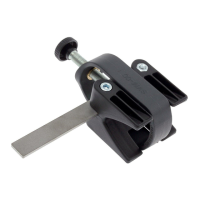
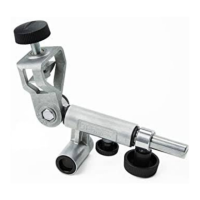
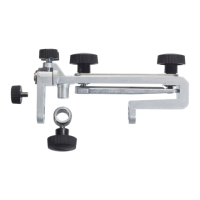
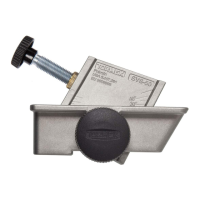
The Tormek Multi Jig SVS-50 is a versatile sharpening jig designed for a wide range of turning and carving tools, including square and skew chisels, parting tools, beading tools, roughing gouges, and carving gouges. This patented jig consists of a housing (1) and two interchangeable seats: one closed (2) and one open (3). The seats can swivel and be locked with a screw (6) at any skew angle between 0° and 45°, allowing for symmetrical grinding of bevels by mounting the tool once and turning the jig upside down.
The SVS-50 jig facilitates precise and repeatable sharpening of various tools by controlling three key factors: the setting of the jig to the skew angle (JS), the protrusion of the tool in the jig (P), and the Universal Support position (B). The Tormek Turning Tool Setter TTS-100 is used to control these factors, allowing users to select a desired profile from a chart and replicate it consistently.
 General
| Brand | tormek |
|---|---|
| Model | SVS-50 |
| Category | Power Tool |
| Language | English |

 To Next Page