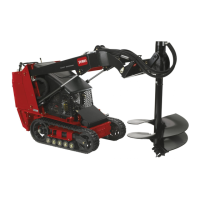
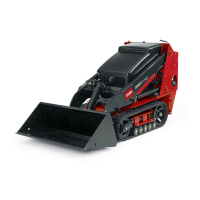
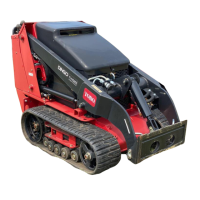
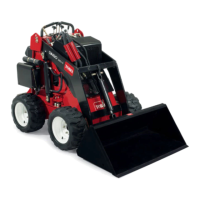
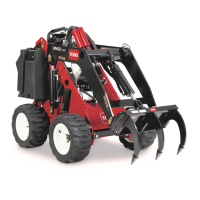
The Toro TX 1000 Compact Tool Carrier is a versatile machine designed for various earth and materials moving activities in landscaping and construction work. It is engineered to operate with a wide array of attachments, each serving a specialized function. Using the product for purposes other than its intended use could pose safety risks to the operator and bystanders.
Function Description:
The TX 1000 serves as a compact tool carrier, providing power and mobility for a range of tasks. Its primary function is to transport and operate different attachments, enabling it to perform specialized jobs such as digging, lifting, grading, and trenching. The machine is designed for efficiency and maneuverability in diverse work environments.
Important Technical Specifications:
The TX 1000 comes in two main models: 22327 and 22328, with slight variations in width.
Model 22327:
- Width: 85 cm (33 inches)
- Length: 256 cm (101 inches)
- Height: 138 cm (54 inches)
- Weight: 1234 kg (2,720 lb)
- Operating Capacity (with 75 kg (165 lb) operator and standard bucket): 454 kg (1,000 lb)
- Tipping Capacity (with 75 kg (165 lb) operator and standard bucket): 1296 kg (2,857 lb)
- Wheelbase: 104 cm (41 inches)
- Dump Height (with standard bucket): 155 cm (61 inches)
- Reach—Fully Raised (with standard bucket): 62 cm (25 inches)
- Height to Hinge Pin (with standard bucket in highest position): 206 cm (81 inches)
Model 22328:
- Width: 103 cm (41 inches)
- Length: 256 cm (101 inches)
- Height: 138 cm (54 inches)
- Weight: 1297 kg (2,860 lb)
- Operating Capacity (with 75 kg (165 lb) operator and standard bucket): 454 kg (1,000 lb)
- Tipping Capacity (with 75 kg (165 lb) operator and standard bucket): 1296 kg (2,857 lb)
- Wheelbase: 104 cm (41 inches)
- Dump Height (with standard bucket): 155 cm (61 inches)
- Reach—Fully Raised (with standard bucket): 62 cm (25 inches)
- Height to Hinge Pin (with standard bucket in highest position): 206 cm (81 inches)
Fuel Tank Capacity: 41 L (11 US gallons)
Crankcase Capacity (with filter): 5.7 L (1.5 US gallons)
Hydraulic Tank Capacity: 37.9 L (10 US gallons)
Engine Oil Type: Detergent diesel engine oil (API service CH-4 or higher).
Engine Oil Viscosity: 10W-30 or 15W-40, depending on ambient temperature.
Recommended Fuel: Clean, fresh diesel fuel or biodiesel fuels with low (<500 ppm) or ultra-low (<15 ppm) sulfur content. Minimum cetane rating of 40. Biodiesel blends up to B20 (20% biodiesel, 80% petrodiesel) can be used, provided the biodiesel meets ASTM D6751 or EN14214 specifications and the blended fuel meets ASTM D975 or EN590.
Hydraulic Fluid Type: Toro Premium Transmission/Hydraulic Tractor Fluid (UTHF). If not available, a conventional, petroleum-based Universal Tractor Hydraulic Fluid (UTHF) meeting specific material properties (Viscosity ASTM D445: cSt at 40°C: 55 to 62; cSt at 100°C: 9.1 to 9.8; Viscosity Index ASTM D2270: 140 to 152; Pour Point ASTM D97: -37 to -43°C) and industry standards (API GL-4, AGCO Powerfluid 821 XL, Ford New Holland FNHA-2-C-201.00, Kubota UDT, John Deere J20C, Vickers 35VQ25 and Volvo WB-101/BM) can be used.
Usage Features:
- Controls: The machine features a control panel with a reference bar, message display, power socket, plug, traction-enable switch, auxiliary hydraulics lever, throttle lever, key switch, loader lock, loader-arm/attachment-tilt lever, traction control, auxiliary-hydraulics lock pedal, and parking brake.
- Starting the Engine: Requires ensuring the battery-disconnect switch is ON, auxiliary-hydraulics lever and traction control are in NEUTRAL, throttle lever is midway, key is in the ON position, waiting for the glow-plug indicator light to stop blinking, and then turning the key to START. In cold conditions, the engine should run at middle throttle for 2-5 minutes to prevent hydraulic system damage.
- Driving the Machine: The traction control is used for movement. Moving it forward or backward controls speed, and releasing it stops the machine. The throttle lever regulates engine speed for optimal performance or slower operation.
- Attachments: Toro-approved attachments enhance the machine's capabilities. Proper installation and use of cylinder locks are crucial when working with raised loader arms. The quick-attach pins must be fully seated for secure attachment.
- Hydraulic Hoses: Connecting hydraulic hoses requires relieving pressure, cleaning connectors, and ensuring secure connections to prevent leaks and contamination.
- Safety Features: Includes battery symbols for explosion, fire, chemical burn hazards, and eye protection. Decals warn against hot surfaces, crushing hazards, cutting/dismemberment hazards, tipping hazards, and electrocution hazards. Safety-alert symbols (Caution, Warning, Danger) highlight potential risks.
- Message Display: Provides indicators for engine-coolant temperature, engine-oil pressure, glow plugs, battery charge, hour meter, parking brake, traction neutral, and auxiliary lever neutral.
- Proposition 65 Warning: The product may contain chemicals known to cause cancer and reproductive harm, requiring users to wash hands after handling.
Maintenance Features:
- Daily/Each Use:
- Check and adjust track tension.
- Grease the machine (immediately after washing).
- Check the air-filter-service indicator.
- Check engine-oil level.
- Drain water and contaminants from the fuel filter/water separator.
- Clean tracks.
- Check tracks for excessive wear and proper tension.
- Clean the screen, oil cooler, and front of the radiator.
- Check coolant level in the expansion tank.
- Check and clean the radiator screen.
- Test the parking brake.
- Remove debris.
- Check for loose fasteners.
- First 8 Hours:
- Check and adjust track tension.
- Replace the hydraulic filter.
- First 50 Hours:
- Change engine oil and filter.
- Every 25 Hours:
- Remove air-cleaner cover, clean debris, check air-filter-service indicator.
- Check hydraulic-fluid level.
- Every 50 Hours:
- Check battery condition.
- Check and adjust track tension.
- Every 100 Hours:
- Change engine oil (more frequently in dusty/sandy conditions).
- Check cooling system hoses.
- Check hydraulic lines for leaks, loose fittings, kinks, mounting supports, wear, weather, and chemical deterioration.
- Check for dirt buildup in the chassis.
- Check alternator/fan belt tension.
- Every 200 Hours:
- Change oil filter (more frequently in dusty/sandy conditions).
- Replace hydraulic filter.
- Every 400 Hours:
- Replace fuel filter canister and in-line filter.
- Check fuel lines and connections for deterioration, damage, or loose connections.
- Change hydraulic fluid.
- Check fuel lines and connections.
- Every 500 Hours:
- Replace alternator/fan belt.
- Every 1,500 Hours:
- Replace all moving hydraulic hoses.
- Yearly:
- Change engine coolant (Authorized Service Dealer only).
- Check and adjust track tension.
- Touch up chipped paint.
- Every 2 Years:
- Drain and clean fuel tank(s) (Authorized Service Dealer only).
- Replace all moving hydraulic hoses.
- Pre-Maintenance Procedures: Includes using cylinder locks for safety when loader arms are raised and accessing internal components by opening the hood and rear-access cover.
- Lubrication: General-purpose grease is used for fittings, with grease applied until it oozes out of bearings.
- Engine Maintenance: Involves servicing the air cleaner (checking indicator, cleaning cover, replacing filter), checking and changing engine oil, and maintaining the fuel system (draining fuel filter/water separator, replacing fuel filter canister and in-line filter, checking fuel lines and connections, bleeding the fuel system, draining fuel tank(s)).
- Electrical System Maintenance: Includes servicing the battery (using the battery-disconnect switch, removing, charging, cleaning, and installing the battery) and servicing fuses.
- Drive System Maintenance: Focuses on servicing and adjusting track tension, cleaning tracks, and replacing tracks.
- Cooling System Maintenance: Involves cleaning the radiator screen and checking/changing engine coolant.
- Brake Maintenance: Testing the parking brake.
- Controls System Maintenance: Adjusting controls for traction control alignment and neutral position.
- Cleaning: Removing debris from the engine area and chassis, and washing the machine with mild detergent (avoiding pressure washing sensitive components).
- Storage: Preparing the machine for storage by cleaning, servicing components, charging the battery, and disconnecting it.

 Need help?
 General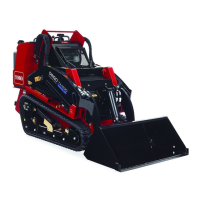

 To Next Page