Toyopuc PC3/PC2 Ethernet Driver
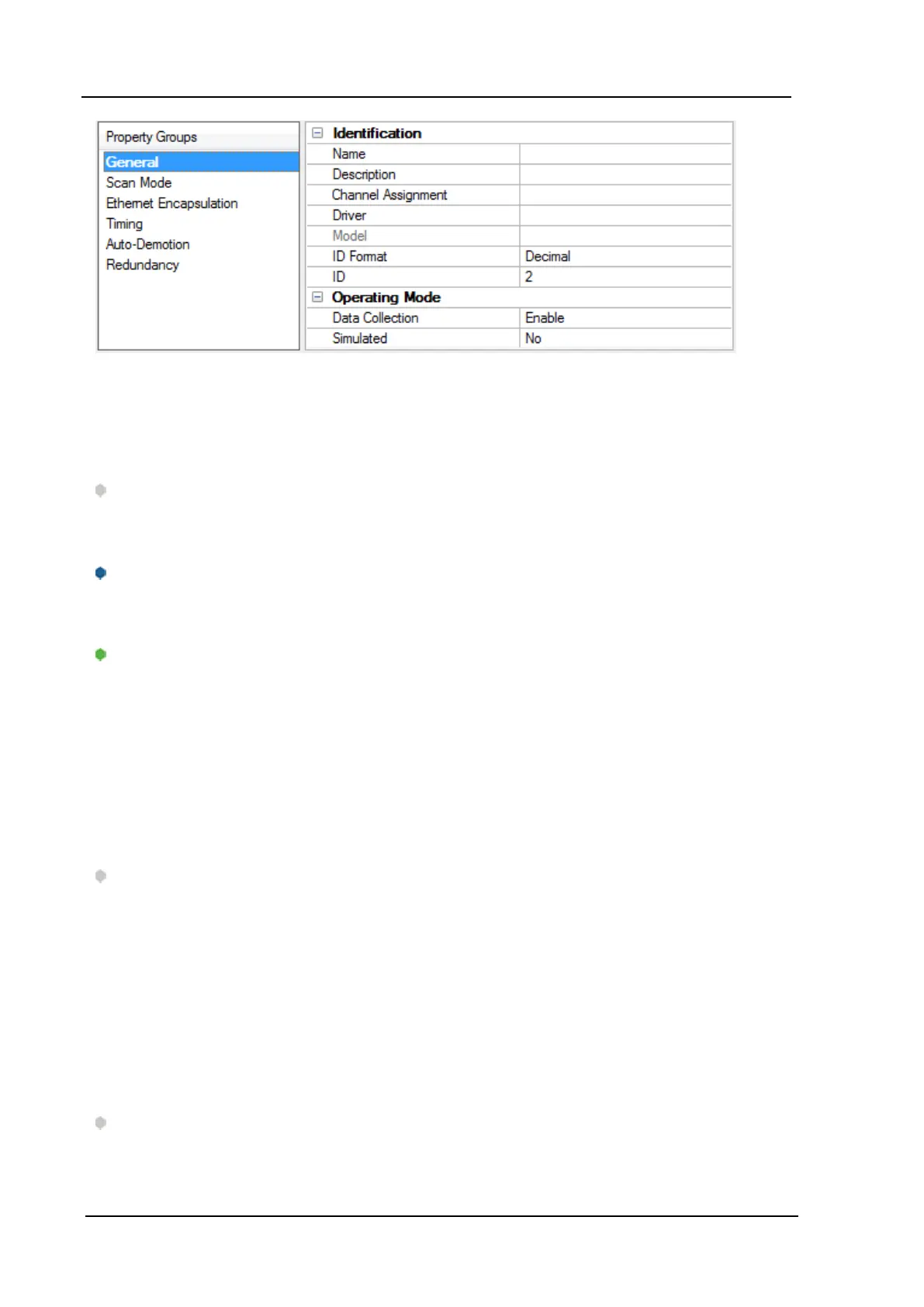
Identification
Name:This property specifies the name of the device. It is a logical user-defined name that can be up to
256 characters long, and may be used on multiple channels.
Note: Although descriptive names are generally a good idea, some OPC client applications may have a
limited display window when browsing the OPC server's tag space. The device name and channel name
become part of the browse tree information as well. Within an OPC client, the combination of channel name
and device name would appear as "ChannelName.DeviceName".
For more information, refer to "How To... Properly Name a Channel, Device, Tag, and Tag Group" in server
help.
Description: User-defined information about this device.
Many of these properties, including Description, have an associated system tag.
Channel Assignment:User-defined name of the channel to which this device currently belongs.
Driver:Selected protocol driver for this device.
Model:This property specifies the specific type of device that is associated with this ID. The contents of the
drop-down menu depends on the type of communications driver being used. Models that are not supported
by a driver are disabled. If the communications driver supports multiple device models, the model selection
can only be changed when there are no client applications connected to the device.
Note:If the communication driver supports multiple models, users should try to match the model
selection to the physical device. If the device is not represented in the drop-down menu, select a model that
conforms closest to the target device. Some drivers support a model selection called "Open," which allows
users to communicate without knowing the specific details of the target device. For more information, refer
to the driver help documentation.
ID:This property specifies the device's driver-specific station or node. The type of ID entered depends on
the communications driver being used. For many communication drivers, the ID is a numeric value. Drivers
that support a Numeric ID provide users with the option to enter a numeric value whose format can be
changed to suit the needs of the application or the characteristics of the selected communications driver.
The ID format can be Decimal, Octal, and Hexadecimal.
Note: If the driver is Ethernet-based or supports an unconventional station or node name, the device's
TCP/IP address may be used as the device ID. TCP/IP addresses consist of four values that are separated by
periods, with each value in the range of 0 to 255. Some device IDs are string based. There may be additional
www. kepware.com
10



 To Next Page