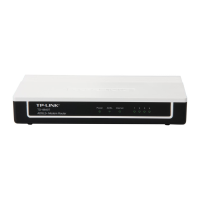
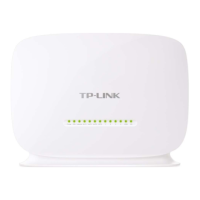
TD-W8950ND 150Mbps Wireless N ADSL2+ Modem Router User Guide
¾ DDNS (Dynamic Domain Name System) - Allows the hosting of a website, FTP server, or
e-mail server with a fixed domain name (e.g., www.xyz.com) and a dynamic IP address.
¾ Default Gateway - A device that forwards Internet traffic from your local area network.
¾ DHCP - A networking protocol that allows administrators to assign temporary IP addresses to
network computers by “leasing” an IP address to a user for a limited amount of time, instead
of assigning permanent IP addresses.
¾ DMZ (Demilitarized Zone) - Removes the modem router's firewall protection from one PC,
allowing it to be “seen” from the Internet.
¾ DNS (Domain Name Server) - The IP address of your ISP's server, which translates the
names of websites into IP addresses.
¾ Domain - A specific name for a network of computers.
¾ DSL (Digital Subscriber Line) - An always-on broadband connection over traditional phone
lines.
¾ Dynamic IP Address - A temporary IP address assigned by a DHCP server.
¾ EAP (Extensible Authentication Protocol) - A general authentication protocol used to control
network access. Many specific authentication methods work within this framework.
¾ Encryption - Encoding data transmitted in a network.
¾ Ethernet - IEEE standard network protocol that specifies how data is placed on and retrieved
from a common transmission medium.
¾ Firewall - A set of related programs located at a network gateway server that protects the
resources of a network from users from other networks.
¾ Gateway - A device that interconnects networks with different, incompatible communications
protocols.
¾ IEEE 802.11b - The IEEE 802.11b standard specifies a wireless networking at 11 Mbps using
direct-sequence spread-spectrum (DSSS) technology and operating in the unlicensed radio
spectrum at 2.4GHz, and WEP encryption for security. IEEE 802.11b networks are also
referred to as Wi-Fi networks.
¾ IEEE 802.11g - Specification for wireless networking at 54 Mbps using direct-sequence
spread-spectrum (DSSS) technology, using OFDM modulation and operating in the
unlicensed radio spectrum at 2.4GHz, and backward compatibility with IEEE 8021b devices,
and WEP encryption for security.
¾ Infrastructure Network - An infrastructure network is a group of computers or other devices,
each with a wireless adapter, connected as an IEEE 802.11 wireless LAN. In infrastructure
mode, the wireless devices communicate with each other and to a wired network by first going
through an access point. An infrastructure wireless network connected to a wired network is
referred to as a Basic Service Set (BSS). A set of two or more BSS in a single network is
referred to as an Extended Service Set (ESS). Infrastructure mode is useful at a corporation
scale, or when it is necessary to connect the wired and wireless networks.
¾ IP Address - The address used to identify a computer or device on a network.
¾ IPoA (IP and ARP over ATM) - A protocol that provides extensions to the IP Group for
handling IP over ATM flows.
¾ ISP (Internet Service Provider) - A company that provides access to the Internet.
97


 To Next Page