10 18-AD47D1-1B-EN
Installer’s Guide
When a refrigerant leak of the indoor coil is detected, the refrigerant
leak detection system turns on the blower of the furnace to dilute
leaked refrigerant.
The installer must verify that the indoor airow setting is sucient
to dilute leaked refrigerant. The nominal airow settings for rst-
stage cooling, rst-stage heat pump, and rst-stage furnace heat
should not be less than shown in the minimum airow table below.
NOTE:
The airow setting should be veried by comparison to
the airow at the lowest listed external static pressure
for the setting. Refer to the airow table provided by the
manufacturer of the furnace.
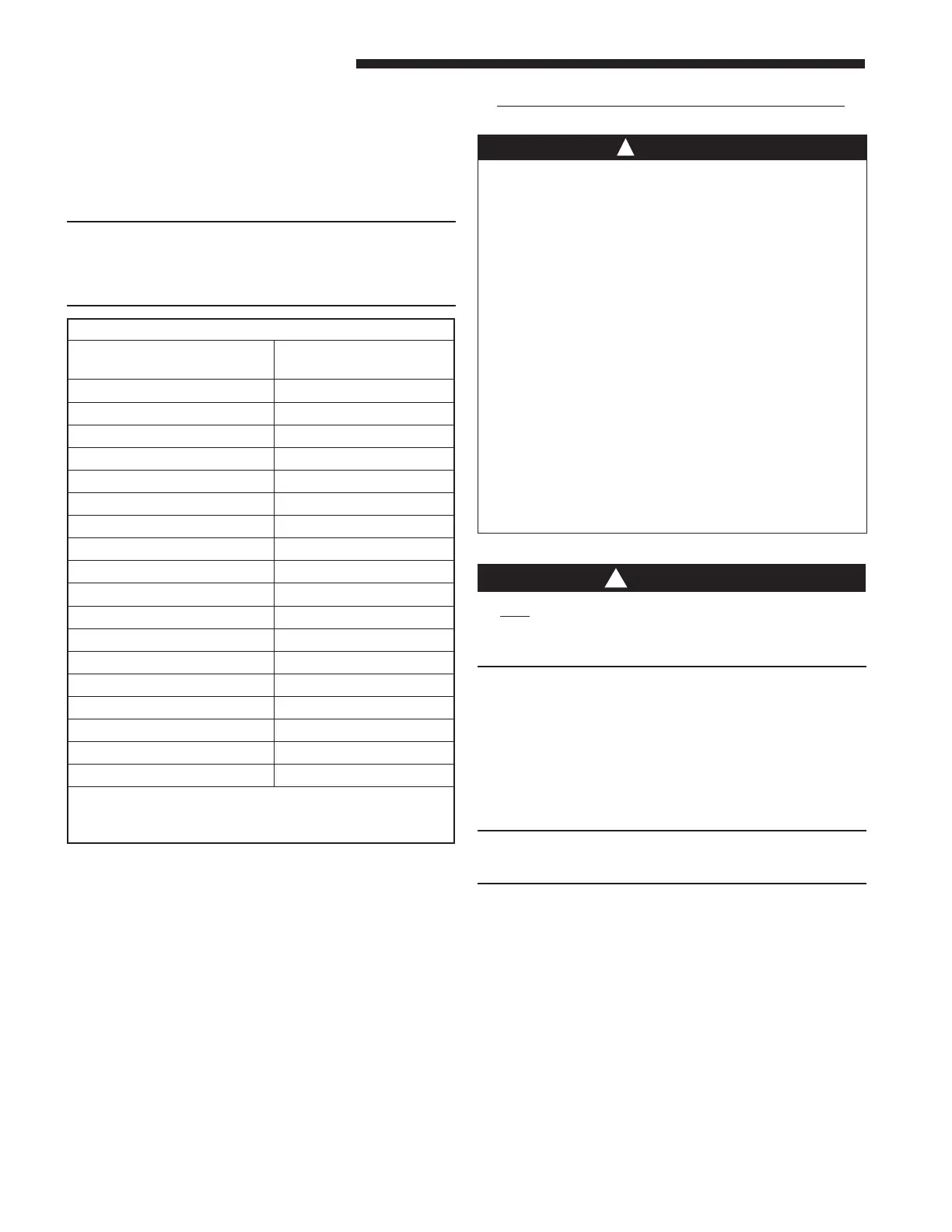
Minimum Airow Setting
System
refrigerant charge (lb) +
Minimum Airow Setting
(CFM)
less than 4 no mimimum
4 108
5 135
6 162
7 189
8 216
9 244
10 271
11 298
12 325
13 352
14 379
15 406
16 433
17 460
18 487
19 514
20 541
+ The system refrigerant charge is the total system charge
which is marked on the system according to the instructions
provided by the manufacturer of the outdoor unit.
K. INSTALLING / BRAZING REFRIGERANT LINES:
RISK OF FIRE!
Failure to following this warning could result in serious
injury, death, or property damage.
The following requirements apply to the room where the
cased coil is installed:
• All combustion appliances located in the same
room that have continuous pilot lights are equipped
with an effective flame arrest.
• Auxiliary devices which may be a potential ignition
source, such as hot surfaces or electric switching
devices, shall not be installed in the connecting
ductwork unless they have been approved by
the manufacturer or declared suitable with the
refrigerant used.
• All indoor field-made joints of the field piping have
been checked for refrigerant leaks after charging
using an electronic leak detector calibrated for
R-454B having a sensitivity of 5 grams per year or
better.
• The room is constructed to ensure that should any
refrigerant leak it will not stagnate and create a fire
hazard.
Do NOT open refrigerant valve at the outdoor unit until the
refrigerant lines and coil have been brazed, evacuated, and
leak checked. This would cause contamination of the refriger-
ant or possible discharge of refrigerant to the atmosphere.
1. The following steps are to be considered when installing
the refrigerant lines:
a. Determine the most practical way to run the lines.
b. Consider types of bends to be made and space
limitations.
c. Route the tubing making all required bends and
properly secure the tubing before making final
connections.
NOTE:
Refrigerant lines must be isolated from the structure and
the holes must be sealed weather tight after installation.



 To Next Page