2
GENERAL DESCRIPTION
The Alnor
®
Velometer
®
Anemometer is a direct reading instrument for
measuring air velocities. It is designed to measure velocities inside
heating and ventilating ducts, or in open areas such as at fume hoods,
grilles, diffusers, slots on ventilated plating tanks, and so forth. It may
also be used for measuring duct static pressures.
The Velometer
®
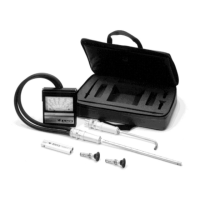
Anemometer set consists of the meter, velocity and
static pressure Range Selectors, measuring probes and connecting
hoses.
The Velometer
®
Anemometer is basically an air flow meter reading in
feet per minute (or meters per second).
The Velometer
®
Anemometer is built with a taut band meter movement; it
is carefully balanced so that you may hold the meter in any normal
position and still get an accurate reading. All Velometer
®
Anemometers
are uniformly calibrated to factory standards: optimum accuracy is
attained when velometers are used with accessories of the same set,
and with the meter in the horizontal position (scale window facing up).
Before using the Velometer
®
Anemometer, study the operational
instructions and procedures to ensure proper use of the instrument for
accurate results.
Meter
The meter receives air through its sensing ports. A force against the
vane causes a deflection of the needle which yields an indicated reading.
On the face of the meter there is a series of range scales (A) which
enables you to read accurately the measured value. Since there are a
number of ranges, it is important that the scale read on the meter face
corresponds to the velocity or static pressure range that is set on the
Range Selector.
On the back side of the meter there are two sensing ports (hose
connections) (B) which are for interconnecting to one of the two Range
Selectors with hoses. One port is marked positive (+) and the other
negative (–).
Sensing port caps are provided and you should place them over the
sensing ports when the meter is not in use.
Check to see that the pointer is at zero each time the meter is put into
service. The zero adjustment screw (C) enables you to make an
adjustment. With the caps still on the ports, use a screwdriver to bring
the pointer to zero. It should continue to read zero whether the meter is
lying flat, standing upright or is at any position in between, including the
position where one end of the scale is lower than the other.

 To Next Page
 Loading...