95
COOLING SYSTEM BLEEDING INSTRUCTIONS
Antifreeze
Applicable
Engine
Capacity
(US gal, Imp gal)
LLC Density
K21, GK21 8.7 (2-1/4, 1-7/8) Standard Specication:
30% (approx. -15C (5F) of
freeze temperature)
For Cold Areas:
50% (approx. -35C (-31F) of
freeze temperature)
K25, GK25 7.9 (2-1/8, 1-3/4)
QD32 10.2 (2-3/4, 2-1/4)
WARNING
!
• Never remove the radiator cap when the engine is hot.
Serious burns could be caused by high-pressure uid or
steam escaping from the radiator.
• Always ensure that the coolant is cooled down sufciently
before removing the radiator cap. When opening the cap,
wrap the cap with a shop cloth and turn the cap slowly to
release the internal pressure.
NOTE:
• Use only Blue Extended Life Coolant/Antifreeze with the proper
mixture ratio for the working environment that the lift truck will be
used in.
• Engine coolant must be disposed of properly. Check all local, state
and federal regulations. Remove the radiator cover and open the
engine hood.
1. Remove the radiator cover and open the engine hood. Remove the
radiator cap.
2. Place an appropriate size container under the radiator. Open the
drain cock of the radiator and extract the coolant.
3. If changing engine coolant ush the cooling system.
4. After draining all of the coolant, securely close the drain cock.
5. Prepare coolant mixture (refer to antifreeze chart at left).
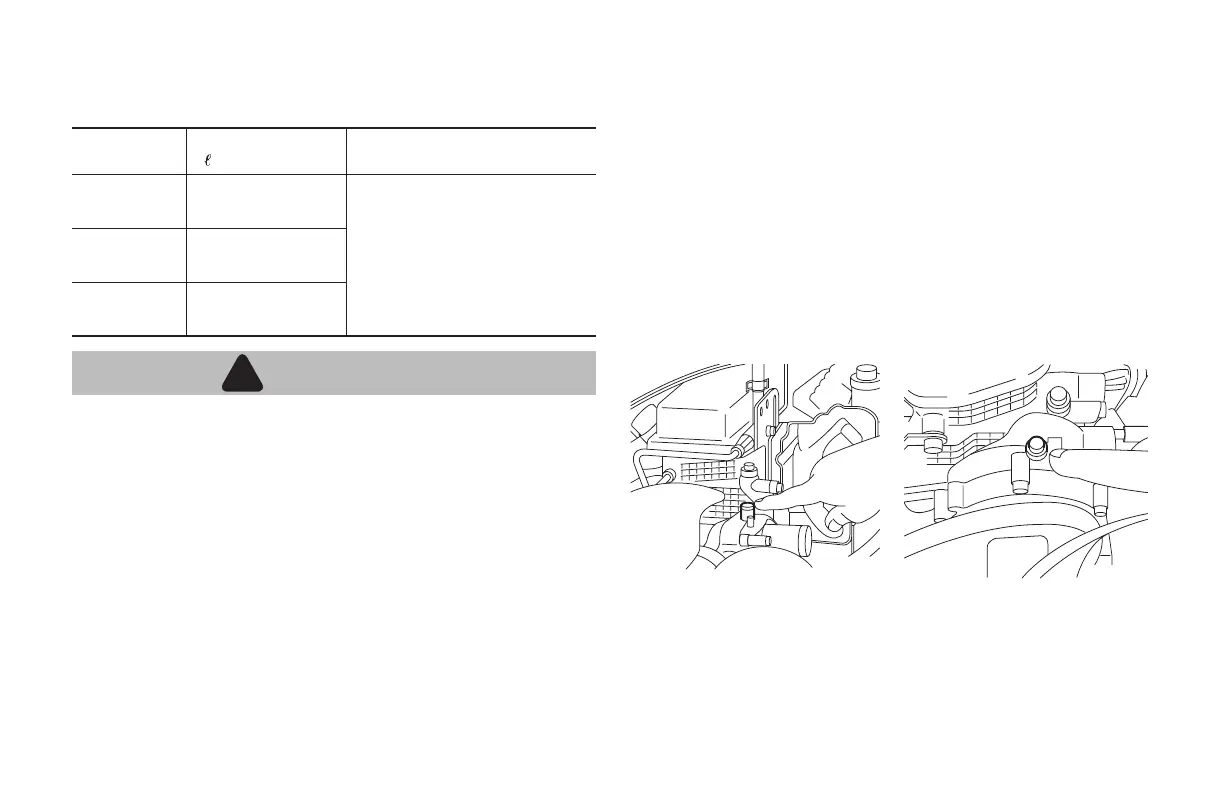
6. With the radiator cap removed, locate the engine coolant system
bleeder screw. The bleeder screw location varies depending on the
model of engine. This screw will either be located in the thermostat
housing or on the top of the water pump. Refer to the illustrations
below for the location of the screw.
7. Completely remove the bleeder screw, pay close attention to the
sealing washer so that it does not fall off the screw as it is being
removed.



 To Next Page