25
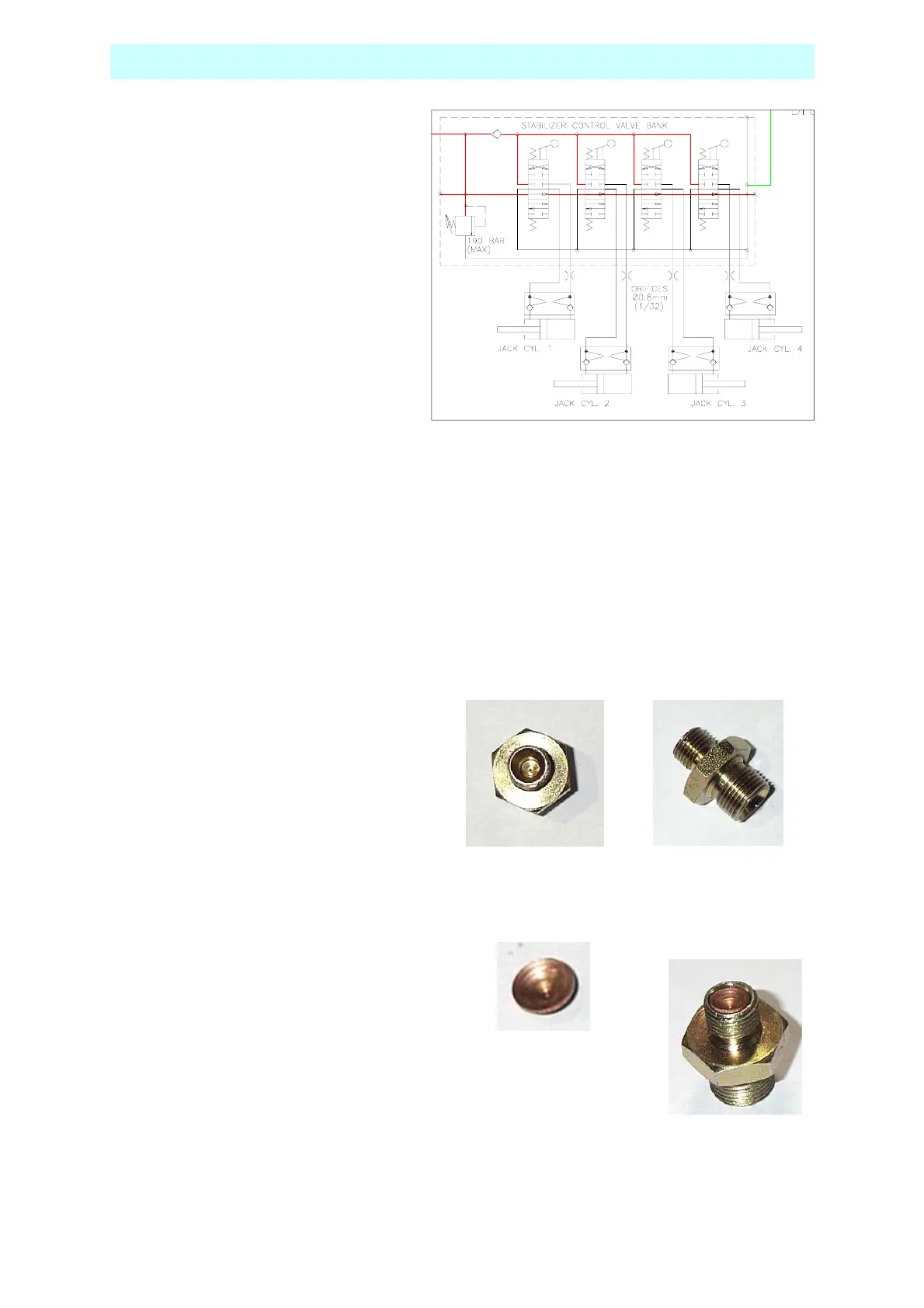
RESTRICTORS
You have seen that all valve blocks
have restrictors fitted at different
locations. The most common version on
the current versions (2002) of the TL37
uses a hose adapter with a drilled hole.
Other types which have been in use
(and still are on other machines) is a
simple copper washer with a sized hole.
The copper washer is squashed
between the hose fitting and the adapter
screwed into the valve block.
It is easy to see when a copper washer
type restrictor have been used as it
looks like the hose fitting is not screwed
fully down onto the adapter when
comparing to the hose fitting next to it.
You also need more force when
tightening the hose fitting to prevent
leaks
OUTRIGGER CONTROL VALVE
This valve is not interchangeable with
the ground control valve even though it
is a 4 bank valve block with a relief
valve and looks identical to the ground
controls.
When the spool is in the neutral position
the annular side of the ram is attached
to the tank line. This is done to ensure
that the pilot pressure holding the check
valve on the full bore open, is drained
off quickly to tank so that the check
valve close quickly
If the valve block is replaced make sure
that the piping is done exactly as
shown. You rely on the closed port as
your back up for the check on the full
bore side.
Some early version did not have this
type of spool. This type can easily be
identified as it has Din-Oil stamped on
the end cap. This type used a standard
closed centre valve block. The leakage
rate across the closed centre spool was
high enough to ensure that the check
would close
Hose adapter shown here with drilled hole.
If cylinder movement is erratic check for
contamination
Copper restrictor fitted
loose in the hose adapter.
Hose end require more
torque to prevent oil leak
when securing hose.
Each A port has a restrictive hose adapter fitted
in the valve block. If the restrictor gets blocked
you will not be able to operate the cylinder
correctly.
When looking for a fault relating to cylinders and
valve blocks - swapping hose connection can
easily give a good pointer to where the fault is. If
the fault stays put, you know that the fault is in
the valve block. If the fault moves you know it is
the cylinder. Do not over tighten the hose fitting.
You are more likely to cause a leak by deforming
the adapter cone than leaving the fitting to loose.
MAINTENANCE PROCEDURE



 To Next Page