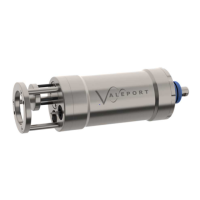
3.5.2 Turbidity
Valeport's Turbidity technology is essentially two sensors in one. The first is a “classic”
nephelometer, using a 90˚ beam angle for turbidity levels between 0 and 2000 NTU. The second
sensor uses optical backscatter - OBS (~120˚ beam angle) for turbidity levels beyond 10 000 NTU.
Both sensors output data simultaneously, at a programmable rate, so there is no need to switch
ranges as conditions vary. Intelligent sampling and the use of a 24 bit ADC eliminates the need to
switch gain. The optical head is very compact, measuring just 20mm diameter and is rated to full
ocean depth.
Nephelometer 0 to >1 000 NTU - linear response
Optical Backscatter: 0 to 4 000 NTU - linear response
(>4,000 NTU has a non-linear monotonic response that allows
derivation of higher values using look-up tables)
3.5.2.1 Safety Statement
The Turbidity sensor is classified EXEMPT under the standard 62471.
As a Valeport Turbidity sensor is classified as EXEMPT a hazard label in not required.
Never look directly into the optical aperture
3.6 Calculated Parameters
3.6.1 SWiFT SVP
3.6.1.1 Calculated Conductivity
From directly measured sound velocity, temperature and pressure, SWiFT calculates Salinity using
a proprietary Valeport algorithm developed from extensive laboratory and fieldwork. This salinity
value is then used to compute conductivity using standard EOS80 formulas.
3.6.1.2 Calculated Salinity
From directly measured sound velocity, temperature and pressure, SWiFT calculates Salinity using
a proprietary Valeport algorithm developed from extensive laboratory and fieldwork.
A new salinity equation for sound speed instruments - Allen - 2017 - Limnology and
Oceanography: Methods - Wiley Online Library
https://aslopubs.onlinelibrary.wiley.com/doi/pdf/10.1002/lom3.10203


 To Next Page