Need help?
Do you have a question about the Vdwall LVP and is the answer not in the manual?
High voltage warning; do not open the cover during maintenance to prevent hazards.
Keep away from water, fire sources, and unplug if unusual noise/smoke occurs. Do not plug/unplug DVI when powered.
Read manual, unplug during lightning/long periods of non-use, only qualified technicians operate, avoid vents, keep away from water/heat.
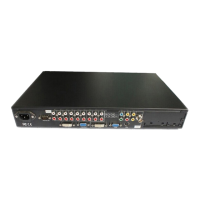
Visual identification of the device's rear panel and its ports.
Details on video input ports (V1-V2, VGA, DP, DVI, HDMI) and audio input.
Visual representation of system connections, showing how components are linked.
Description of audio output functionality, corresponding to selected video input signals.
Description of RS232 serial communication port and its function.
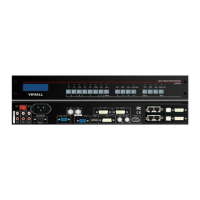
Visual representation of the LVP603's front panel layout, identifying controls.
Explanation of the functions of the 16 buttons on the front panel, including input selection and auto-adjustment.
Details on adjusting output image brightness using BRT- and BRT+ buttons across 32 levels.
How to use the Info button to display current settings and input signal status.
Explains seamless and fading switching effects between input signals.
Description of Picture-in-Picture (PIP) and Picture-on-Picture (POP) modes and their configuration.
Functionality for adding captions, logos, or animations to the current picture.
How to switch between full screen and partial screen display modes.
Option to choose the display language for the device, supporting Chinese and English.
Configuration settings for the output image resolution and format.
Adjustments for image brightness, color saturation, and definition.
Settings for configuring PIP and POP window parameters.
Parameters for text overlay, including mode and color thresholds.
Settings for input image parameters, particularly for parallel machine operation.
Options for mapping audio inputs (AD1, AD2) to video signals.
Settings related to device initialization and factory defaults.
Procedure to access the device's setup menu using the 'Setup' button.
Steps to select the display language (Chinese or English) within the setup menu.
How to select the output format (resolution and refresh rate) for the device.
Detailed settings for output image brightness, color saturation, and definition.
Configuration for PIP image window parameters like start, width, height, and frame.
Options for setting the frame mode for the PIP image window.
Setting the height for the POP image display.
Parameters for text overlay, including mode and color thresholds.
Configuration of input image parameters for parallel machine operation.
Illustration of setting up multiple LVP603 units for a large screen display.
Details on setting input image width and height ratios for parallel operation.
How to define the capture start points for input images in parallel setups.
Mapping external audio inputs (AD1, AD2) to video channels.
Procedure to exit the setup mode and save settings.
Settings for device initialization, bias adjustment, and auto ADC calibration.
Details of input signal types, formats, and connectors.
Details of output signal types, formats, resolutions, and connectors.
Information on control, power, operating temperature, humidity, and size.
Physical weight of the LVP603 unit.
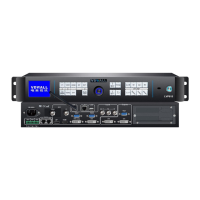
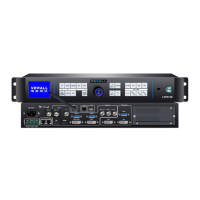
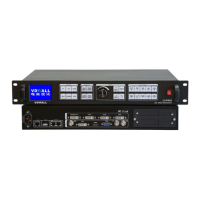
The LVP603 is an LED Video Processor designed for various video display applications, particularly with LED screens. It functions as a central unit for processing and outputting video signals, offering a range of input and output options, as well as features for image manipulation and display management.
The primary function of the LVP603 is to process multiple video input signals and output them to LED display devices. It supports a variety of input sources, including composite video, VGA, DisplayPort (DP), DVI, and HDMI, allowing for flexibility in connecting different types of video equipment. The processor can handle up to 6-channel signal input and 4-channel stereo audio input, with audio switching synchronized to video input selection.
A key feature of the LVP603 is its ability to perform seamless or fading in/out switching effects between different video input signals, categorized into three groups (V1, V2; VGA; DP, DVI, HDMI). This ensures smooth transitions without flickering, trembling, stasis, delay, or black screen occurrences. For signals within the same group, it offers a freezing seamless switching effect.
The device also supports Picture-in-Picture (PIP) and Picture-on-Picture (POP) modes, allowing users to insert a secondary video window (PIP) into the main background picture, or display two independent video sources side-by-side (POP). The size and location of these windows can be freely adjusted.
Another notable function is the Text Overlay mode, which enables users to add captions, company logos, or animations onto the current video picture. These captions can be created using office software like PowerPoint.
For output, the LVP603 provides VGA and DVI digital graphic signal outputs. The VGA output can be used for local monitoring, while the DVI outputs are typically connected to external LED transmission cards or boxes to drive the LED screen. The processor supports various output resolutions, including 1024x768, 1280x1024, 1600x1200, and 1920x1080, with different refresh rates.
The LVP603 also supports parallel operation, where multiple units can be connected to drive larger LED screens. In such configurations, each LVP603 unit captures a specific part of the overall input image to form a complete large picture.
 General
| Brand | Vdwall |
|---|---|
| Model | LVP |
| Category | Media Converter |
| Language | English |

 To Next Page