49
48
Complex Profiles & Coordinated Motion
Appendix G
Coordinated Motion
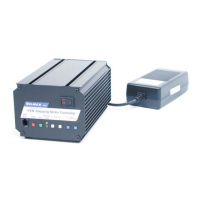
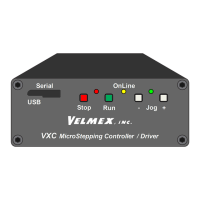
The most common method to move is one axis at a time. Using one VXM controller this is
the only option available. However, with two VXMs connected together with the VXM bus
two axes at a time can be run. Assuming there are two VXMs connected by a bus cable,
the following commands can be utilized to produce complex coordinated motion profiles.
Complex Profiles
The VXM automatically does a simple profile move every time it is required to perform an
index. This profile consists of a acceleration segment, slew segment, and a deceleration
segment. Using the VXM’s Continuous indexing feature more complex motion profiles
are possible. In addition to the Continuous Index commands described in Appendix D,
below are two more specifically for making complex profiles.
U77 Start of Continuous Index with no output. This command is same as the “U7”
except it does not produce the pulse on user output 2.
Memory usage = 2 bytes.
U99 End of Continuous Index with no deceleration. This command is similar to the
"U9" command without the deceleration move after the last index.
Memory usage = 2 bytes.
CAUTON: The motor speed should be below 800 steps/second, when the VXM executes
this command, to prevent an excessively hard stop that may cause a mechanical
overshoot of intended position.
As mentioned in Appendix D, speed commands can be used between indexes in the
continuous index mode. The number of speed changes is limited only by available
program memory space. Changes in speed will occur at the acceleration rate set before
the continuous index mode.
This is a typical example of running two motors sequentially when each axis is on a
different VXM:
ndex commands to run simultaneously:
Combine Index commands to run simultaneously on two VXM controllers
connected by VXM bus.
I1M400,I3M800,R
To run these two motors (motor 1 and motor 3) the same time requires adding “( )” around
the indexes. This example will combine the i
(i3,i1,..)
i3,i1,.. = index commands, slave motor (3,4) first.
Memory usage = 2 bytes.
Example:
(I3M800,I1M400,)R
NOTE: A motor 3 or motor 4 index command must be before a motor 1 or motor 2 index
for simultaneous operation to occur.
Example:
(I1M400,I3M800,)R
This will not run
the motors same time!
Two VXM controllers that are bussed together can be set to execute entire programs
simultaneously. The procedure to coordinate VXM program to VXM program is as
follows:
1. Transfer a program to the Slave using “[ ]”
2. Program associate the Master to the Slave with the “PMAx” command
[i1,i2...] Send data to Slave through the Master. i1,i2... = commands for Slave.
NOTE: Status requests, ”R”, and “Q” commands are not allowed.
PMAx Program associate program number x in Master to the same program
number in the Slave. Program x in the Slave will run the same time when
program x in the Master is run. x= 0,1,2,3,4
PMA-x Program associate all programs in the Master to all the programs in the
Slave except for program number x. Programs numbers except x in the Slave
will run the same time when a program in the Master is run. x= 0,1,2,3,4
PMA255 Disable Master/ Slave Program association (default)
See Also
U7, U8, U9, U91, U92, Appendix D
There are special Excel spreadsheet files on the CDROM to create the VXM
commands for producing sinusoidal motion, triangles, rectangles with
radius/chamfer corners, and circles.


 To Next Page