8
9
Index Motor 1 Example
+
+
+
+
Stepping Motor ControllerStepping Motor ControllerVXMVXM
www.velmex.comwww.velmex.com
VXM
Bus
VXM
Bus
StopStop
RunRun
On-LineOn-Line
LocalLocal
-- --
++ ++
Jog 1Jog 1
Jog 2Jog 2
+
+
+
+
Stepping Motor ControllerStepping Motor ControllerVXMVXM
www.velmex.comwww.velmex.com
VXM
Bus
VXM
Bus
StopStop
RunRun
On-LineOn-Line
LocalLocal
-- --
++ ++
Jog 1Jog 1
Jog 2Jog 2
+
+
+
+
Stepping Motor ControllerStepping Motor ControllerVXMVXM
www.velmex.comwww.velmex.com
VXM
Bus
VXM
Bus
StopStop
RunRun
On-LineOn-Line
LocalLocal
-- --
++ ++
Jog 1Jog 1
Jog 2Jog 2
VisualBASIC, C,
LabVIEW, etc.
“F”
command
:
:
:
“R”
¬ wait for “^”
“C”
command
:
:
:
:
:
“rsm”
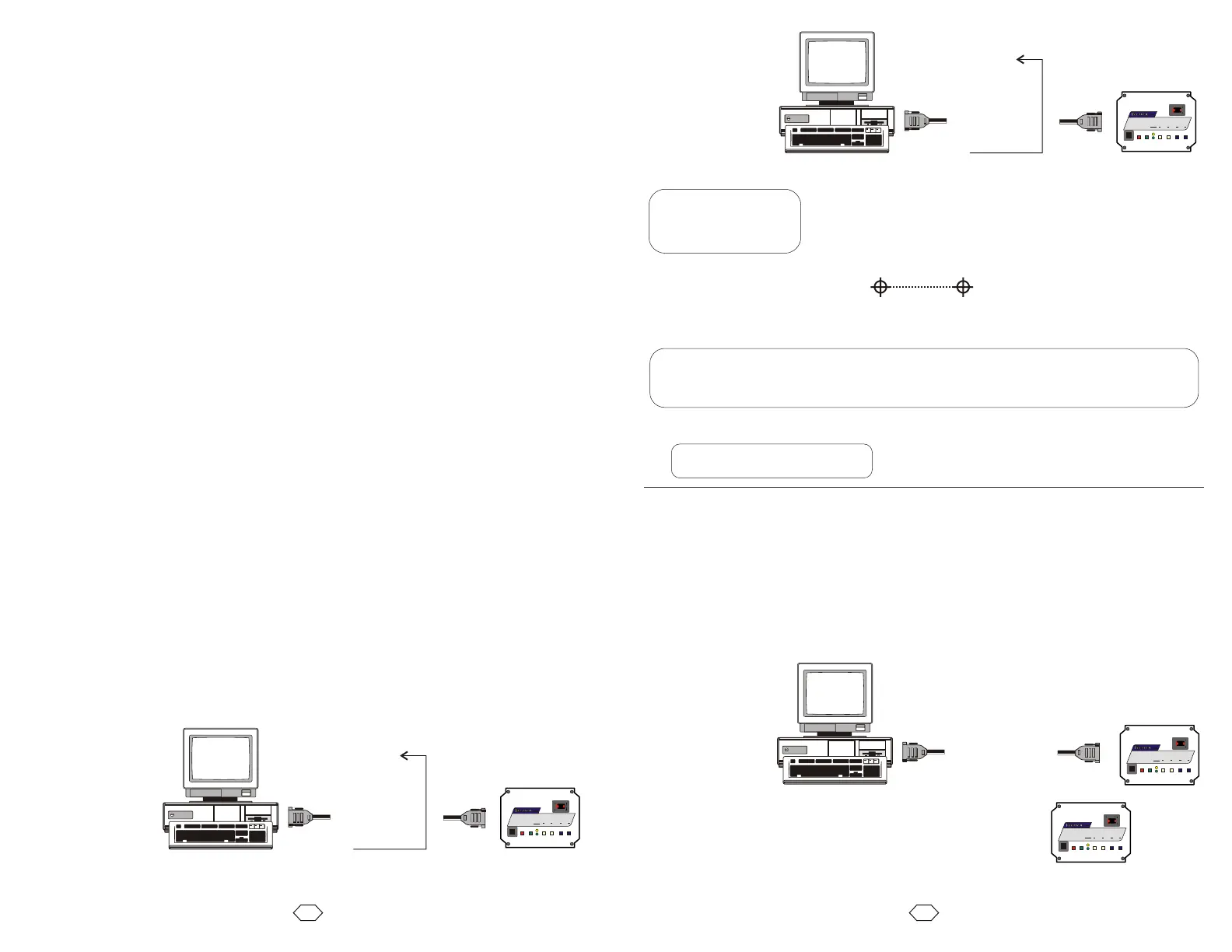
RS-232 Download/ Stand-alone Mode
Entire programs can be transferred to the VXM over the RS-232 interface. When a
program(s) has been downloaded to the VXM, it will keep the program(s) in memory until a
clear (”C”) command is used. To prevent loss of program data when power is turned off,
program memory can be permanently saved by using the “rsm” command. The ability to
retain programs allows the VXM to be used in a stand-alone mode. In a stand-alone mode
the operator starts the program by Run button located on the front panel, or by using the Run
input on the I/O connector.
+
+
+
+
Stepping Motor ControllerStepping Motor ControllerVXMVXM
www.velmex.comwww.velmex.com
VXM
Bus
VXM
Bus
StopStop
RunRun
On-LineOn-Line
LocalLocal
-- --
++ ++
Jog 1Jog 1
Jog 2Jog 2
Windows running
Velmex COSMOS,
or Windows
HyperTerminal
“E”
command
:
:
:
“R”
¬ wait for “^”
“C”
ÿ
G
Send commands
and permanently
save them in
VXM with “rsm”
command
VXM holds program(s) that can be activated with the
Run input. The default program to run is program 0.
Inputs 2 and 3 can configured to binary select and run
programs 0 to 3.
E
I1M400
R
E
I1M400
R
E I1M400,R E I1M400,R
E ;Enable On-Line mode with echo on
I1M400 ;Incremental Index Motor #1 +400 steps (1rev.)
R
E ;Enable On-Line mode with echo on
I1M400 ;Incremental Index Motor #1 +400 steps (1rev.)
R
¬Enable On-Line mode with echo on
¬Incremental Index Motor #1 +400 steps (1rev.)
¬Run Index
Comments can be included using a semicolon: (Never use comments after “R”)
Commands can be on the same line, separated by commas, spaces are optional:
Graphic Representation: ®
start end
RS-232 Interactive Mode
The VXM can be controlled in an interactive mode. Interactive mode is when a host
computer sends only the commands necessary to perform a single operation (usually an
Index), then the host will wait for the VXM to finish before sending any additional commands.
The following procedure would be used for running the VXM in an interactive mode:
1. The host puts the VXM On-Line by sending an "F"
2. The host sends a "N" to zero position registers if necessary
3. The host sends speed, and acceleration if necessary
4. The host sends an Index ("I" command)
5. The host sends a "R" to start the Index
6. The host then will wait until it receives a ready prompt ("^") from the VXM
NOTE: The VXM does not send a carriage return or line feed following the "^", refer
to the "G" command in Appendix O for more information
7. The user's routine for outputting, measuring, etc. would be executed by the host
8. A "C" would be sent from the host to clear the previous Index command from the
VXM's memory
9. The process is repeated from step # 3
Communication Methods
Programming of the VXM is accomplished by sending commands (ASCII characters) to
the VXM through the RS-232 interface. The simplest method to send commands is with
the Velmex COSMOS program, or with HyperTerminal in Microsoft Windows.
Another method to send commands is with commercially available languages such as
VisualBASIC, C, LabVIEW, etc.
To put the VXM in the On-Line mode/programming mode, the host must send either an
"E", or "F". When the Controller receives an "E", or "F" the On-line light will light and the
Jog inputs will be disabled.
The "E" puts the VXM on-line with echo "on" (echoes all characters received back to the
host). The "F" puts the VXM on-line with echo "off". If you are using HyperTerminal to
communicate to the VXM use the "E" so typed characters will be displayed. When using a
software language to send commands, use the "F" so the host’s input buffer will not be
burdened with echoed characters from the VXM.
NOTE: All command characters are case sensitive


 To Next Page