6
Hardware Features (Option 01)
Keypad
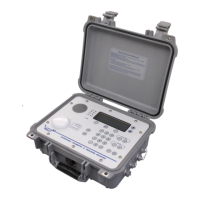
The keypad is used to control the functions of the Decoder/Display unit (Option 01) and to enter
data during the setup procedure. Ten digit keys (0 to 9) and a minus sign provide for numeric data
entry. The ENTER/YES key is used to enter the numeric data, or to answer YES to Yes/No (Y/N)
questions. The NEXT/NO key allows cycling through lists of possible identifiers and units during
setup, or to answer NO to Yes/No (Y/N) questions.
The two top right hand keys have dual functions. If pressed directly, the top right hand key (FREQ)
will place the unit in Set Frequency mode (see Set Frequency section). If this key is pressed after
the red shift key, the unit will be placed in the SETUP routine to set the real time clock and
initialize various channel parameters.
The button below this, if directly pressed, will place the unit in DECODE mode for reception of
pulses from the receiver (see Decode section). If this key is pressed after the red shift key, the unit
logs data to an internal memory data storage module inside the VR60 receiver. The LOG function
requires Option 03B. The red shift key is also a plus key (+), used to increment the channel
frequency. The plus key is not used for entering a positive number.
Display
The display is a low power consumption LCD alphanumeric display of two lines, each containing a
maximum of sixteen characters. This display is more clearly viewed from approximately twenty
degrees below horizontal. The optimum viewing angle is factory set by adjusting a trimming
potentiometer on an internal printed circuit board.
Serial Port Configuration
Serial data output is RS232C compatible (Signals: data in, data out, and GND only) and is wired as
Data Communications Equipment (DCE). The 1.5 second delay after <CR> for 300 baud allows
low cost thermal printers to be connected to the receiver. The specifications for each baud rate are
described below:
BAUD RATE 9600 1200 300
CODE
ASCII ASCII ASCII
DATA BITS
Eight Eight Eight
PARITY
None None None
STOP BITS
One One Two
END OF LINE
<CR> <LF> <CR> <LF> <CR> (no <LF>)
DELAY AFTER <CR>
None None 1.5 second



 To Next Page