
 Need help?
Do you have a question about the VMI PHEBUS and is the answer not in the manual?
Guidance on proper handling, storage, and following safety instructions within the manual.
Explanation of icons used in the manual for safety, warnings, and general usage guidance.
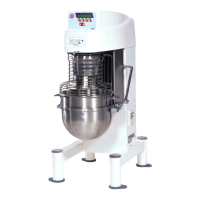
Overview of mixer functions, technical features, dimensions, and capacity details.
Details on the materials used for various parts of the mixer's construction.
Critical warnings for operation, maintenance, and prohibited actions to ensure user safety.
Guidelines on prohibited ingredients, unsuitable environments, and proper machine utilization.
Requirements for installation location, floor load, unpacking, and safe handling of the mixer.
Procedures for leveling the mixer using adjustable feet and ensuring stability.
Instructions for electrical hookup, safety device compliance, and pre-operation checks.
Best practices for loading ingredients, avoiding flour dust, and using PPE.
Steps for starting the mixer, programming the timer, and changing speeds during operation.
Guidance on safely unloading the bowl and its contents after mixing.
Explanation of stop buttons, cycle suspension, and safety grid interlocks for mixer operation.
Procedures for cleaning the mixer, including alimentary zones, electrical parts, and control panel.
What not to use during cleaning, such as high-pressure water or abrasive tools.
Instructions for cleaning the safety grid, noting exceptions for certain options.
Guidelines for cleaning splashing zones and handling cleaning products safely.
Step-by-step guide for changing the mixer's drive belt, including access and reassembly.
How to adjust belt tension and when to perform checks after initial use or replacement.
Detailed steps for fine-tuning the belt tension for optimal performance.
Instructions for lubricating grid rollers and the recommended grease type.
Solutions for common problems like the mixer not starting, stopping, or forcing.
Interpretation and resolution of specific error messages and faults displayed on the mixer.
Information on the buyer's responsibility for disposing of electrical and electronic waste.
Guidance on environmentally friendly disposal methods for various machine parts.
Details on the mixer's conformity to standards and the terms of the guarantee.
Information regarding transport, claims, and contact details for after-sales service.
An exploded view of the mixer showing major mechanical parts and their labels.
Identification of parts like the control panel, frame, bowl, and lifting mechanism.
Detailed diagrams and parts list for a specific sub-assembly of the mixer.
Parts list and diagrams for the planetary mixer frame (Bati batteur).
Diagram and parts list for the bowl cradle and its associated components.
Diagram and parts list for the system that detects the presence of the bowl.
Diagram and parts list for the mixer head assembly.
Diagram and parts list for the mixer's motorization and drive system.
Detailed diagram of the gearbox with numbered parts.
Parts breakdown for the right, left, and back roller grids.
Diagram and parts list for the mixer's lifting and lowering mechanism.
Diagrams and parts lists for the various mixing tools (spiral, beater, whip).
List of additional optional parts like stainless steel cradles, feet, and scrapers.
List of accessories such as transparent covers, trolleys, and heating systems.
Tables detailing tool reduction kits for various mixer models and equipment types.
Parts list for the bowl trolley accessory.
Installation, connection, and usage instructions for the electric heating system.
Installation and connection guidelines for the gas heating system.
Detailed electrical wiring diagrams for the PH202 and PH402 EV models.
Detailed electrical wiring diagrams for the PH602 EV model.

 To Next Page
 General