4.Advanced User Guidebook
6. In the right menu, press Hori (Hz) to make the symbol in front of the
frequency value, turn the M knob to adjust the horizontal position of FFT
waveform; then press to make the symbol in front of the frequency/div
below, turn the M knob to adjust the time base of FFT waveform.
7. Select Vertical in the right menu; do the same operations as above to set the
vertical position and voltage division.
To select the FFT window
■ There are 6 FFT windows. Each one has trade-offs between frequency
resolution and magnitude accuracy. What you want to measure and your source
signal characteristics help you to determine which window to use. Use the
following guidelines to select the best window.
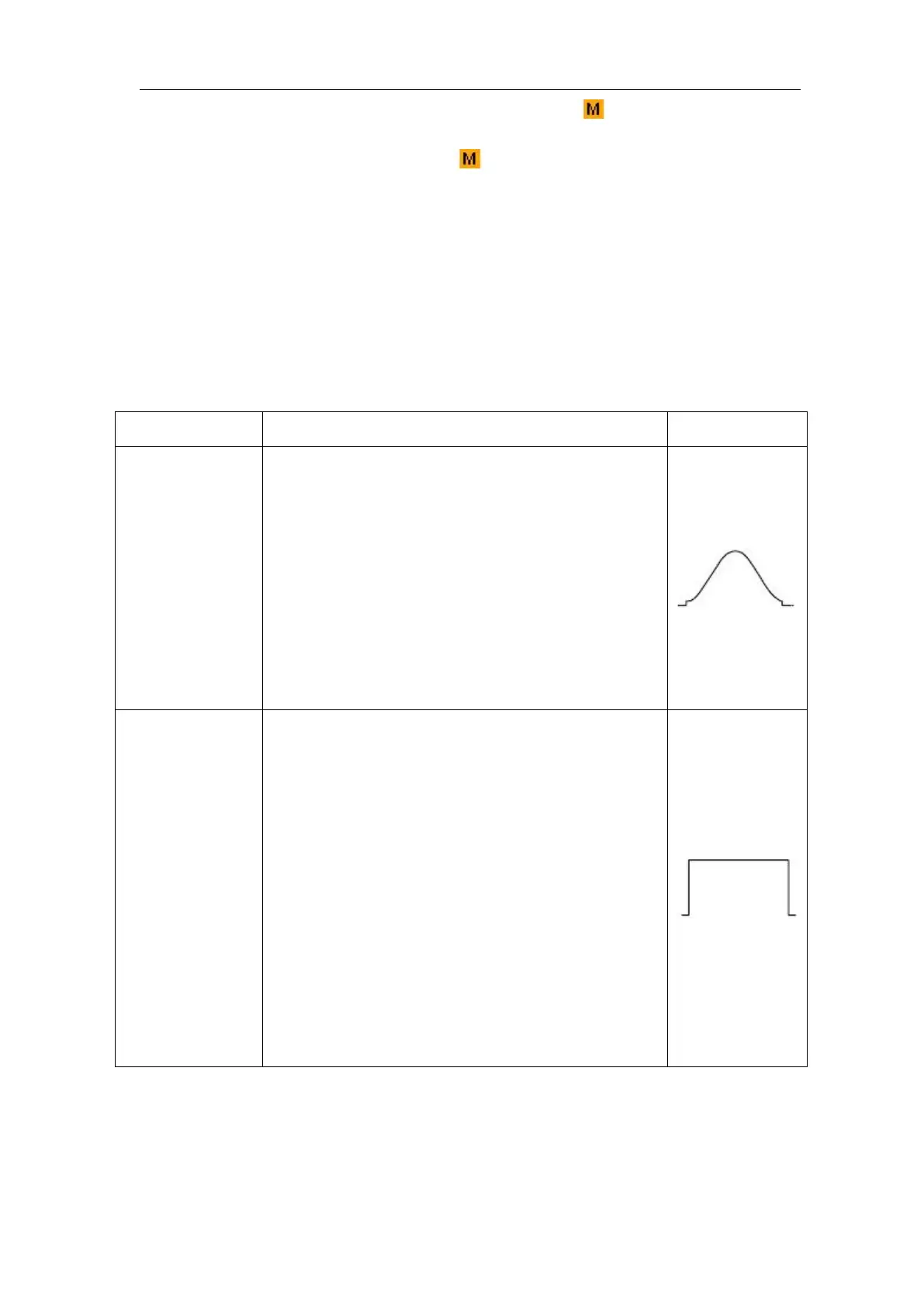
Better solution for magnitude than Rectangle,
and good for frequency as well. It has slightly
better frequency resolution than Hanning.
Recommend to use for:
Sine, periodic and narrow band random
noise.
Transients or bursts where the signal levels
before and after the event are significantly
different.
Best solution for frequency, worst for
magnitude.
Best type for measuring the frequency
spectrum of nonrepetitive signals and
measuring frequency components near DC.
Recommend to use for:
Transients or bursts, the signal level before
and after the event are nearly equal.
Equal-amplitude sine waves with
frequencies those are very close.
Broadband random noise with a relatively
slow varying spectrum.




 To Next Page