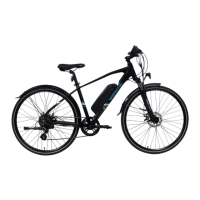
This document is a user manual for the WAYSCRAL ANYWAY E-100 power-assisted bicycle (VAE), also known as an electric bicycle. It provides comprehensive information on the correct use, adjustment, and maintenance of the bicycle, ensuring safe and optimal operation.
Function Description:
The WAYSCRAL ANYWAY E-100 is an adult electric bicycle designed for urban and suburban use. It is equipped with an electric pedal assistance system that complements the user's pedaling effort, making daily commutes easier, longer, and less strenuous. The motor activates as soon as the user starts pedaling and provides assistance up to a speed of 25 km/h. Beyond this speed, the motor stops, and the user must rely on their own effort. The assistance automatically resumes when the speed drops below 23 km/h and the user is pedaling. The motor will not function until a full turn of the pedal has been completed, a feature designed to protect the motor and controller and extend the lifespan of electrical components. The bicycle is not intended for off-road use, competition, or use on unpaved or damaged terrain. It is suitable for individuals over 14 years old, with parents responsible for ensuring safe use by children.
Important Technical Specifications:
- Maximum Weight (User + Load + Bicycle): 130 kg
- Maximum Weight (User + Load): 106.6 kg
- Maximum Speed with Assistance: 25 km/h
- Autonomy: 50 to 80 km (depending on various factors)
- Motorisation:
- Max Power: 250 W
- Voltage: 36V
- Maximum Noise during Use: < 60 dB
- Battery:
- Type: Lithium-ion
- Voltage: 36V
- Capacity: 13 Ah
- Weight: 3.2 kg
- Charge Time: 4 hours
- Number of Cycles (≥70% capacity): 500 cycles
- Charger:
- Input Voltage: 100-240V
- Output Voltage: 36 V
- Total Bicycle Weight: 23.4 kg
- Dimensions of the Bicycle: 700 (likely referring to wheel size in mm)
- Tyre/Wheel Size: 700 x 38 mm
- Warranty:
- Frame and forks: 5 years
- Electric components: 2 years (if maintained)
- Any other component: 2 years
Usage Features:
- LCD Display: The bicycle features an LCD display on the handlebars that shows various information, including:
- Battery voltage and charge level (100%, 80%, 60%, 40%, 20%, <25% with flashing icon).
- Current power consumption (indicated by segments, higher consumption means lower autonomy).
- Assistance mode (ECO, POWER, NORMAL).
- Pedestrian assistance indicator ("6KM" when activated, assisting up to 6 km/h).
- Trip information: Odometer (ODO), Time spent pedaling since switch-on (TIME), resettable mileage counter (TRIP1), and total kilometers traveled since switch-on (TRIP2).
- Control Box: A separate control box is provided, equipped with a 5V USB charging socket.
- Assistance Levels: Six levels of pedal assistance (1 to 6) can be selected using "+" and "-" buttons on the control box. Level 0 deactivates assistance. Higher levels (5-6) are suitable for slopes, headwinds, or heavy loads, while lower levels (1-2) are energy-saving modes.
- LCD Display Settings: The LCD display allows for various adjustments:
- Assistance mode selection (ECO, POWER, NORMAL).
- Resetting trip mileage.
- Setting maximum assistance speed (10 to 25 km/h).
- Selecting wheel diameter (16" to 28" - important for safety, should match installed wheels).
- Choosing speed unit (Km/h or MPH).
- Battery Handling:
- The battery is located on the diagonal tube and connects directly to the control box.
- The charge level can be checked by pressing a button on the battery itself, indicated by 4 LEDs.
- The battery can be inserted by sliding it along the rail and locked with a key. It can be removed by unlocking and sliding it out.
- Charging can be done directly on the bicycle or by removing the battery.
- Safety Features:
- Lighting System: Includes two reflectors (white front, red rear), a front light, a rear light, and two orange spoke reflectors. Reflective tires enhance side visibility.
- Bell: Installed on the handlebars, audible up to 50m.
- Helmet Use: Strongly recommended for safe use, and mandatory for children under 14 years old (riders or passengers).
- Brakes: Front and rear mechanical disc brakes. The right lever activates the rear brake, and the left lever activates the front brake. Braking force distribution of 60/40 (front/rear) is recommended. Brake levers should not contact handlebars, and cables should run smoothly.
- Suspension: The fork has two positions: rigid (locked) and flexible (unlocked), adjustable via a blue dial. Locking is recommended on flat surfaces, unlocking on uneven paths.
- Kickstand: Must be folded up before riding.
Maintenance Features:
- Regular Maintenance: The bicycle requires regular maintenance for safety and longevity. Mechanical components should be checked periodically for wear and replaced with original parts if necessary.
- Cleaning: To prevent corrosion, the bicycle should be rinsed with fresh water after each use, especially if exposed to sea air. Cleaning should be done with a sponge, warm soapy water, and a low-pressure water jet. High-pressure cleaners are not recommended.
- Lubrication: Essential for moving components to prevent corrosion. The chain should be oiled regularly, sprockets and chainrings brushed, and a few drops of oil applied to brake and derailleur cable housings. Components should be cleaned and dried before lubrication.
- Regular Checks:
- Bolts and Nuts: Check tightening torques for levers, cranks, pedals, and stem. Specific torques are provided for various components (e.g., pedals on crank arms: 30-40 Nm, crank arm on bottom bracket: 30-40 Nm, stem/handlebar: 6-9 Nm, headset: 14-15 Nm, brake lever: 6-8 Nm, brake calipers: 6-8 Nm, seat on carriage: 18-20 Nm, seat post clamp: quick clamp, wheel: 30 Nm or quick clamp).
- Tires: Regularly check pressure, wear, cuts, cracks, and pinching. Replace if necessary.
- Rims: Check for excessive wear, warping, dents, and cracks.
- Revisions:
- First Revision (1 month or 150 km): Check tightening of components (crank arm, wheel, stem, pedals, handlebars, seat clamp), electric assistance function, brake adjustment, wheel tension/truing, and tire pressure.
- Annual Revision (or every 2000 km): Check wear levels (brake pads, gear system, tires), electric assistance function, bearings (bottom bracket, wheels, steering, pedals), cables (brakes, derailleur, suspension), lighting, wheel tension/truing, and tire pressure.
- Every 3 Years (or 6000 km): Check wear levels (transmission, tires), bearings (bottom bracket, wheels, steering, pedals), cables (brakes, derailleur, suspension), change transmission (chain, freewheel, chainring), check electric assistance function, change tires, check wheel wear (spokes, rim), spoke tensioning/wheel straightening, change brake pads, check electric assistance function, and check electrical functions.
- Battery Maintenance:
- Charge regularly or after each use.
- Avoid hot places (ideal charging temperature 20°C).
- Allow battery to cool for 30 minutes after use.
- Store in a dry, protected place between 5°C and 35°C if not used frequently, and fully charge monthly.
- Do not expose to heat, direct sunlight, liquids, or metal objects.
- Do not disassemble or modify the battery.
- Dispose of used batteries at authorized recycling points.
- Motor and Controller Maintenance:
- Do not use the bicycle in flooded areas or thunderstorms.
- Avoid shocks to the motor.
- Protect the controller from water ingress and submersion. If water is suspected, turn off the battery and resume use without assistance once dry.
- Do not shake, knock, or drop the controller.
- Do not open, modify, or adjust the controller housing, as this will void the warranty.
- Any modification to electrical management system parameters, especially speed limit changes, is strictly prohibited and will void the warranty.
The manual also includes a basic troubleshooting guide for common issues related to pedaling assistance, battery autonomy, and charger functionality.

 Need help?


 To Next Page
 General