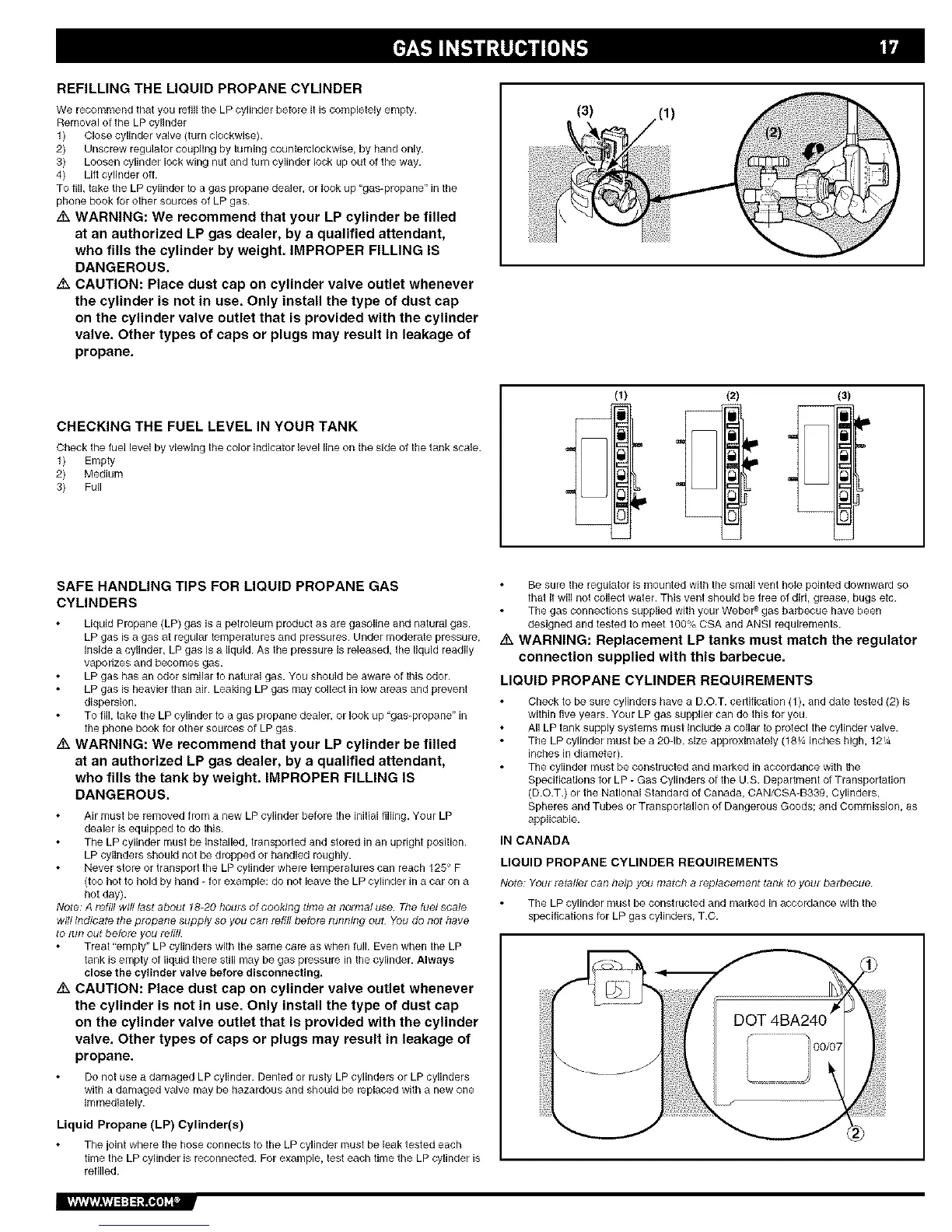
REFILLING THE LIQUID PROPANE CYLINDER
We recommend that you refill the LPcylinder before JtJscompletetyempty.
Removal of the LP cylinder
1) Closecylinder valve (turn clockwise).
2) Unscrew regulator coupling by turning counterclockwise, by hand only.
3) Loosen cylinder lock wing nut and turncylinder lock up out of the way.
4) Lift cylinder oft.
To till take the LP cylinder to a gas propane dealer, or look up "gas-propane" Jnthe
phone book for other sources of LP gas.
,!', WARNING: We recommend that your LP cylinder be filled
at an authorized LP gas dealer, by a qualified attendant,
who fills the cylinder by weight. IMPROPER FILLING IS
DANGEROUS.
,!', CAUTION: Place dust cap on cylinder valve outlet whenever
the cylinder is not in use. Only install the type of dust cap
on the cylinder valve outlet that is provided with the cylinder
valve. Other types of caps or plugs may result in leakage of
propane,
(3)
CHECKING THE FUEL LEVEL IN YOUR TANK
Check the fuel level by viewing the color indicator level line on the side of the tank scale.
1) Empty
2) Medium
3) Full
(t) (2) (3)
SAFE HANDLING TIPS FOR LIQUID PROPANE GAS
CYLINDERS
Liquid Propane (LP) gas isa petroleum product as are gasoline and natural gas.
LP gas isa gas at regular temperatures and pressules. Under moderate pressure,
inside a cylinder, LP gas isa liquid.As the pressure Jsreleased,the liquid readily
vaporizes and becomes gas.
LP gas has anodor similarto natural gas. You should be aware of this odor.
LP gas Jsheavierthan air. Leaking LP gas may collect Jnlow areas and prevent
dispersion.
To fill, take the LP cylinder to a gas propane dealer, or look up "gas-propane" in
the phone book for other sources of LP gas.
A', WARNING: We recommend that your LP cylinder be filled
at an authorized LP gas dealer, by a qualified attendant,
who fills the tank by weight. IMPROPER FILLING IS
DANGEROUS.
Air must be removed from a new LP cylinder before the initial filling. Your LP
dealer isequipped to do this.
The LP cylinder must beinstalled,transported and stored inan upright position.
LP cylinders should notbe dropped or handled roughly.
Never store or transport the LP cylinder where temperatures can reach 125° F
(too hot to hold by hand - for example: do not leave the LP cylinder in acar on a
hot day).
Note: A refill will last about 18-20 hours ofcooking time at normal use The fuelscale
will indicate the propane supply so you can refill before running OULYOUdo not have
torun out before you refill
Treat "empty" LP cylinders with the same care as whenfull. Even when the LP
tank is empty of liquid there still may be gas pressure in the cylinder. Always
close the cylinder valve before disconnecting.
Ak CAUTION: Place dust cap on cylinder valve outlet whenever
the cylinder is not in use. Only install the type of dust cap
on the cylinder valve outlet that is provided with the cylinder
valve, Other types of caps or plugs may result in leakage of
propane.
Do not use a damaged LP cylinder. Dented or rusty LP cylinders or LP cylinders
with a damaged valve may be hazardous and should be replaced with a new one
immediately.
Liquid Propane (LP) Cylinder(s)
The joint where the hose connects to the LP cylinder must be leak tested each
time the LP cylinder is reconnected. For example, test each time the LP cylinder is
retiiied.
Be sure the regulator is mounted with thesmall vent hole pointed downward so
that it will notcollect water. This vent should be free ofdirt, grease, bugs etc.
The gas connections supplied with your Webe_ gas barbecue have been
designed and tested to meet 100% CSA and ANSI requirements.
.4', WARNING: Replacement LP tanks must match the regulator
connection supplied with this barbecue.
LIQUID PROPANE CYLINDER REQUIREMENTS
Check to be sure cylinders have a D.O.T. cedification (1), and date tested (2) is
within five years. Your LP gas supplier can do this for you.
All LP tank supply systems must include a collar to protect the cylinder valve.
The LP cylinder must be a 20db. size approximately (18!:_ inches high, 12,4
inches in diameter).
The cylinder must be constructed and marked in accordance with the
Specifications tor LP - Gas Cylinders of the U.S. Department of Transportation
(D.O.T.) or the National Standard of Canada, CAN/CSA-B339, Cylinders,
Spheres and Tubes or Transportation of Dangerous Goods; and Commission, as
applicable.
IN CANADA
LIQUID PROPANE CYLINDER REQUIREMENTS
Note: Your retailer carl help you match a replacement tank to your barbecue
The LP cylinder must be constructed and marked in accordance with the
specifications for LP gas cylinders, T.C.




 To Next Page