Fuel System
The
generator must
have
its
own
fuel
supply line;
in
other
words,
it
must
have
its
own
pickup
tubes
and
primaryfilter/Water separator.
DO
NOT
tee
off another engine's
fuel
supply.
Installations with the
fuel
tank(s)
at or above the generator with the
fuel
supply lines to the engine's carburetor routed below the
level
of
the
fuel
tank's top must
have
a
means
of shutting off the
fuel
to the generator's
engine
when
the
engine
is
not
running.
This
installation procedure helps
guard
against the possibility of gasoline siphoning through this
supply line into the engine through the carburetor,
should
the carburetor float
needle
valve
stick
in
the
open
position or not
seat
properly, or
should
the
fuel
line rupture
between
the
engine
and
fuel
tank.
This
(anti-siphon) shut-off
valve
can
be
electrically-operated
(with
manual
override) to
open
when
the
gen-
erator's engine
is
started, orwhen it
is
shut
down.
A manually-operated
valve
can
also
be
installed
and
should
be
operationable from the generator's start/stop
panel
or from
the
vessel's deck. I nstallations
where
the
gen-
erator
is
located above the
fuel
tank(s), whereby the routing of the
fuel
supply line to the generator's
car-
buretor
remains
above the top
level
of the
fuel
tank,
do not require this (anti-siphon) shut-off
valve.
A
manually-operated service
shut
-off
valve
should
be
located
between
the
fuel
pickup at the tank
and
the
ser-
vice shut-off
valve
located at the
fuel
connection to the generator.
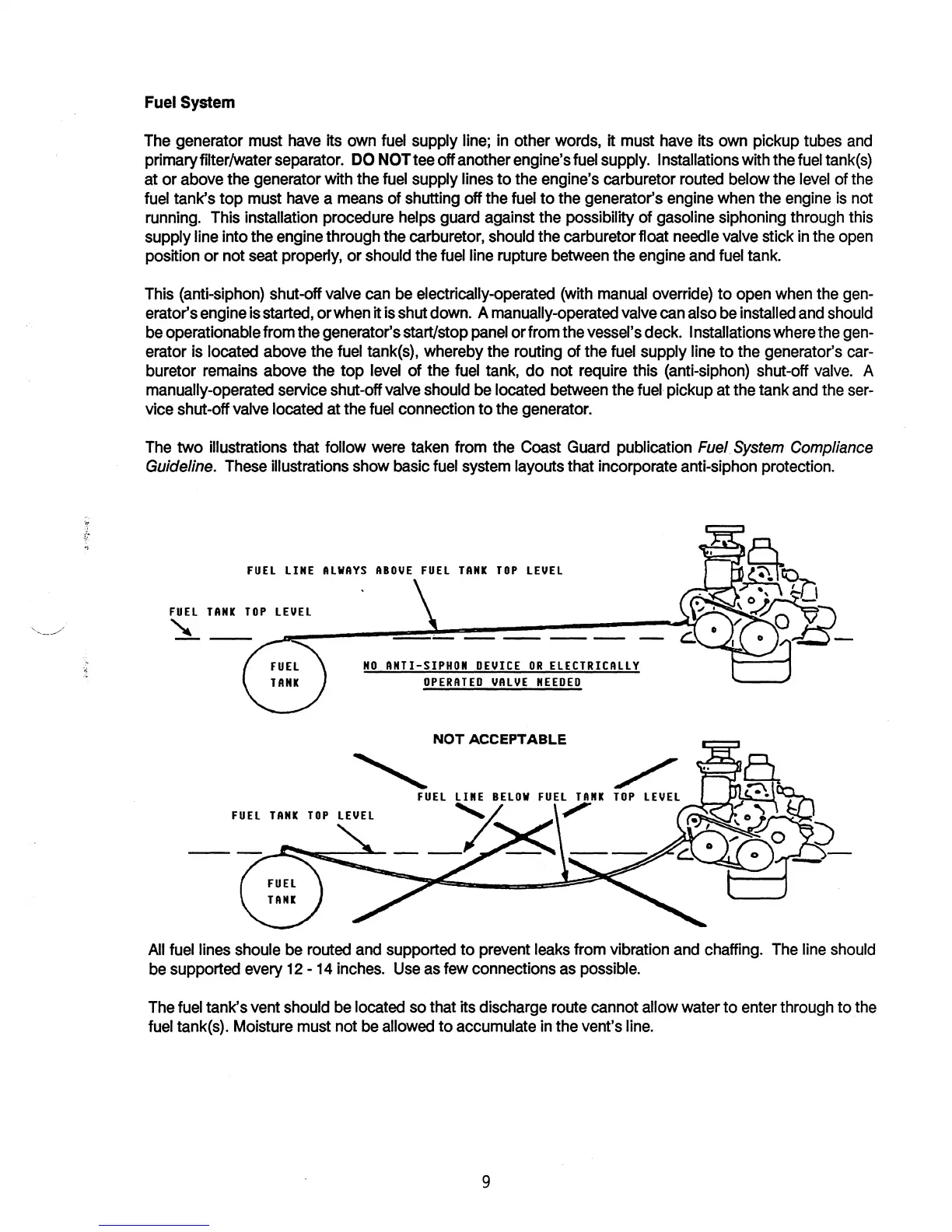
The
two illustrations that follow
were
taken
from
the
Coast
Guard
publication Fuel. System Compliance
Guideline.
These
illustrations show basic
fuel
system
layouts that incorporate anti-siphon protection.
FUEL
LINE
ALWAYS
ABOVE
FUEL
TANK
TOP
LEVEL
TOP
LEVEL
---'
-
--
--
--
--
--
NO
ANTI-SIPHON
DEVICE
OR
ELECTRICALLY
OPERATED
VALVE
HEEDED
NOT
ACCEPTABLE
FUEL
TANK
TOP
LEVEL
All
fuel
lines
shoule
be
routed
and
supported to
prevent
leaks
from
vibration
and
chaffing.
The
line
should
be
supported every
12
-
14
inches.
Use
as
few
connections
as
possible.
The
fuel
tank's vent
should
be
located
so
that its discharge route cannot allow water to enter through to
the
fuel
tank(s). Moisture must not
be
allowed to accumulate
in
the vent's
line.
9



 To Next Page