CONTROL
PANELS
DESCRIPTION
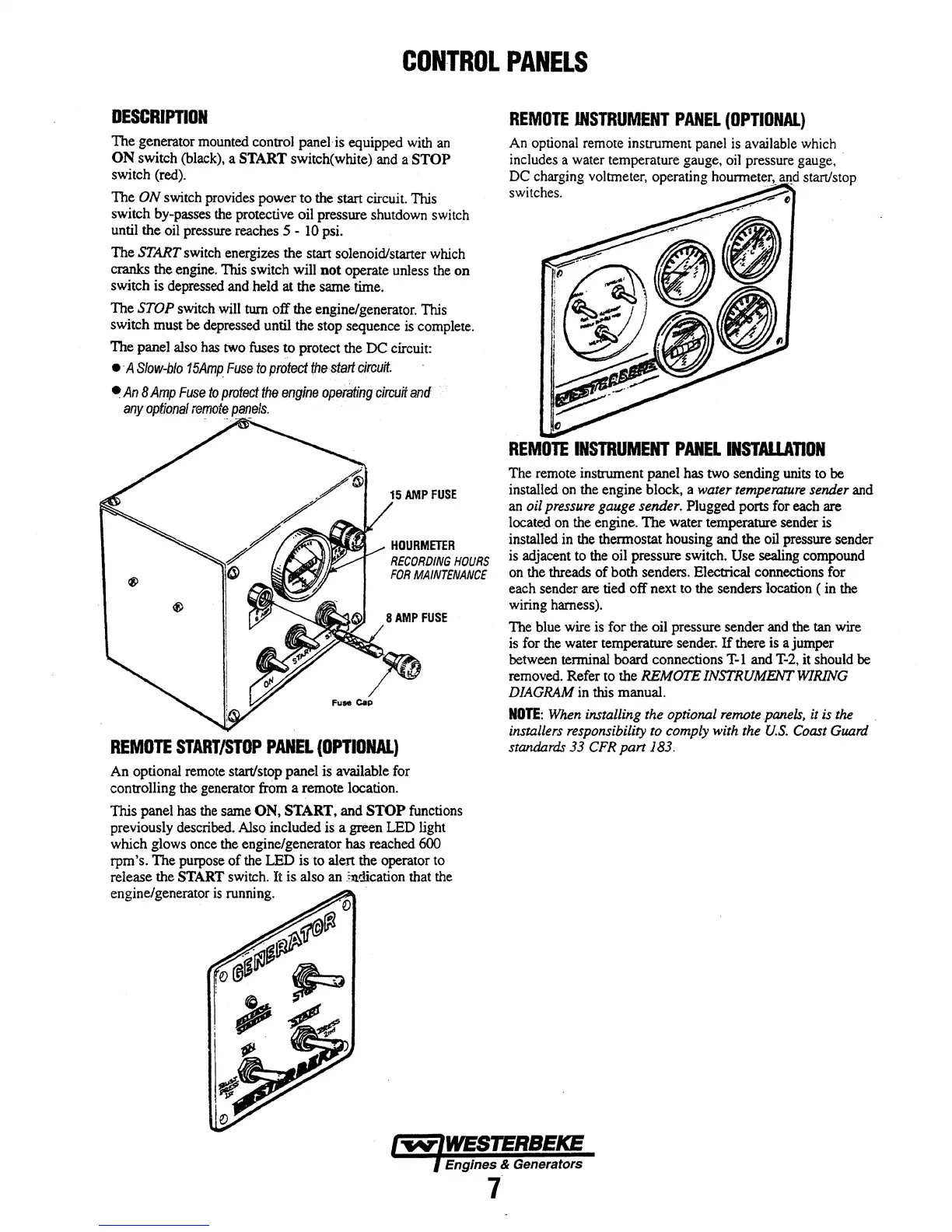
The generator mounted control
panelis
equipped with
an
ON
switch (black), a START switch(white) and a
STOP
switch (red).
The
ON
switch provides power
to
the start circuit.
nus
switch by-passes the protective oil pressure shutdown switch
until the oil pressure reaches 5 -
10
psi.
The
START switch energizes the start solenoid/starter which
cranks the engine. This switch will
not
operate unless the
on
switch is depressed and held at the same time.
The
STOP switch will twn
off
the engine/generator.
nus
switch must
be
depressed until the stop sequence
is
complete.
The
panel also has two fuses to protect the
DC
circuit:
•·A
Stow-blo
15Amp
Fuse
to
protect
the
start
circuit.
•An
8
Amp
Fuse
to
protect
the
engine
operating
circuff
ancf
any
optional
remote.
~a'!_efs.
15
AMP
FUSE
HOURMETER
RECORDING
HOURS
FOR
MAINTENANCE
8
AMP
FUSE
REMOTE
START/STOP
PANEL
(OPTIONAL)
An
optional remote start/stop panel is available for
controlling the generator from a remote location.
This panel has the same ON, START, and STOP functions
previously described. Also included is a green LED light
which glows once the engine/generator has reached
600
rpm's. The purpose
of
the LED is to alert the operator to
release the
START switch. It is also an .'ndication that the
engine/generator
is
running.
REMOTE
INSTRUMENT
PANEL
(OPTIONAL}
An optional remote instrument panel is available which
includes a water temperature gauge, oil pressure gauge,
DC charging voltmeter, operating hourmeter
•.
aQd
start/stop
switches.
·
REMOTE
INSTRUMENT
PANEL
INSTALLATION
The remote instrument panel has two sending
units
to
be
installed on the engine block, a water temperature sender and
an
oil pressure gauge sender. Plugged ports for each are
located on the engine.
The
water temperature sender is
installed in the thennostat housing and the oil pressure sender
is adjacent to the oil pressure switch.
Use sealing compound
on the threads
of
both senders. Electrical connections for
each sender are tied
off
next to the senders location ( in
the
wiring harness).
The blue wire is for the oil pressure sender and the
tan wire
is for the water temperature sender.
If
there is a jumper
between terminal board connections
T-1
and
T-2,
it should
be
removed. Refer to the REMOTE INSTRUMENT WIRING
DIAGRAM
in this manual.
NOTE:
When
installing the optional remote panels, it is
the
installers responsibility to comply with the
U.S.
Coast Guard
standards
33
CFR
part 183.
Engines & Generators
7



 To Next Page