Locating Wall Furnace & Thermostat (Con't)
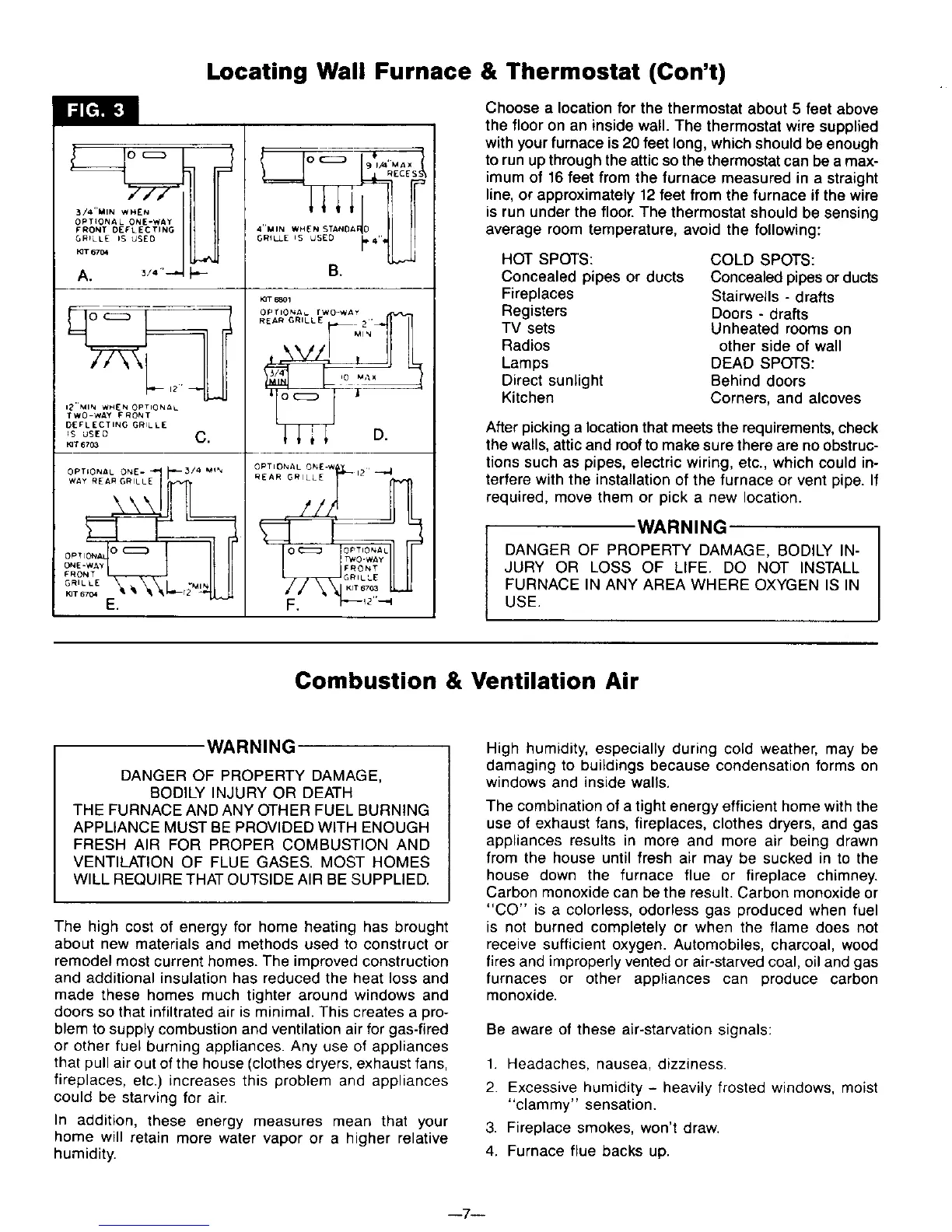
_/4"MIN WHEN
OPTIONAL ONE-WAY
FRONT DEFLECTING
GRILLE IS USED
....,%
A. 3/4 "_- _
12 ¸' _
12"MIN WHEN OPTIONAL
T W0 -WAY F_ONT
DEFL [CTING GRILLE
rS USED C.
FJT 67_
OPTIONAL ON[- _'_ I,_- 3/4 MI%
WAY f_EAR GRILLE
0PTIONAo__
_IE-WAy
FRONT
GRILL[ -MI N
r2
E.
0 _ I_llM A X
GRIU-E IS US[D 1_4" _
B.
KIT I_01
OP_IONA_ rWO-WA_ _.
REAR GRILLE 2 ¸'_ I
D.
;_
Choose a location for the thermostat about 5 feet above
the floor on an inside wall. The thermostat wire supplied
with your furnace is 20 feet long, which should be enough
to run up through the attic sothe thermostat can be a max-
imum of 16 feet from the furnace measured in a straight
line, or approximately 12 feet from the furnace if the wire
is run under the floor. The thermostat should be sensing
average room temperature, avoid the following:
HOT SPOTS:
Concealed pipes or ducts
Fireplaces
Registers
TV sets
Radios
Lamps
Direct sunlight
Kitchen
COLD SPOTS:
Concealed pipes or ducts
Stairwells - drafts
Doors - drafts
Unheated rooms on
other side of wall
DEAD SPOTS:
Behind doors
Corners, and alcoves
After picking a location that meets the requirements, check
the walls, attic and roof to make sure there are no obstruc-
tions such as pipes, electric wiring, etc., which could in-
terfere with the installation of the furnace or vent pipe. If
required, move them or pick a new location.
WARNING
DANGER OF PROPERTY DAMAGE, BODILY IN-
JURY OR LOSS OF LIFE. DO NOT INSTALL
FURNACE IN ANY AREA WHERE OXYGEN IS IN
USE.
Combustion & Ventilation Air
WARNING
DANGER OF PROPERTY DAMAGE,
BODILY INJURY OR DEATH
THE FURNACE AND ANY OTHER FUEL BURNING
APPLIANCE MUST BE PROVIDED WITH ENOUGH
FRESH AIR FOR PROPER COMBUSTION AND
VENTILATION OF FLUE GASES. MOST HOMES
WILL REQUIRE THAT OUTSIDE AIR BE SUPPLIED.
The high cost of energy for home heating has brought
about new materials and methods used to construct or
remodel most current homes. The improved construction
and additional insulation has reduced the heat loss and
made these homes much tighter around windows and
doors so that infiltrated air is minimal. This creates a pro-
blem to supply combustion and ventilation air for gas-fired
or other fuel burning appliances. Any use of appliances
that pull air out of the house (clothes dryers, exhaust fans,
fireplaces, etc.) increases this problem and appliances
could be starving for air.
In addition, these energy measures mean that your
home will retain more water vapor or a higher relative
humidity.
High humidity, especially during cold weather, may be
damaging to buildings because condensation forms on
windows and inside walls.
The combination of a tight energy efficient home with the
use of exhaust fans, fireplaces, clothes dryers, and gas
appliances results in more and more air being drawn
from the house until fresh air may be sucked in to the
house down the furnace flue or fireplace chimney.
Carbon monoxide can be the result. Carbon monoxide or
"CO" is a colorless, odorless gas produced when fuel
is not burned completely or when the flame does not
receive sufficient oxygen. Automobiles, charcoal, wood
fires and improperly vented or air-starved coal, oil and gas
furnaces or other appliances can produce carbon
monoxide.
Be aware of these air-starvation signals:
1. Headaches, nausea, dizziness.
2. Excessive humidity - heavily frosted windows, moist
"clammy" sensation.
3. Fireplace smokes, won't draw.
4. Furnace flue backs up.
--7--



 To Next Page