Combustion & Ventilation Air (cont.)
AIR REQUIREMENTS
The requirements for providing air for combustion and
ventilation are listed in the National Fuel Gas Code NFPA
54/ANSI Z223.1 (in Canada: CAN/CGA B149). Most homes
will require that outside air be supplied to the furnace area
by means of ventilation grilles or ducts connecting direct-
ly to the outside or spaces open to the outdoors such as
attic or crawl space. The only exception is when the fur-
nace area meets the requirements and definitions for an
unconfined space with adequate air infiltration.
WARNING
DANGER OF PROPERTY DAMAGE,
BODILY INJURY OR DEATH
THE FURNACE AND ANY OTHER FUEL BURNING
APPLIANCE MUST BE PROVIDED WITH ENOUGH
FRESH AIR FOR PROPER COMBUSTION AND
VENTILATION OF FLUE GASES. MOST HOMES
WILL REQUIRE THAT OUTSIDE AIR BE SUPPLIED.
All air openings and connecting ducts must comply with
the following:
IF THE FURNACE IS INSTALLED IN AN AREA WITH
ANOTHER GAS APPLIANCE(S), THE TOTAL INPUT
RATING OF ALL APPLIANCES MUST BE CONSIDERED
WHEN DETERMINING THE FREE AREA RE-
QUIREMENTS FOR COMBUSTION AND VENTILATION
AIR OPENINGS.
Ducts must have the same cross-sectional area as the free
area of the openings to which they connect.
The minimum dimension of rectangular air ducts must not
be less than 3 inches.
LOUVERS / GRILLES AND SCREENS
COVERING FREE AREA OPENINGS
If screen is used to cover opening(s), it must not be smaller
than 1/4 inch mesh. Use the free area of a louver or grille
to determine the size opening required to provide the free
area specified. If the free area is not known, assume a
20% free area for wood and a 60% free area for metal
louvers or grilles.
EXAMPLE 1.
FURNACE LOCATED IN UNCONFINED SPACE.*
*An unconfined space must have a volume of a minimum
50 cubic feet per 1000 Btuh of total of all appliances in
area. Adjoining rooms may be included only if there are
no doors between the rooms, or if special provisions are
made such as ventilation grilles installed between con-
necting rooms.
Fig 6, page 9 shows the minimum area in square feet, bas-
ed on 8 foot ceiling heights, required for different Btuh
input ratings.
A. If your furnace is in an open area (unconfined space*)
the air that leaks through the cracks around doors and
windows may be enough for combustion and ventila-
tion air. The doors should not fit tight. The cracks
around windows should not be caulked or weather
stripped.
To determine if infiltration air is adequate, perform the
following checks:
1. Close all doors and windows. If you have a fire-
place, start a fire and wait until flames are burning
vigorously.
DRAFT HOOD SPILLAGE
VENT PIPE
DRAFT HOOD
__MATCH
WATER
HEATER
__L
I
WALL
FURNACE
MATCH
DRAFT
HOOD
OPENING
2,
3,
Turn on all exhausting devices, such as:
- kitchen and bathroom exhaust fans
- dryers (gas and electric)
Turn on all vented gas appliances, such as:
- heating equipment (includes any room heaters)
- water heaters
4. Wait ten (10) minutes for drafts to stabilize.
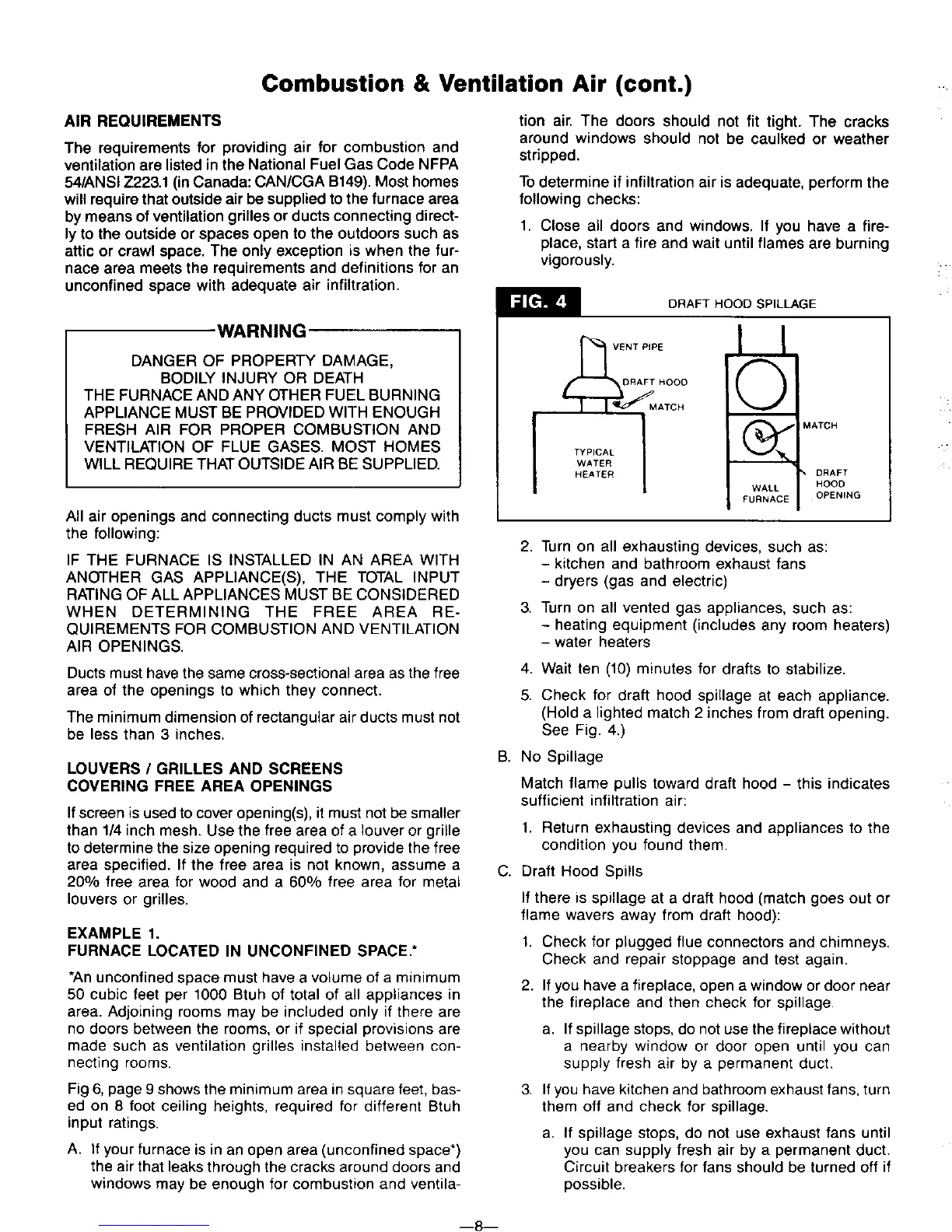
5. Check for draft hood spillage at each appliance.
(Hold a lighted match 2 inches from draft opening.
See Fig. 4.)
B. No Spillage
Match flame pulls toward draft hood - this indicates
sufficient infiltration air:
1. Return exhausting devices and appliances to the
condition you found them.
C. Draft Hood Spills
If there is spillage at a draft hood (match goes out or
flame wavers away from draft hood):
1. Check for plugged flue connectors and chimneys.
Check and repair stoppage and test again.
2. If you have a fireplace, open a window or door near
the fireplace and then check for spillage.
a. If spillage stops, do not use the fireplace without
a nearby window or door open until you can
supply fresh air by a permanent duct.
3. Ifyou have kitchen and bathroom exhaust fans, turn
them off and check for spillage.
a. If spillage stops, do not use exhaust fans until
you can supply fresh air by a permanent duct.
Circuit breakers for fans should be turned off if
possible.
m8--



 To Next Page