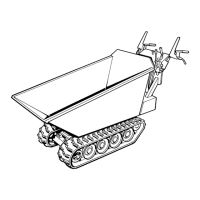
Gradients
IMPORTANT: Read the notes in “Safe
Working” and also remember the
following:
Slippery or loose surface conditions can
adversely affect safe machine
operation, particularly on gradients.
ALWAYS choose routes that avoid
steep, slippery or loose gradients.
NEVER park the machine on a
gradient.
NEVER attempt to turn on, or drive
across, a gradient.
ALWAYS drive forwards up gradients
when loaded.
ALWAYS reverse down gradients when
loaded.
NEVER tow up or down gradients.
NEVER operate on a gradient which
exceeds 25% (1 in 4), or across
gradients which exceed 16% (1 in
6). This should be reduced where
surfaces are wet or unstable.
NEVER operate high discharge or
rotating skip options on gradients.
Braking
Dumpers with hydraulically operated
brakes
The brake pedal operates a hydraulic
master cylinder that supplies oil to brakes
within the front axle. (Brakes fitted within
the rear axle are an option.)
The handbrake operates a caliper that
acts upon a disc mounted on the
transmission.
Engaging gear lever
When changing gear, always depress the
clutch pedal before moving the gear lever
from one gear to another.
Stopping the dumper
IMPORTANT: Never make unnecessary
‘crash’ stops when travelling at speed,
especially in forward direction.
Release accelerator and brake to a halt
progressively.
Select neutral gear.
Apply parking brake when stationary.
Stop the engine. Turn the starter key to
the ‘OFF’ position, and remove the key.
Leaving the dumper
Ensure the machine is parked on firm,
level ground. Do not park on a gradient.
Check that the parking brake is applied.
Ensure that the skip is fully lowered.
With the engine stopped, operate the skip
hydraulic control lever fully in each
direction several times to ‘dump’ hydraulic
pressure from the system.
Remove starter key (where fitted) from
switch.
Electric start dumpers: If unattended for
some time, remove earth cable from
battery, or activate the Battery Isolator,
(where fitted).
2.10 OPERATION
DRIVING THE DUMPER


 To Next Page