
 Need help?
Do you have a question about the Yamaha 301 and is the answer not in the manual?
Explains Yamaha electronic product safety labels and graphic symbols.
Essential safety precautions for power supply and cord usage.
Caution against opening the instrument due to user-serviceable parts.
Safety instructions regarding exposure to water and moisture.
Precautions to prevent fire hazards related to the unit.
Instructions to follow in case of instrument malfunction or smoke.
Basic precautions for handling power plugs and cords safely.
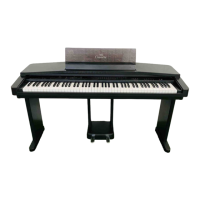
Identification and brief explanation of the instrument's panel controls.
Detailed mapping of panel controls to their functions and page numbers.
Instructions for playing the Clavinova's various voice types.
Guidance on playing back and practicing with preset songs.
How to use repeat playback for practicing difficult song sections.
Using performance assistant technology to play backing parts with songs.
How to use auto accompaniment (Style Playback) by playing chords.
How One Touch Setting automatically selects appropriate panel settings for a style.
Using Music Finder to find and apply appropriate panel settings for songs.
Guidance on singing along with songs, including karaoke features.
Steps for connecting a microphone to the instrument.
How to automatically add harmony vocals to your voice.
Instantly accessing desired displays using the Direct Access function.
Explanation of the Main and File Selection displays and their segments.
How to perform operations like saving, copying, deleting, and renaming files/folders.
Instructions on how to save created songs or voices to files.
How to reset the instrument's settings to factory defaults.
Resetting specific categories of settings to factory defaults.
How to save and recall all original settings as a single file.
Recommendations for backing up important data to external media.
How to play multiple voices simultaneously for richer sounds.
How to transpose and fine-tune the instrument's pitch.
How to add depth and expression to sounds using effects.
Controlling keyboard parts and song/style channels via the Mixing Console.
Guide to creating custom voices by editing parameters.
Settings related to style playback, including split points and timing.
Adjusting volume and tonal balance for style parts via the Mixing Console.
Using Music Finder to call up pre-programmed panel settings for songs.
Guide to creating and editing custom styles.
Methods for creating a new style: Realtime Recording, Step Recording, Style Assembly.
Basic operations for editing styles created via Realtime, Step, or Assembly.
How to edit data, delete events, and apply quantize settings per channel.
How to save panel settings to Registration Memory buttons.
Using Registration Sequence to play back setups in a specified order.
Detailed operations for starting, stopping, and controlling song playback.
Combining auto accompaniment with song playback.
Adjusting volume and voice balance for song channels in the Mixing Console.
How to use the guide function with keyboard lamps and microphone.
Overview of different recording methods: Quick, Multi Track, Step.
Recording multiple instrument parts to different channels.
Basic operations for editing recorded songs.
How to re-record specific sections of a song using Punch In/Out.
Editing channel events like data deletion and transposition.
Changing or deleting recorded notes and chords.
How to change tempo, time signature, and other system events.
Brief guide to creating and editing Vocal Harmony types.
Adjusting microphone and harmony sound settings.
Instructions for connecting the Clavinova to the internet.
How to access the special Clavinova website for data downloads.
Information on purchasing and downloading data from the website.
How to reset all internet settings to their default values.
Connecting computers and USB devices via USB TO HOST and MIDI terminals.
Making MIDI-related settings for the instrument.
Solutions for common problems encountered with the Clavinova.
 General
| Type | Flute |
|---|---|
| Key | C |
| Model | YFL-301 |
| Footjoint | C |
| Case Included | Yes |
| Material | Nickel Silver |
| Category | Student |
| Body Material | Nickel Silver |
| Headjoint Material | Nickel Silver |
| Finish | Silver Plated |
| Key Type | Covered |



 To Next Page