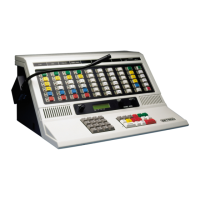
Operating Button-Based Consoles
46 025-9535L
The console waits up to 1.5 seconds for dial tone audio.
If audio is detected, the specified page is sent, and the telephone becomes active as
described above.
If no audio is detected, the telephone is put back on hook and the page aborted. If the
designated telephone channel is currently locked out by another position, the page is
aborted. When an Instant Call page designates the selected channels as the destination and
at least one telephone channel is active, the page is immediately sent to the telephone. No
KeyUp delay occurs. If an Instant Call page designates a mixture of radio and telephone
channels as the destination, the radio channels are ignored and only the telephone channels
are processed.
ANI Operation
Automatic number identification (ANI) allows a calling party to transmit a unique
identification code and have it displayed on the console. ANI operation requires that one
of several options be installed. ANI detection may be done on the selected channel only or
on a specific channel, or channels. ANI may be DTMF, 5/6 tone, SS1, GE-Star, or MDC-
1200 signaling.
There are two modes of ANI operation: Reverse Selective Calling (RSC) and PTT ID. The
console ANI operating mode (RSC or PTT ID) is determined by the CPS programming. If
neither a primary nor a secondary ANI address is programmed, the console operates in the
PTT ID ANI mode. If either a primary or secondary ANI address is programmed, the
console operates in the RSC mode.
Reserve Selective Calling Mode
When a valid ANI is received, the console beeps and display the number of the calling unit
bracketed by dashes (-XXXXXX-). If the number is longer than six digits, only the last six
digits are retained. If the calling unit’s channel is muted, it automatically is unmuted to
allow the audio from the calling party to be heard (this can be changed with CPS). If
additional ANIs are received, the console stores them in an internal ANI stack. A
maximum of 24 ANIs can be stored in the stack. The current number of ANIs in the stack
is displayed next to the “-XXXXXX-” display.
When the console’s ANI stack contains only one ANI, the ANI REVIEW button’s red
LED turns on. If the ANI stack contains two or more ANIs, the LED flashes. Each press of
the ANI REVIEW button removes the current ANI from the stack (the one being
displayed) and display the next oldest ANI until the stack is empty, at which time all ANI
information is removed, the time and date are redisplayed, and the ANI REVIEW LED
goes off.
If a channel has been programmed with an ANI SOURCE button, its red LED turns on if
the displayed ANI is from that channel. If the ANI stack contains an ANI from a channel
but it is not currently being displayed, that channel’s LED blinks. When there are no more
ANIs in the stack for a channel, then its LED turns off. This can be useful if a different
channel is selected after one or more ANIs have already been received.



 To Next Page