
 To Next Page
J
James WhiteheadJul 26, 2025
What to do if recording source is not selected correctly on Zoom Computer Hardware?
- JJennifer HardingJul 26, 2025
If the recording source is not selected correctly, set the SOURCE parameter to a suitable setting.

What to do if recording source is not selected correctly on Zoom Computer Hardware?
If the recording source is not selected correctly, set the SOURCE parameter to a suitable setting.
What to do if recording/playback is not possible in sampler mode on Zoom Computer Hardware?
If recording or playback is not possible in sampler mode, turn the system on as described in "Preparations", and follow the instructions in "Getting Connected". Also, try replacing the cable.
Covers power, environment, handling, alterations, and connection safety guidelines.
Addresses electrical interference and proper cleaning procedures for the unit.
Describes versatile effects, distortion, easy edit, and MIDI capabilities.
Covers sampler, jam play, and the extensive patch library.
Details the editing software and the unit's stage-ready hardware design.
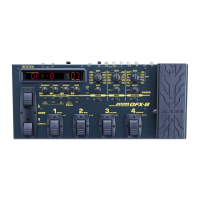
Identifies all controls and indicators on the top panel of the GFX-8.
Details rear panel jacks, ports, and the power connection.
Explains effect modules, parameters, and the signal flow diagram.
Describes the organization of patches in memory across groups and banks.
Lists and briefly explains the different operating modes: play, manual, edit, jam play, sampler.
Defines the concept of real-time parameter control using expression pedal or MIDI.
Details the standard setup for connecting a guitar to an amplifier.
Explains connecting to a guitar amplifier's power amp input jack.
Details connecting CD/MD players for practice or sampling.
Provides steps for safely powering on the unit and connected equipment.
Sets up amp simulation to match various connection types for optimal sound.
Instructions on how to select and switch through patches and banks.
Using the expression pedal for real-time effect parameter adjustment.
Adjusting effects and parameters quickly without entering full edit mode.
Saving edited patch settings to memory.
Pointers to amp simulator, tuner, sampler, and jam play features.
Interpreting the information shown on the panel during play mode.
Detailed steps for selecting patches by bank and group using foot switches.
Using selectors and keys to change effects and toggle modules ON/OFF.
Utilizing PARM knobs for quick adjustments to major effect parameters.
Important notes on temporary edits, module status, and edited marks.
Using foot switches to temporarily disable effects or mute the signal.
Detailed instructions for using the built-in chromatic tuner.
Setting the tuning reference pitch for accurate guitar tuning.
Switching effect modules ON/OFF individually for independent control.
Steps to activate edit mode and select modules for parameter editing.
Using keys and knobs to choose modules and specific parameters for editing.
Modifying parameter values using specific knobs like PARM VALUE/ADJUST.
Toggling effect modules on or off within a patch using keys or foot switches.
Procedures for saving changes or cancelling edits and returning to play mode.
Using module selectors and keys for quick effect changes within edit mode.
Using PARM knobs 1-4 for fast adjustments to main parameters of selected modules.
Selecting CUSTOM1 or CUSTOM2 for user-defined distortion effects.
Adjusting core parameters for custom distortion effects.
Fine-tuning distortion character with specific frequency band parameters.
Saving the created custom distortion as a patch.
Saving custom settings for the MOD and DLY/REV modules.
Saving edited patches or copying existing ones to other locations.
General description of the DRIVE module's capabilities including distortion and overdrive.
Detailed explanation of DRIVE module parameters like GAIN, TONE, and RTM settings.
Descriptions of compressor and combined effect types (COMP, CMP+CRU, CMP+OD, CMP+DIST).
Details on EXT DIST and ACOUSTIC effects, including custom settings.
Information on CUSTOM1 and CUSTOM2 effects for user-defined sounds.
Explanation of the ZNR (Zoom Noise Reduction) function and its parameters.
Overview of the EQ module and its first page of parameters.
Detailed EQ parameters and frequency settings for sound tailoring.
Second page of EQ parameters including RTM and CONTROL switch assignments.
General description and common parameters for modulation effects.
Details on CHORUS and CE CHORUS effects.
Descriptions for VIBRATO, FLANGER, and PHASE effects.
Details on TREMOLO and AUTO WAH effects.
Information on ECHO and ST CHORUS effects.
Explanations for CRY, PITCH, and PDL PIT effects.
Details on RING MOD and SLOW ATK effects.
Descriptions for DELAY and TIMETRIP effects.
Details on PP DLY and SEAMLESS delay effects.
Information on BPM DLY and HOLD DLY effects.
Descriptions for TRM+CHO and RING+VIB effects.
Details on CUSTOM1 and CUSTOM2 delay effects.
Details on DLY+HALL and DLY+ROOM delay/reverb combination effects.
Descriptions for REV HALL and REV ROOM reverb effects.
Details on PP DLY and SEAMLESS delay effects.
Details on CHO+DLY and AUTO PAN effects.
Information on ECHO, ST CHO, and PIT+DLY effects.
Descriptions for BEND CHO and JAM PLAY effects.
Common parameters for SFX effects: Predly, Mix, and Sens.
Introduction to the sampler feature, including recording time and playback.
Description of the AWA+TRM effect, combining auto-wah and tremolo.
Details on GATE REV and HPS pitch shifter effects.
Information on TWIN PIT and SMPLHOLD effects.
Descriptions of SYNTH and CUSTOM1/CUSTOM2 SFX.
Adjusting patch output level and naming the patch.
Assigning RTM and CONTROL switch functions to modules.
Configuring global amp simulator settings like type and cabinet.
Selecting the controller (expression pedal or MIDI) for RTM.
Choosing which parameter RTM will control within a module.
Defining the minimum and maximum values for RTM control range.
Setting the function of the CONTROL switch (foot switch 4) for real-time control.
Activating and using the switch for boost, bypass, tap input, or parameter control.
Setting up the JAM PLAY effect and choosing playback style (Normal, Reverse, Scratch).
Selecting different trigger and gate modes for jam play playback.
Starting the recording process for jam play using foot switches.
Managing recorded phrases, controlling playback, and stopping the performance.
Exiting the jam play function by pressing the expression pedal, EDIT key, or CONTROL switch.
Connecting sources and setting sampler parameters like source, pitch, speed, and tone.
Capturing audio samples and controlling playback using foot switches.
Exiting the sampler function by pressing the expression pedal, EDIT key, or CONTROL switch.
Configuring MIDI receive/send channels and ports for communication.
Controlling patches remotely via MIDI messages from an external unit.
Using bank select and program change messages for precise patch selection.
Mapping MIDI program numbers to specific GFX-8 patches for flexible control.
Connecting GFX-8 to control external MIDI gear and vice-versa.
Configuring MIDI output for sending bank select and program change information.
Sending custom control change information (CT1, CT2) for external device control.
Controlling specific GFX-8 modules (DRIVE, MOD, EQ, DLY/REV) via MIDI.
Assigning specific MIDI control numbers for various GFX-8 functions.
Saving GFX-8 settings and patch data via MIDI for backup or transfer.
Loading GFX-8 settings and patch data from external MIDI devices.
Overview of patch librarian and editor software included on the CD-ROM.
Restoring the unit to its original factory default condition.
Automatically cycling through factory default patches to showcase capabilities.
Readjusting the expression pedal's sensor for optimal operation.
Disabling the default bypass/mute behavior activated by foot switches.
Solutions for common operational problems like no sound or recording issues.
Details on effects, sampler, memory capacity, and sampling frequency.
Information on inputs, outputs, control connectors, and power requirements.
Overview of DEMO, STANDARD, MODELING, ARTIST, VARIATION user groups.
Examples of RTM, Line Out, and SFX patches within user groups.
Artist simulations, RTM control examples, and crystal clean sounds.
Lists HEAVY, ROCK, BLUES, INSTRUMENT, JAZZ/FUSION, etc., preset categories.
 General
| Cabinet Simulation | Yes |
|---|---|
| USB | No |
| Manufacturer | Zoom |
| Amp Modeling | Yes |
| Programmability | Yes |
| Expression Pedal | Built-in |
| Inputs | 1/4" Input |
| Category | Guitar Effects |