B-4 Operating Principles
The membranes of the WBCs become selectively permeable, so that they begin to shrink down to their
nuclei in the slightly hypertonic Lyse solution. Effectively hemolysed samples contain WBC particles
in the 30–300 fl region (for veterinary species).
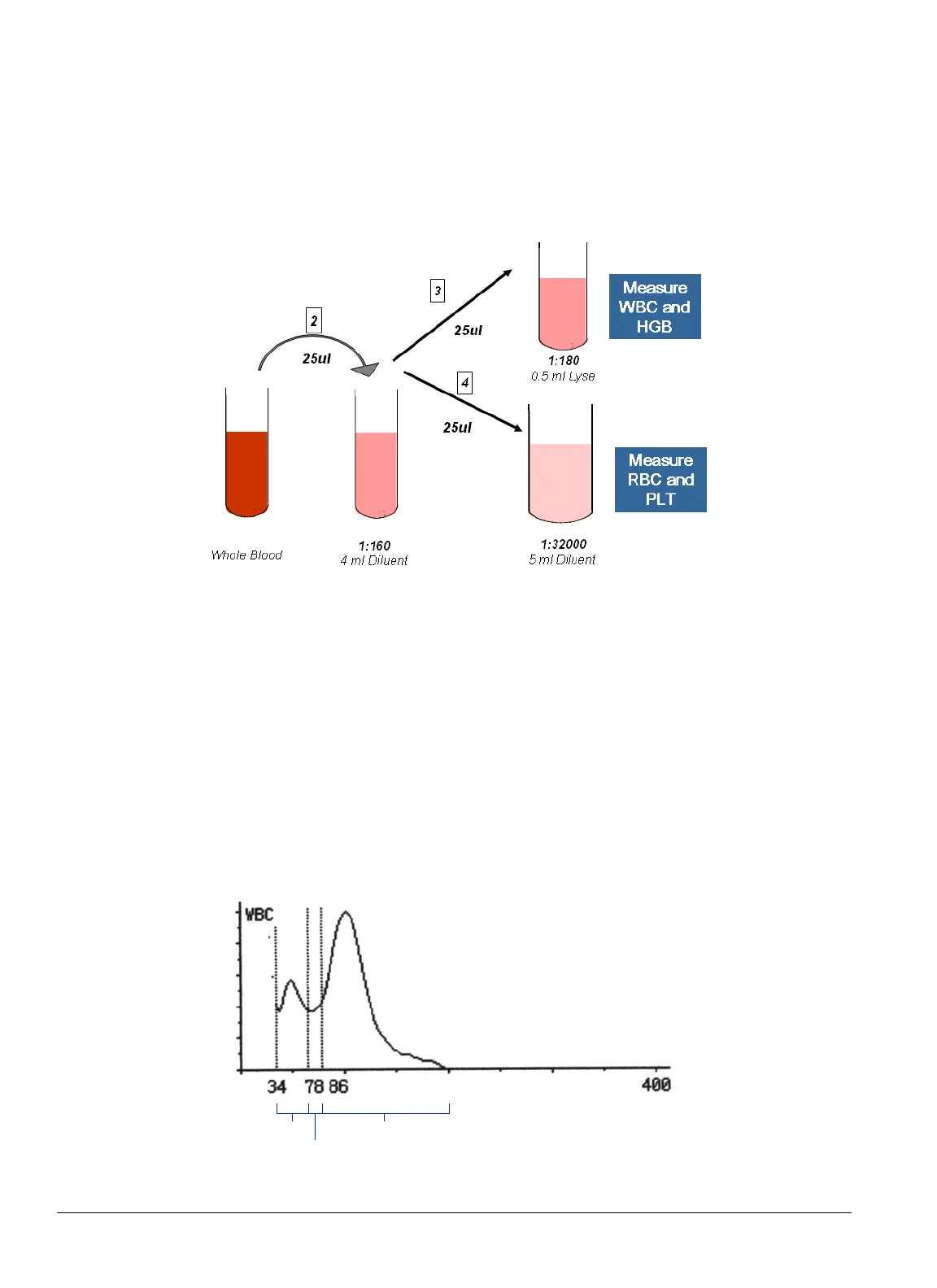
For the three-part counting, a primary dilution of 1:160 is created by diluting 25
µ
l of whole blood with
4 ml of Diluent into the chamber. After taking the RBC sample of 25
µ
l, the remaining diluted blood is
treated with 0.5–0.7 ml of Lyse reagent — this depends on the animal profile selected — to destroy red
blood cells. The remaining solution is suitable for photometric measurements of HGB, and counting of
WBC. After these measurements are done, the software is able to determine HGB, WBC, LYM,
LYM%, MON, MON%, total GRA, and GRA%. GRA contains all types of granulocytes: GRA = NEU
+ EOS + BAS, and GRA% = NEU% + EOS% + BAS%. Volume distribution of three-part measure-
ment can be seen on the three-part histogram. The cells are separated in three regions depending on
their sizes: LYM, MON, and GRA, from left to right, separated by discriminators.
The figure below shows a typical three-part differential WBC histogram of selective hemolysis (dog).



 To Next Page