Installation and Operation Manual Chapter 1 Introduction
ASMi-54 Ver. 1.0 Functional Description 1-11
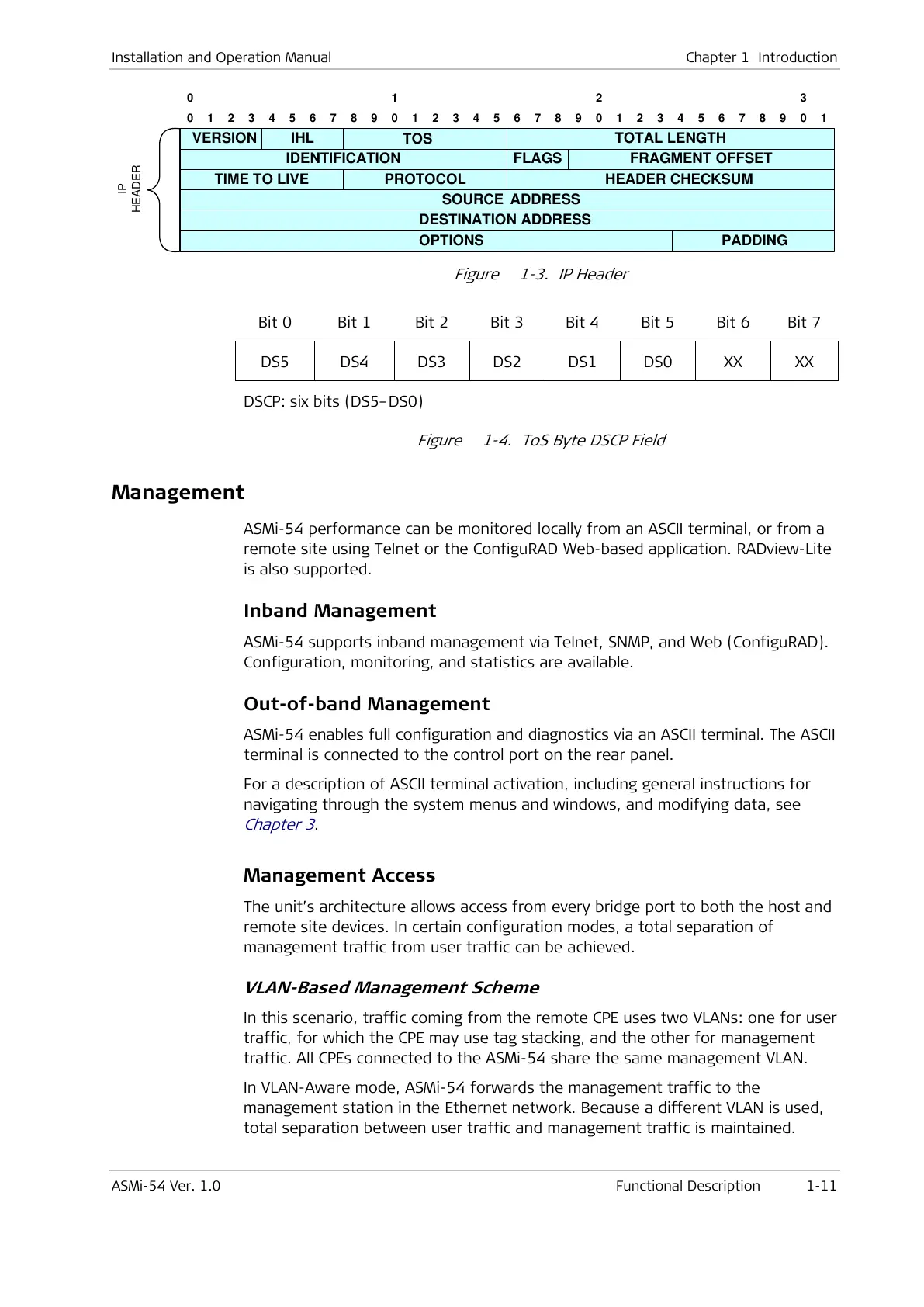
0
01234567890
1
0
2
0
3
1
VERSION IHL
TOS
TOTAL LENGTH
IDENTIFICATION FLAGS FRAGMENT OFFSET
TIME TO LIVE PROTOCOL HEADER CHECKSUM
SOURCE ADDRESS
DESTINATION ADDRESS
123456789 123456789
OPTIONS PADDING
IP
HEADER
Figure
1-3. IP Header
Bit 0 Bit 1 Bit 2 Bit 3 Bit 4 Bit 5 Bit 6 Bit 7
DS5 DS4 DS3 DS2 DS1 DS0 XX XX
DSCP: six bits (DS5–DS0)
Figure
1-4. ToS Byte DSCP Field
Management
ASMi-54 performance can be monitored locally from an ASCII terminal, or from a
remote site using Telnet or the ConfiguRAD Web-based application. RADview-Lite
is also supported.
Inband Management
ASMi-54 supports inband management via Telnet, SNMP, and Web (ConfiguRAD).
Configuration, monitoring, and statistics are available.
Out-of-band Management
ASMi-54 enables full configuration and diagnostics via an ASCII terminal. The ASCII
terminal is connected to the control port on the rear panel.
For a description of ASCII terminal activation, including general instructions for
navigating through the system menus and windows, and modifying data, see
Chapter 3
.
Management Access
The unit’s architecture allows access from every bridge port to both the host and
remote site devices. In certain configuration modes, a total separation of
management traffic from user traffic can be achieved.
VLAN-Based Management Scheme
In this scenario, traffic coming from the remote CPE uses two VLANs: one for user
traffic, for which the CPE may use tag stacking, and the other for management
traffic. All CPEs connected to the ASMi-54 share the same management VLAN.
In VLAN-Aware mode, ASMi-54 forwards the management traffic to the
management station in the Ethernet network. Because a different VLAN is used,
total separation between user traffic and management traffic is maintained.


 To Next Page