49 PCIE-1816_1816H User Manual
Appendix B Operation Theory
B.2.2 Analog Output Operation Modes
Single Value Operation Mode
The single value conversion mode is the simplest way for analog output operation.
Users can set the mode of each channel individually. Then users just need to use
software to write output data to specific register. The analog output channels will out-
put the corresponding voltage immediately. In the single value operation mode, users
need not set any clock source and trigger source, but only output voltage range.
Waveform Mode
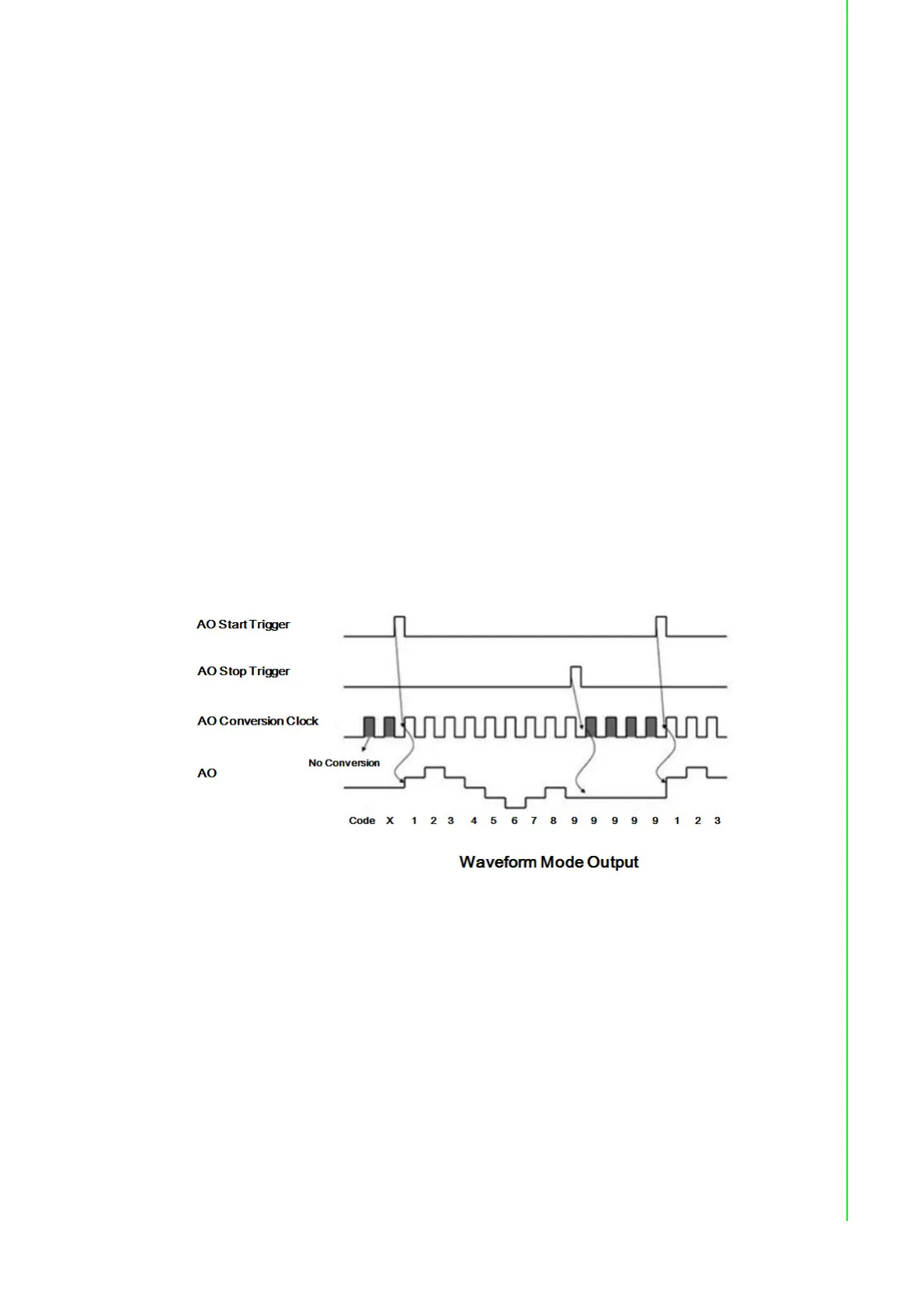
In waveform mode, all AO channels can change output voltage at the same time.
Users can accurately control the update rate (up to 3 MS/s) between conversions of
individual analog output channels, and takes full advantage of the PCIE-1816/1816H.
In this mode you can specify a clock and trigger source and either of the two analog
output channels to work in this mode.
Before operating in this mode, users need to set the clock and trigger source first,
and then generate the output data stored in the memory buffers of host PC. The host
computer then transfers that data to the DACs’ buffers on PCIE-1816/1816H. When
PCIE-1816/1816H detects a trigger, it outputs the values stored in its buffer. When
the buffer’s storage decreases, the card sends an interrupt request to the host PC
which in turn sends samples to the buffer. This output operation will repeat until either
all the data is sent from the buffers or until you stop the operation. If the two AO chan-
nels are both operating in continuous output mode, the data in buffer will be sent in
an interlaced manner, i.e. the “Even Address” samples in the buffer are sent to AO
channel 0, while the “Odd Address” samples to AO channel 1.


 To Next Page