Need help?
Do you have a question about the AJAX KeyPad and is the answer not in the manual?
Step-by-step instructions for connecting KeyPad to the Ajax hub via the Ajax app.
How to arm/disarm the entire facility using a general code and specific keys.
How to manage group security using a general code, group ID, and specific keys.
Arming/disarming the entire facility using a personal user code and user ID.
Managing group security with a personal user code, user ID, and group ID.
Controlling the entire facility security using an access code.
Managing group security using an access code, group ID, and specific keys.
Instructions for replacing the batteries in the KeyPad.
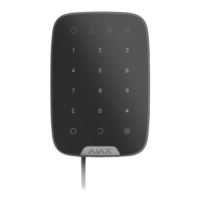
The KeyPad is a wireless indoor touch-sensitive keyboard designed to manage the Ajax security system. It allows users to arm and disarm the system and view its current security status. The device is equipped with protection against code-guessing attempts and can trigger a silent alarm if a duress code is entered. It communicates with the Ajax hub via the secured Jeweller radio protocol, with a range of up to 1,700 meters in line of sight. The KeyPad is configured through Ajax apps available for iOS, Android, macOS, and Windows.
The KeyPad features several functional elements:
To access the tamper button and QR code, the SmartBracket panel needs to be slid down. The tamper is designed to actuate if there's any attempt to tear the device off its surface.
The KeyPad serves as a touch keypad for managing the Ajax system, controlling security modes for the entire object or individual groups, and activating Night Mode. It supports a "silent alarm" function, which discreetly informs the security company without triggering sirens or app notifications, in cases where a user is forced to disarm the system.
Security modes are controlled using codes. To activate the keypad ("wake up"), a user must touch it, which enables button backlighting and triggers a beep.
The KeyPad supports three types of codes:
The number of personal and access codes available depends on the hub model.
The brightness of the backlight and the volume of the keypad can be adjusted in its settings. If batteries are low, the backlight will operate at its minimum level regardless of settings. If the keypad is not touched for 4 seconds, the backlight dims, and after 8 seconds, it enters power-saving mode, turning off the display and resetting any entered commands.
KeyPad supports 4 to 6 digit codes. Code entry must be confirmed by pressing one of the action buttons: Arm, Disarm, or Night Mode. Any mistakenly typed characters can be reset using the Clear button. The KeyPad can also control security modes without a code if the "Arming without Code" function is enabled in the settings (disabled by default).
The Function button operates in three modes:
The Duress Code allows users to simulate alarm deactivation while simultaneously raising a silent alarm. Unlike a panic button, entering a duress code will not trigger sirens or expose the user through the Ajax app. Instead, the security company and other users are instantly alerted, and the keypad and app will indicate a successful disarming of the system.
Types of duress codes include:
If an incorrect code is entered three times within one minute, the keypad will lock for a duration specified in the settings. During this lock period, the hub ignores all codes and notifies users and the CMS about the code-guessing attempt. The keypad automatically unlocks after the set time, but users or PROs with admin rights can unlock it via the Ajax app.
KeyPad supports two-stage arming. When enabled, the system will only arm after being re-armed with a SpaceControl device or after a second-stage detector (e.g., a DoorProtect on a front door) is restored.
The keypad uses the Jeweller radio protocol for secure, two-way wireless communication with the hub, ensuring fast and reliable transmission of events and alarms. This protocol employs block encryption with a floating key and device authentication to prevent sabotage and spoofing. The hub regularly polls devices (every 12 to 300 seconds, configurable in the Ajax app) to monitor communication and display statuses.
The Ajax system can transmit alarms to the PRO Desktop monitoring app and central monitoring stations (CMS) via various protocols (SurGard, SIA, ADEMCO 685, and proprietary protocols).
KeyPad can transmit the following events:
Upon receiving an alarm, the monitoring station operator receives detailed information, including the device type, security group, assigned name, and room, to facilitate a rapid response. The specific parameters transmitted may vary based on the CMS type and communication protocol. Device ID and loop (zone) number are available in the Ajax app.
When touched, the KeyPad wakes up, illuminating the keyboard and indicating the current security mode (Armed, Disarmed, or Night Mode). This indication is always current, regardless of the control device used to change the mode.
Malfunction indicator blinks to notify about communication loss with the hub or keypad lid opening. A short beep and a single LED blink confirm a button press. Arming is indicated by a short sound signal and the Armed Mode/Night Mode LED lighting up. Disarming is indicated by two short sound signals and the Disarmed LED lighting up. Incorrect passcodes result in a long sound signal and the keyboard backlight blinking three times. A malfunction during arming (e.g., a lost detector) triggers a long beep and three blinks of the current arming state LED. If the hub doesn't respond, a long sound signal and the Malfunction indicator light up. After three unsuccessful passcode attempts, a long sound signal and simultaneous blinking of security mode indicators occur, and the keypad locks while the Malfunction indicator blinks smoothly. When activated with low batteries, the KeyPad beeps with a long sound signal, and the Malfunction indicator smoothly lights up and then switches off.
If any device is offline or has a low battery, the KeyPad can notify users with an audible sound and blinking X LEDs. Malfunction notifications also appear in the events feed, SMS, or push notifications. To enable these sound notifications, use Ajax PRO and PRO Desktop apps: navigate to Devices → Hub Settings → Service → Sounds and Alerts, and enable "If battery of any device is low" and "If any device is offline." These settings are available for hubs with OS Malevich 2.15 or higher, and KeyPad firmware 5.57.1.1 or higher.
If a device is offline, two short sound signals and the Malfunction indicator blinking twice occur, followed by a beep once per minute until all devices are online. Users can delay this for 12 hours. If the KeyPad itself is offline, the same sound and light indications occur, but the sound indication cannot be delayed. If a battery is low, three short sound signals and the Malfunction indicator blinking three times occur, followed by a beep once per minute until the battery is restored or removed. Users can delay this for 4 hours. Malfunction notifications appear after keypad indication finishes. If multiple malfunctions occur, the keypad prioritizes notifying about connection loss first.
Before connecting, ensure the hub is on and connected to the internet (white or green logo), the Ajax app is installed, an account and hub are added, and at least one room is created. Also, confirm the hub is not armed and not updating. Only users with admin rights can add devices.
To connect:
For detection and pairing, the KeyPad must be within the hub's wireless network coverage. The connection request is transmitted briefly when the device is switched on. If connection fails, switch the KeyPad off for 5 seconds and retry. The connected device will appear in the app's device list, with status updates depending on the hub's detector ping interval (default 36 seconds).
Important: There are no pre-set codes for KeyPad. All necessary codes (keypad code, personal user codes, and duress codes) must be set before use.
The device's location depends on its distance from the hub and obstacles that might hinder radio signal transmission (walls, floors, large objects). The device is designed for indoor use only.
Do not install KeyPad:
Always check the Jeweller signal strength at the installation location. If the signal level is low (one bar), stable operation cannot be guaranteed. Move the device to improve signal quality; even a 20 cm shift can help. If signal strength remains low, use a radio signal range extender. KeyPad is designed for operation when fixed to a vertical surface; handheld use may compromise sensor keyboard operation.
The Ajax system allows setting up a keypad code and personal codes for registered users. With OS Malevich 2.13.1 update, access codes can also be created for people not connected to the hub, useful for granting access to cleaning companies, for example.
To set a keypad code: Go to keyboard settings, select "Keypad Code," and set the desired code. To set a keypad duress code: Go to keypad settings, select "Duress Code," and set the desired code. To set a personal code for a registered user: Go to profile settings (Hub → Settings → Users → User Settings), click "Passcode Settings," and set the "User Code" and "User Duress Code." Each user sets their personal code individually. To set an access code for an unregistered person: Go to hub settings (Hub → Settings), select "Keypad Access Codes," and set up a "Name" and "Access Code."
For duress codes, group access settings, Night Mode, code ID, or to temporarily disable/delete a code, select it in the list and make changes. PROs or admin users can set up or change access codes, a function supported by hubs with OS Malevich 2.13.1 and higher, but not by the Hub control panel.
Security can be controlled for the entire facility or separate groups using general, personal, or access codes. If a personal user code is used, the user's name appears in notifications and the event feed. If a general code is used, the user's name is not displayed. Keypad Access Codes are supported by hubs with OS Malevich 2.13.1 and higher but not by the Hub control panel.
Enter the general code and press the Arming, Disarming, or Night Mode activation key (e.g., 1234 → Arm).
Enter the general code, press *, enter the group ID, and then press the Arming, Disarming, or Night Mode activation key (e.g., 1234 → * → 2 → Arm). If a group is assigned to the KeyPad (in the Arming / Disarming permission field of keypad settings), entering a general or personal user code is sufficient, and the group ID is not needed. Note that if a group is assigned, Night Mode cannot be managed with a general code; it requires a personal user code with appropriate rights.
Enter user ID, press *, enter personal user code, and then press the Arming, Disarming, or Night Mode activation key (e.g., 2 → * → 1234 → Arm).
Enter user ID, press *, enter personal user code, press *, enter group ID, and then press the Arming, Disarming, or Night Mode activation key (e.g., 2 → * → 1234 → * → 5 → Arm). If a group is assigned to the KeyPad, the group ID is not needed; a personal user code is sufficient.
Enter the access code and press the Arming, Disarming, or Night Mode activation key (e.g., 1234 → Arm).
Enter the access code, press *, enter the group ID, and then press the Arming, Disarming, or Night Mode activation key (e.g., 1234 → * → 2 → Arm).
The Duress Code allows for a silent alarm and simulated alarm deactivation, alerting the security company and other users instantly without triggering sirens or app notifications. Both personal and general duress codes can be used, as well as duress access codes for unregistered persons. Scenarios and sirens react to disarming under duress in the same way as normal disarming.
To use a general duress code: Enter the general duress code and press the Disarming key (e.g., 4321 → Disarm). To use a personal duress code of a registered user: Enter user ID, press *, then enter the personal duress code and press the Disarming key (e.g., 2 → * → 4422 → Disarm). To use a duress code of an unregistered person: Enter the duress code set in Keypad Access Codes and press the Disarming key (e.g., 4567 → Disarm).
The KeyPad can mute interconnected fire detector alarms by pressing the Function button (if enabled). The system's reaction depends on its state:
With OS Malevich 2.12 update, users can mute fire alarms in their groups without affecting detectors in groups they don't have access to.
The Ajax system allows for functionality tests of connected devices. Tests do not start immediately but within 36 seconds under standard settings. The test start time depends on the detector scanning period set in the Jeweller settings of the hub.
Before installation, ensure the optimal location is selected and complies with manual guidelines. The KeyPad must be attached to a vertical surface.
Once fixed in SmartBracket, the KeyPad's LED X (Fault) will blink, indicating the tamper has been actuated. If the malfunction indicator does not blink, check the tamper status in the Ajax app and the panel's tightness. If the KeyPad is torn off or removed, a notification will be received.
Regularly check the KeyPad's operating capability. The pre-installed batteries provide up to 2 years of autonomous operation (with a hub inquiry frequency of 3 minutes). When the battery is low, the security system sends notices, and the malfunction indicator smoothly lights up and goes out after each successful code entry.
 General
| Battery Life | Up to 2 years |
|---|---|
| Operating Humidity | Up to 75% |
| Communication Protocol | Jeweller |
| Arm/Disarm | Yes |
| Panic Button | Yes |
| Material | Plastic |
| Backlight | Yes |
| Type | Wireless |
| Power Supply | Batteries |
| Communication Range | Up to 1, 700 m in open space |
| Operating Temperature | -10°C to +40°C |
| Encryption | AES encryption |
| Compatibility | Ajax hubs and range extenders |
| Tamper Protection | Available |


 To Next Page