English Maintenance
-16 Plate Heat Exchanger 3490008529 rev 2012-01
EN
DE
FR
ES
PT
IT
SV
DA
FI
NL
RU
PL
NO
HU
SK
CS
SL
LV
LT
ET
EL
BG
RO
ZH
BG
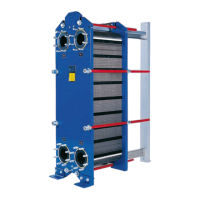
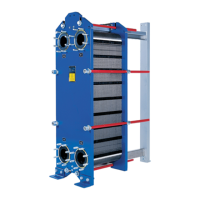
Maintenance
To keep the PHE in good condition regular mainte-
nance of the component is required.It is recommend-
ed to record maintenance of the PHE.
The plates needs to be cleaned on a regular basis.
The frequency depends on several of factors such as
type of media and temperatures. Different methods
can be used to perform cleaning, refer “Cleaning -
Product side” on page 16, “Cleaning – Non-product
side” on page 18 or a reconditioning at an Alfa Laval
service center.
After a longer time of use it can be required to regas-
keting the PHE by exchanging the gaskets. Refer to
“Regasketing” on page 23.
Other maintenance that should be performed regu-
lary:
• Keep carrying bar and guiding bar clean with par-
affin oil.
• Keep the tightening bolts cleaned.
• The stainless steel surfaces of the frame plate,
the pressure plate and connection plates are
glass blasted.
Clean with cloth wetted by paraffin oil. Do not
degrease the surface!
• Lubricate the threads of the tightening bolts with
an EP (extreme pressure) grease. For example
Gleitmo 800 or equivalent.
Grease the suspension wheels on the pressure
plate and the connection plates.
Cleaning - Product side
Immediately after a production cycle, the product
side is normally cleaned by circulation of acid and/ or
lye as a built in sequence in the production cycle.
Sterilisation is performed immediately before starting
the next production cycle. Refer to “Sterilisation” on
page 16.
Flow rates
The flow rate during cleaning of product side should
always be at least the same as the productions flow
rate. Increased flow rate may be required in some
cases as e.g. milk sterilisation and processing of vis-
cous liquids or liquids containing particles.
Recommended limits for cleaning solutions
• 5 % by volume AlfaCaus at max. 70 °C.
• 0.5 % by weight acid solution at max. 70 °C.
Sterilisation
Methods of sterilisation below are recommendations.
Instructions for sterilisation can also be included in
the documentation of the complete system delivered
with the PHE as one part.
Note!
After the first test run with product, the PHE should be
cleaned following a cleaning program applicable to the
product in question. The PHE should then be opened,
refer to “Opening” on page 19, and the plate surfaces
carefully inspected. The cleaning result should be
checked at regular intervals.
Warning!
Use proper protective equipment, such as safety boots,
safety gloves and eye protection, when using the clean-
ing agents.
Warning!
Corrosive cleaning liquids. Can cause
serious injuries to skin and eye!
Method Instructions
By heat
Circulate water of 90 °C until all parts of
the system have been kept at the
required temperature for at least ten
minutes.
Chemically by
hypochlorite
Before introducing the hypochlorite
solution, make sure that the equipment
is clean, has cooled down and is free
from deposits and that no acid residues
are left.
Gradually dose 100 cm
3
of hypochlorite
solution, containing max. 150 g/I active
chlorine to 100 I of circulation water at a
max. temperature of 20 °C.
Treat for five minutes, up to maximum
15 minutes. Rinse well after sterilisation.



 To Next Page