G) COMPONENT REPLACEMENT
AND USE OF ACCESSORIES
There is a huge number of components and accessories that can
enhance your riding experience and improve the appearance and
cycling behaviour of your bicycle. However, if you replace any
bicycle parts or add any accessories, you do so at your own risk. The
manufacturer of your bicycle may not have tested the compatibility,
reliability, and safety of this part for your bicycle. Before you install
any part, including tyres of other sizes, make sure that it’s compatible
with your bicycle by contacting the salespeople in your bicycle shop.
Read and fully observe instructions on the installation and use of a
new part.
WARNING: Incompatibility or incorrect installation of a new
component or accessory can result in a fall and injury.
ATTENTION: Replacement of bicycle parts may void the
warranty. Before you replace any part, check your bicycle
warranty policy and contact your dealer.
CHAPTER 4. SIZE SELECTION
AND BICYCLE SIZE ADJUSTMENT
NOTICE: Correct size selection and bicycle size
adjustment is one of the key requirements for ensuring the
highest levels of safety, comfort and ease of control. Proper
bicycle set-up requires experience, and specialist
skills and tools. Ask the salespeople and mechanics of your
bicycle shop to assist you with this.
Make sure that the bicycle is the right size for you. A bicycle that is
too small or too big is difficult to control and may be
uncomfortable.
ATTENTION: If a bicycle is incorrectly set-up or the wrong
size for you, it may cause you to lose control and fall.
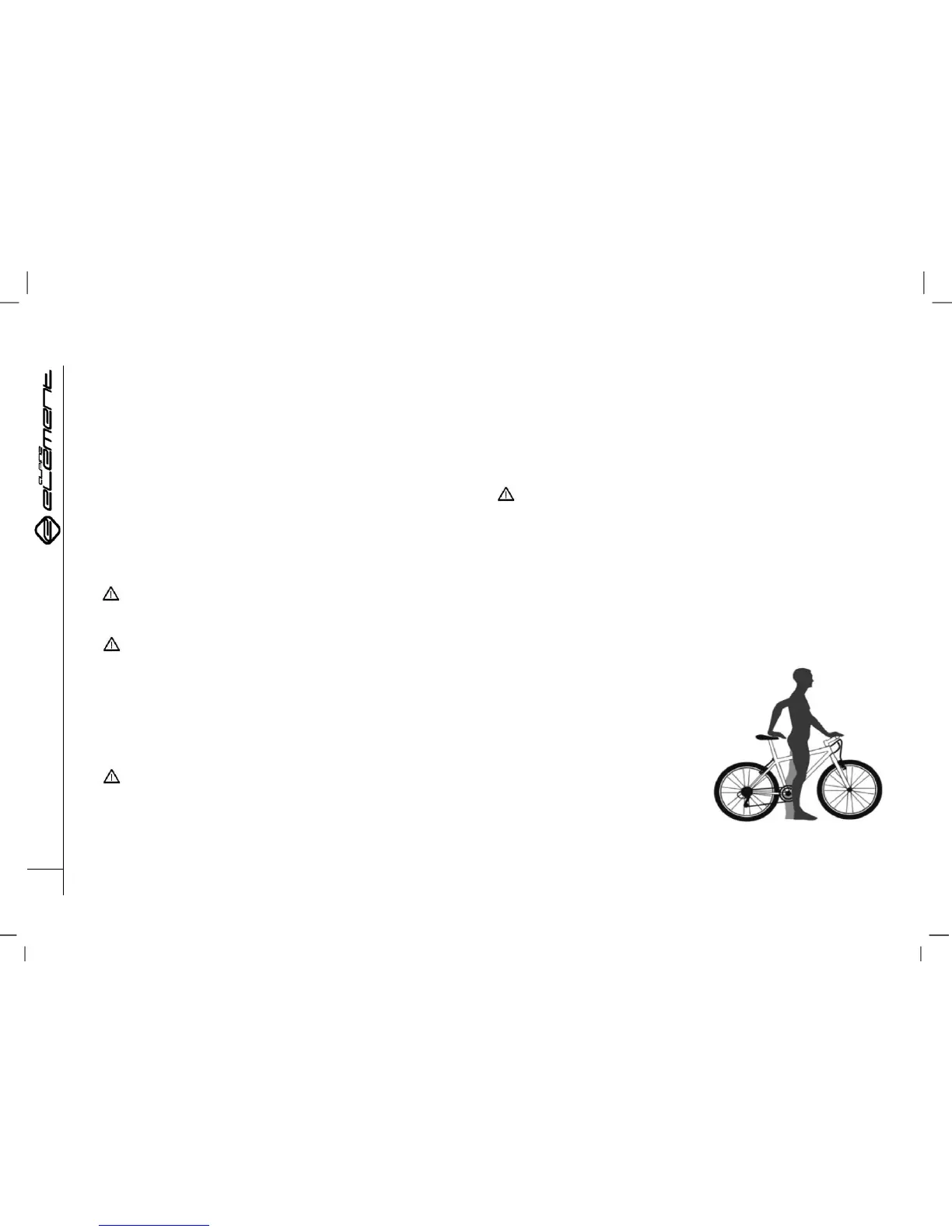
A) STANDOVER HEIGHT
The bicycle size check starts with a standover height check. The
standover height is the distance from the ground to the centre of
the upper surface of the top tube (fig. 3). If you are unable to hop
on your feet energetically without touching the upper tube while
standing over it in the shoes in which you’re going to cycle the
bicycle is certainly too big for safe cycling.
A bicycle you will ride only on
tarmac and never in off-road
conditions should have a
standover height of at least
3−5 cm less than the distance
from the ground to the crotch. For
bicycles for use on various non-
tarmac surfaces, this difference
should be 5−8 cm, whereas for
bicycles used in true mountain
biking in a rugged cross-country
environment, this difference
should be 10 cm or more.



 To Next Page