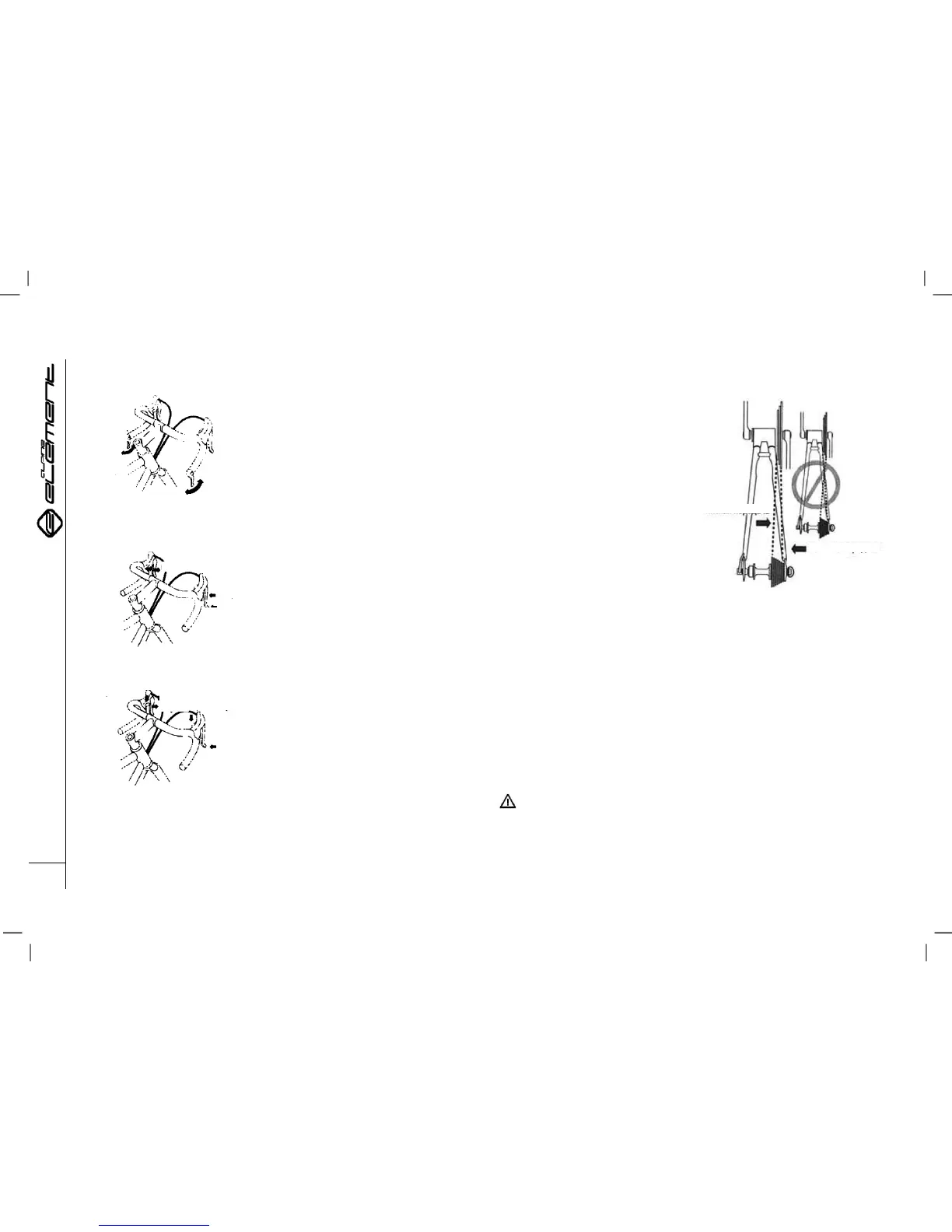
B) Shifting the rear derailleur
The rear derailleur is controlled by
the right shifter. The function of the
rear derailleur is to move the drive
chain from one gear sprocket to
another, thereby changing the gear
ratio. Smaller sprockets will give
higher gear ratios. Pedalling in the
higher gears requires greater
pedalling effort, but takes you a
greater distance with each revolution
of the pedal cranks. Larger
sprockets will give lower gear ratios.
Pedalling in the lower gears requires
less pedalling effort, but takes you a
shorter distance with each revolution
of the pedal cranks. Moving the
chain from a smaller sprocket to a
larger sprocket results in a
downshift, and from a larger
sprocket to a smaller sprocket, in an
upshift. In order for the derailleur to
move the chain from one sprocket to
another, the chain must be moving
forward—that is, the rider must be
pedalling forward.
C) Shifting the front derailleur
The front derailleur is controlled by the left shifter, and its
function is to move the drive chain from one chainring to
another. Moving the chain from a smaller chainring to a larger
chainring results in an upshift, and from a larger chainring to a
smaller chainring, in an downshift.
D) What gear should I use?
The combination of the largest
sprocket and the smallest
chainring is for the steepest hills;
the combination of the smallest
sprocket and the largest chainring
is for the greatest speed (fig. 22).
It is not necessary to shift gears
in sequence. Find a “starting
gear,” which is hard enough for
quick acceleration, but
easy enough to let you start without wobbling, and then try shifting
up and down. At first, practice shifting where there are no
obstacles, hazards, or other road users, until you’ve built up your
confidence. Later, you will start to feel which gear suits best for
particular conditions and learn to shift smoothly.
E) Pedals
1. Some bicycles (particularly small-framed) have toe overlap,
which is when the cyclist’s toe can touch the front wheel when
turning the handlebar to steer while a pedal is in the forward most
position. To avoid this, keep the inside pedal up, and the outside
pedal down when making a turn.
WARNING: Toe overlap could cause you to lose control and
fall. If you have toe overlap on your bicycle, be extra careful when
making a turn.



 To Next Page