to tyres designed for very
specific weather or terrain
conditions. Your bicycle is
fitted with the tyres that the
manufacturer considers to
best suit the assumed
riding conditions of the
bicycle. If, after some time,
you feel that different tyres
might better suit your riding
needs, go to the nearest
bicycle shop and ask them
to help you select the most
appropriate design.
Replacing the tyres with a wider or
narrower option will lead to
changing the bicycle behaviour and at some point can make it
dangerous. Always use tubes matching your new tyres in size. In
some cases, especially when using larger diameter tyres, the gap
between the tyre and the frame may decrease considerably, and
the tyre will touch the stays. This can lead to frame damage and,
potentially, failure. In addition, this can void the frame warranty.
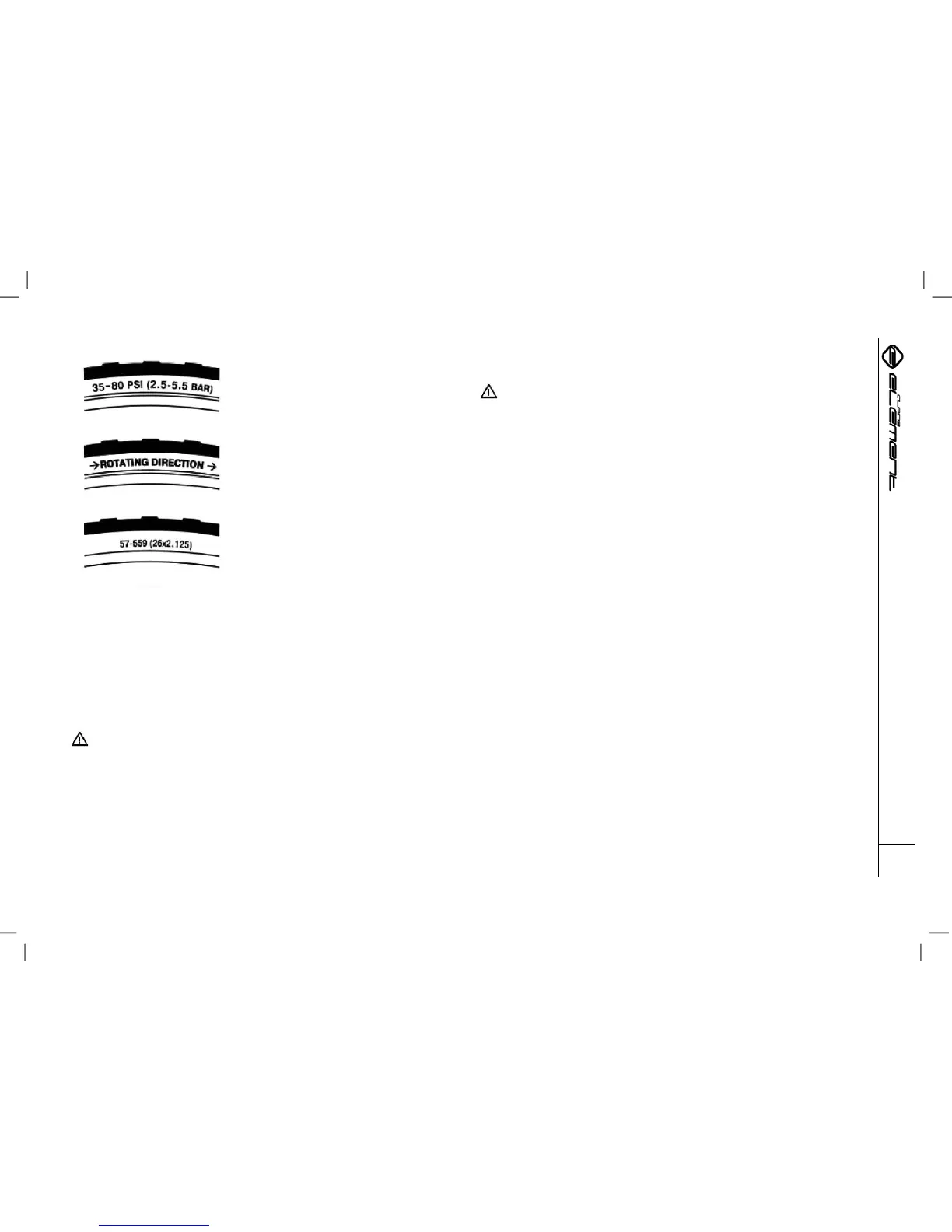
The size, recommended pressure, and, with some tyres,
recommended conditions of use, are marked on the tyre sidewall
(fig. 23).The most important parameter for you is the pressure.
WARNING: Never inflate a tyre beyond the maximum
pressure marked on the tyre sidewall. Exceeding the
recommended maximum pressure may blow the tyre off the rim,
which could cause damage to the bicycle and injury to the rider
and bystanders.
The best way to inflate a bicycle tyre is with a bicycle pump
which has a built-in pressure gauge.
WARNING: There is a safety risk in using petrol station
air lines or other air compressors! They are not made for
bicycle tyres, as they have a very high output and could
cause the tyre to explode.
Tyre pressure on the tyre sidewall is given either as maximum
pressure or as a recommended pressure range. How a tyre
performs under different terrain or weather conditions depends
largely on tyre pressure. Inflating the tyre to near its maximum
recommended pressure gives the lowest rolling resistance but
also produces the harshest ride. High pressures work best on a
smooth, dry surface. Very low pressures give the best
performance on smooth, slick terrain, such as hard-packed clay,
and on loose surfaces, such as dry sand.
Tyre pressure that is too low for your weight and the riding
conditions can cause a puncture of the tube by allowing the tyre
to deform sufficiently to pinch the inner tube between the rim and
the riding surface.
Your dealer will recommend the best tyre pressure for the kind of
riding you will do, and inflate your tyres to that pressure. Then,
check inflation as described in section 2.C so you’ll know how
correctly inflated tyres should look and feel. Some tyres may
need to be brought up to pressure every week or two.
Some special tyres have unidirectional treads. The sidewall of
such tyres will have an arrow showing the correct rotation
direction. If your bicycle



 To Next Page