A-36
- L'utilizzo della gru con angolo tra 1° e
2° braccio minore del valore indicato
al §B.9.5 e nei diagrammi di carico
(vedi §D.1).
L'errato utilizzo potrebbe causare
l'abbassamento automatico del
2.braccio e del carico a seguito
dell'apertura della valvola di sovra-
pressione sul 2.braccio (vedi §B.5.2).
L'
abbassamento incontrollato potreb-
be provocare urti contro cose e
persone e perfino la rottura strutturale
della gru.
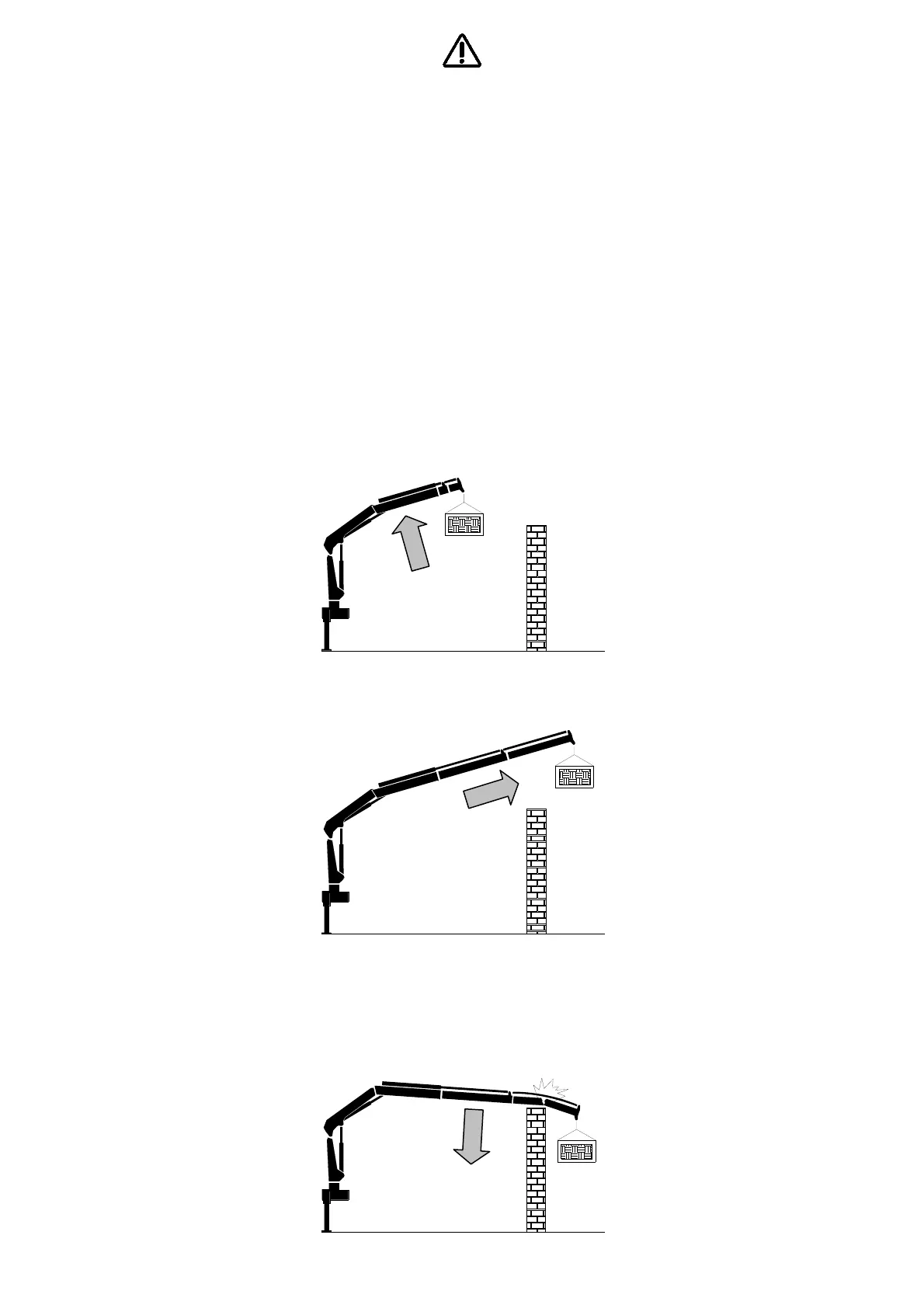
Di seguito viene riportato un esempio
del problema che potrebbe insorgere:
1) si solleva il carico aprendo
completamente il cilindro 2.braccio.
2) vengono estesi gli sfili telescopici.
3) Mentre escono gli sfili idraulici la
pressione all'interno del cilindro
2.braccio aumenta fino far aprire la
valvola di sovrapressione: il 2.braccio
scende e urta un ostacolo.
- Using the crane with an angle
(between 1st and 2nd boom) less than
the value indicated at §B.9.5 and in
the loa
d diagrams (see §D.1)
T
he incorrect using could cause the
automatic lowering of the 2.boom and
of the load because of the opening of
the 2.boom overpressure valve
(see §B.5.2).
T
he uncontrolled lowering could
cause impact with people or things
and even structural damage of the
crane.
Here below you find an example of a
problem that might arise:
1) a load is hoisted opening the
2.boom cylinder completely.
2) the telescopic elements are
extended
3) As the hydraulic extensions come
out, the the pressure inside the 2.boom
cylinder increases until the
overpressure valve opens: the 2.boom
lowers and collides with an obstacle.
Verwendung des Krans wenn der
Neigungswinkel zwischen dem
1. Ausleger und dem 2. Ausleger
weniger als der im §B.9.5 und auf den
Lastdi
agrammen angezeigte
Winkelwert beträgt. Die unrichtige
Verwendung könnte das automatische
Senken des 2. Auslegers und der Last
infolge der Öffnung des Überdruck-
ventils des 2. Auslegers verursachen
(siehe §B.5.2). Das unkontrollierte
Senke
n könnte Stöße mit Personen
und Gegenständen und sogar den
strukturellen Bruch des Krans
verursachen.
Im Nachfolgenden wird ein Beispiel
für das Problem dargestellt, das
auftreten könnte:
1) Die Last wird beim völligen
Ausfahren des 2. Auslegerzylinder
angehoben.
2) Die Ausschübe fahren aus.
3) Beim Ausfahren der Ausschübe
steigt der Druck im
2. Auslegerzylinder so lange an, bis
das Überdruckventil öffnet: der
2. Ausleger senkt sich und stößt
gegen ein Hindernis.



 To Next Page