Revision 2
11
milliseconds. The T/R “Relay” control jack is well within the range of almost any transceiver or
radio. The “Relay” jack has an open circuit voltage of 13-volts, and closed circuit current less
than 20 mA. Virtually any modern amateur radio will directly key this amplifier.
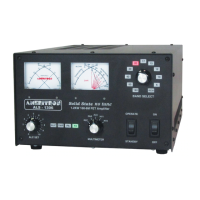
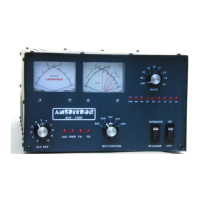
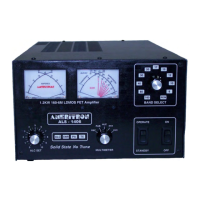
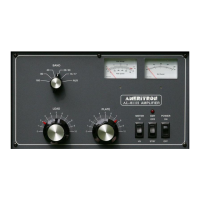
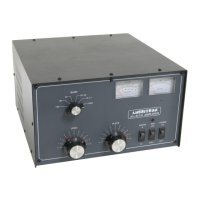
This amplifier includes full metering using large easy-to-read conventional panel meters. The
meters read all critical parameters including forward and reflected peak envelope RF power.
Installation
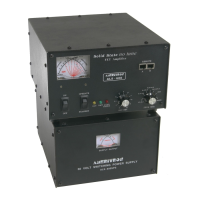
Please look your amplifier and power supply over carefully. Observe the air inlet and outlet
ventilation holes. Facing the amplifier front panel, the cooling air inlets are on the top left and
lower right side, including the right bottom. The warm air outlet is on the lower left side of the
cabinet as viewed from the normal operating position (front view). While outlet air will not be
particularly warm, it is never a good idea to have warm air blow into heat sensitive equipment,
such as transceivers or other power amplifiers. Have the same consideration for your new
amplifier and power supply. Be sure the air inlet temperature is not substantially above normal
room temperature. Ideally, the air inlet temperatures should be below 32° C or 90° F, although
temperatures up to 41° C or 106° F are permissible. If ambient temperatures exceed these limits
it might become necessary to reduce duty cycle or power.
Warning: Do not block cooling air inlets and outlets!
Never expose the amplifier to water or mist.
Installation Clearances
The amplifier must have a clear area to the bottom, both sides, and top for proper airflow, and to
the rear for interconnection wiring. It is especially important to avoid obstructions that block the
air inlet on the top left, as well as both lower sides. Two inches clearance is normally adequate
for full ventilation. Keep any papers or loose objects that might impede airflow away from the
air inlets and outlets.
Locate the amplifier and power supply away from sensitive equipment such as microphones,
audio processing equipment, or low level audio or radio frequency amplifiers. Generally, the best
location for the power supply is below the operating desk and away from antenna feed lines. This
will keep fan noise and any RF coupling to a minimum.
The power supply has an air inlet at the rear, and air outlets on the top. The highly efficient
power supply produces very little heat, but the inlet and outlet must remain open to normal room
temperature air.
Installation Warnings
Accessory Equipment and Devices
One of the most common causes of amplifier failures or erratic fault protection alarms is
installation of antenna switches, lightning protection devices, or baluns with lightning spark gaps
in high SWR lines. If your antenna system has an SWR high enough to require an antenna tuner,
do not use 50-ohm lightning protection devices after the tuner.
Installation, Wiring, and Connections
The power supply is factory wired for 200-260 Vac. It uses a standard NEMA-6-15P 15-ampere
240-volt plug. The round center pin is the safety ground. Do not remove the safety ground.



 To Next Page